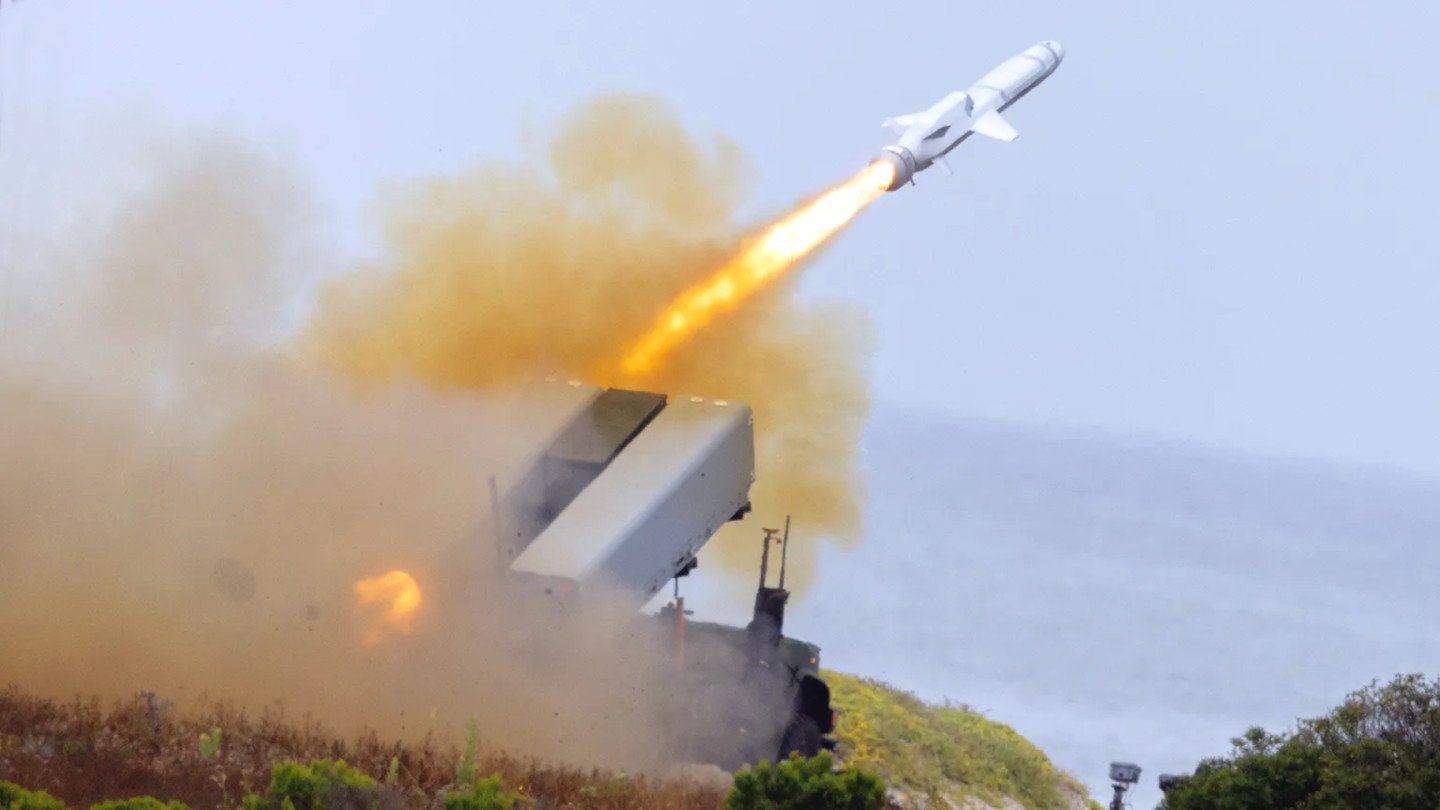
The U.S. Marine Corps is looking at ways to at least double the range of its ground-launched Naval Strike Missile (NSM) anti-ship cruise missiles. NSMs able to hit targets up to 270 nautical miles away, if not more, would significantly increase the area Marine missile batteries could hold at risk. This could be a particular boon in future island-hopping campaigns that are the centerpiece of the Corps’ still-evolving expeditionary and distributed concepts of operations.
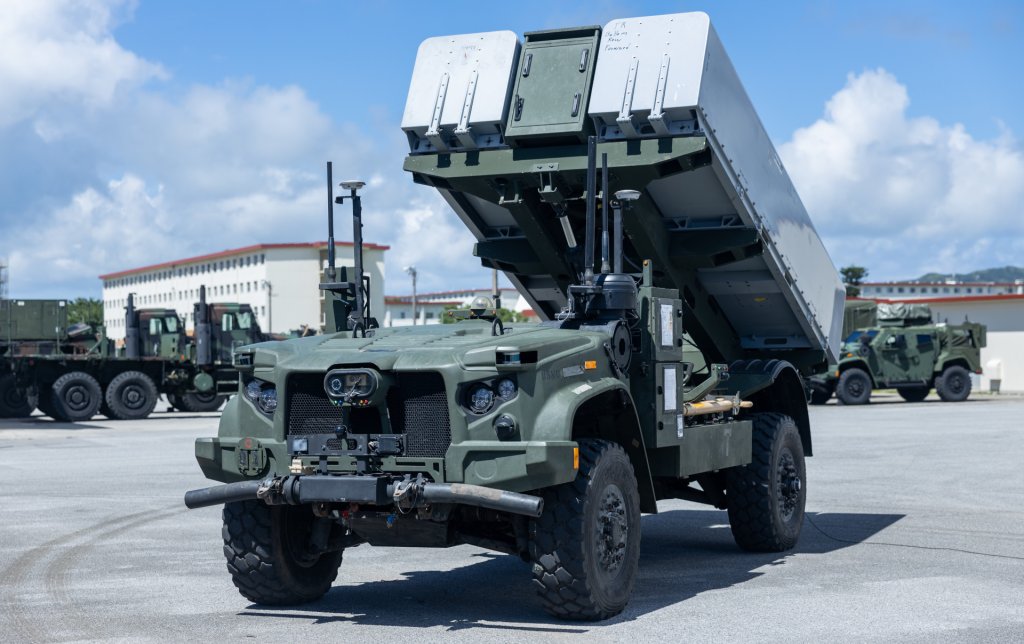
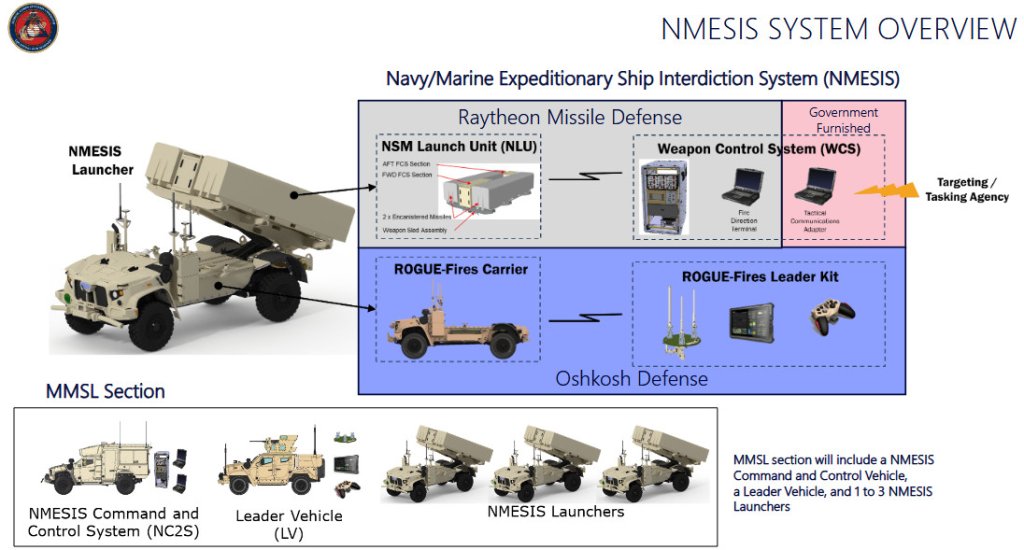
The Marines currently field NSM as part of the Navy-Marine Expeditionary Ship Interdiction System (NMESIS). At NMESIS’ core is the Remotely Operated Ground Unit Expeditionary-Fires (ROGUE-Fires) platform, an uncrewed launcher vehicle based on the 4×4 Joint Light Tactical Vehicle (JLTV). Each ROGUE-Fires launcher can be loaded with up to two NSMs, which come in ready-to-fire canisters, at a time.
The NSM is also in U.S. Navy service, primarily on Independence class Littoral Combat Ships (LCS). The stated plan is to eventually arm Freedom class LCSs with these missiles, as well. One Arleigh Burke class destroyer has been equipped with NSM on an as-yet experimental basis. NSM is also in growing service globally in ship-launched and ground-based configurations.
“The range of the Naval Strike Missile is 135 nautical miles,” a Marine Corps spokesperson recently confirmed to TWZ. “The Marine Corps is currently exploring opportunities to more than double the range of the NSM.”
The 135 nautical mile figure already reflects a boost in the missile’s stated reach, which came with the introduction of the Block 1A variant in the early 2020s. Earlier versions of the NSM, which was developed by Norway’s Kongsberg in partnership with Raytheon in the United States, were said to be able to fly out to around 100 nautical miles. The Marines have also previously said that NSM’s existing range can extend beyond 135 nautical miles depending on the flight profile to the target.
In its current form, NSM is already a very modern design with stealthy features to help reduce the chances of detection and interception. It performs high-G evasive maneuvers in the terminal phase of flight to make it even harder for defenders to engage.
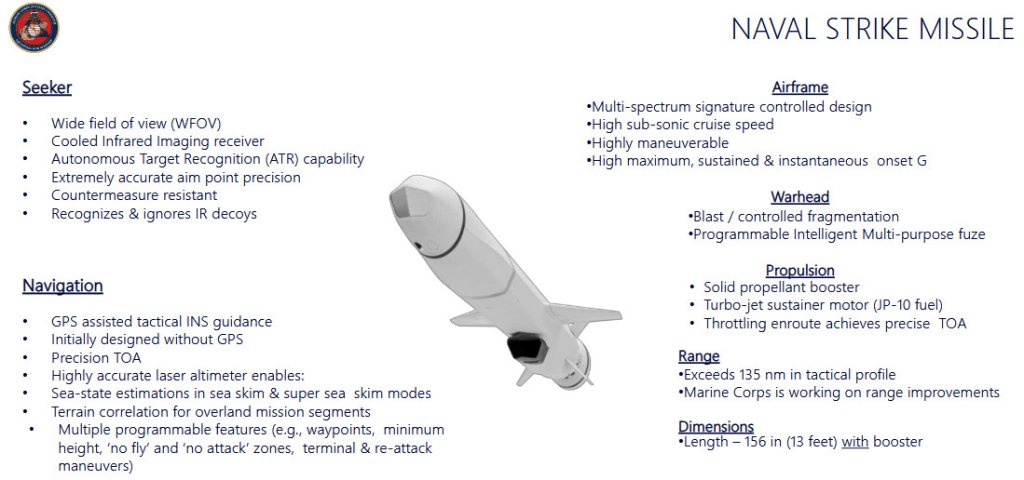
The missile also uses an imaging infrared seeker to find and home in on targets in the terminal stage of flight after making its way to the designated area first using a GPS-assisted inertial navigation system (INS) guidance. The seeker is passive, meaning it does not emit signals that can alert the enemy to the fact that they are under attack. It is also immune to radiofrequency jamming.
Designed primarily as an anti-ship weapon, NSM has a secondary land-attack capability.
What avenues the Marines might be looking at now to extend the reach of its NSMs are unknown. Lowering the missile’s gross weight, including by reducing the size of the warhead, as well as increasing fuel economy and/or capacity, could be among the possibilities.
Even with potential trade-offs, an NSM with a range of 270 nautical miles, if not more, would offer a substantial boost in capability for NMESIS. With the existing 135-nautical-mile range, a single ROGUE-Fires launcher would be able to hold targets at risk anywhere within a circle encompassing around 57,255 square nautical miles. Doubling the missile’s reach increases the size of that zone roughly fourfold, to some 229,022 square nautical miles.
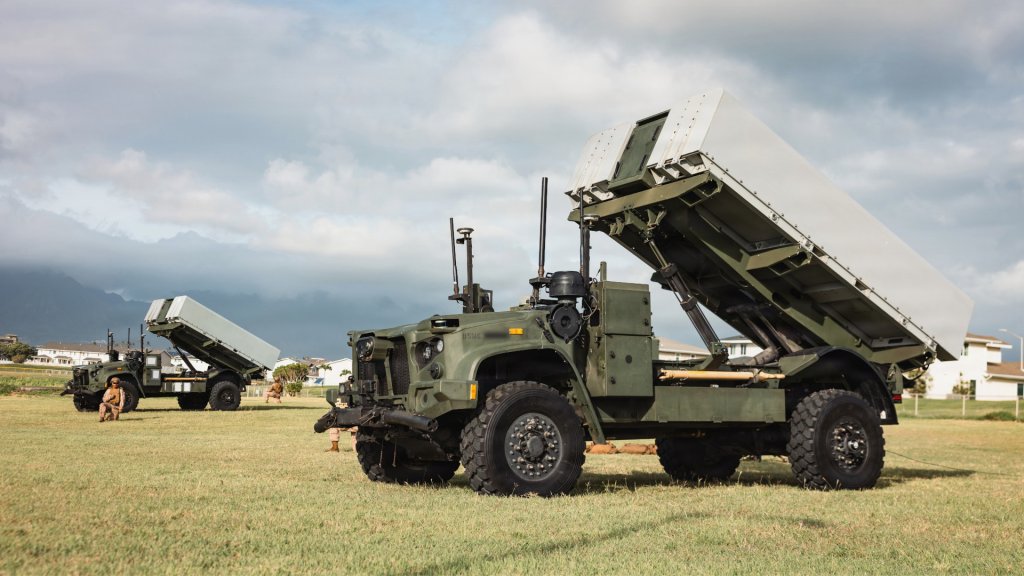
As noted, the increased range and area coverage could be especially relevant in future Marine operations set to be dominated by expeditionary and distributed deployments. The Corps sees these concepts of operations as particularly central to future island-hopping campaigns in the Pacific. The service sees NMESIS as a key component of how it will help provide sea control from island outposts in those scenarios. The Marines also expect to conduct those operations inside an opponent’s so-called “weapons engagement zone,” necessitating capabilities that can be rapidly deployed and redeployed to reduce vulnerability.
The Marines have already demonstrated these concepts in several exercises in recent years that have involved the deployment of NMESIS to remote Japanese and Filipino islands situated relatively close to Taiwan. The map below shows how a Marine battery armed with existing versions of NSM situated in the Batanes Islands in the Philippines could create an anti-access/area denial ‘bubble’ in the highly strategic Luzon Strait.
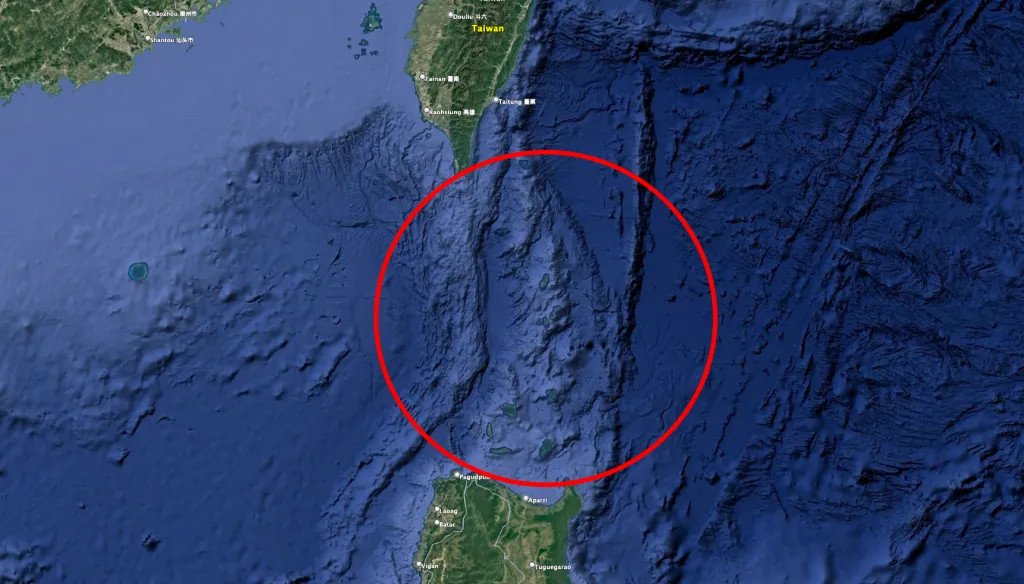
Just in October, launchers and other elements of NMESIS were sent to Japan’s Yonaguni Island as part of the most recent iteration of the Keen Sword exercise. Yonaguni is only some 65 nautical miles east of Taiwan.
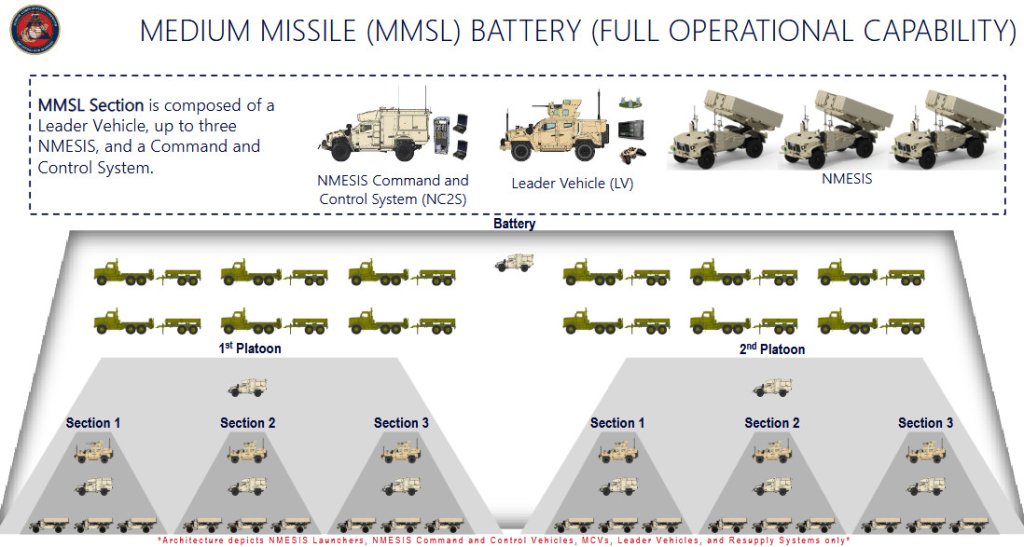
A larger group of launchers loaded with extended-range NSMs could, of course, cover even more area when deployed across a broader front. At present, the Marine Corps is organizing NMESIS in what it calls Medium Missile (MMSL) units. The basic building block of these formations is an MMSL section that includes three ROGUE-Fires launchers. Each section also has two JLTVs, one of which carries the NMESIS command and control system, while the other is configured for general utility use.
An MMSL Battery is made up of two platoons, each with three sections, for a total of 18 launchers, along with other supporting assets. In October, the Marines announced the standing up of their first MMSL battalion – 1st Battalion, 10th Marine Regiment – which will be a multi-battery formation.
For the Marines, NSMs with double the range could help fill at least some gaps resulting from the service’s cancellation of plans to also field ROGUE-Fires launchers armed with Tomahawk cruise missiles. At the same time, even with twice as much reach, the NSM cannot match Tomahawk’s ability to hold targets at risk roughly 1,000 miles in any direction.
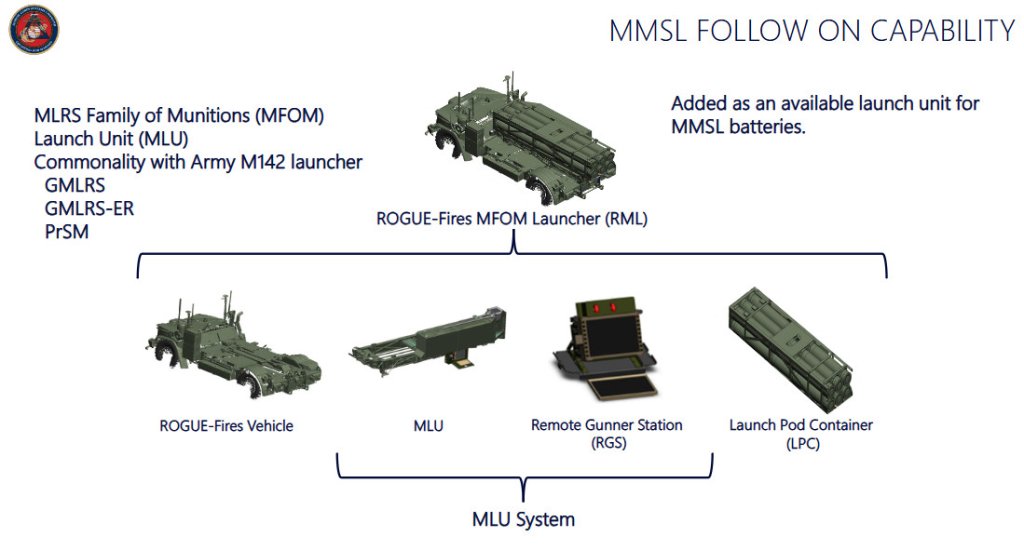
The Marines could field other long-range surface-to-surface missile capabilities in the future, including Precision Strike Missile (PrSM) short-range ballistic missiles. The Corps has 6×6 M142 High Mobility Artillery Rocket System (HIMARS) launch vehicles that could fire PrSM. An anti-ship version of PrSM able to hit moving targets is in development now, as well.
The Corps has also raised the possibility of fielding a version of ROGUE-Fires able to fire the entire array of podded munitions currently available for HIMARS, which also includes 227mm guided artillery rockets. The tracked M270 Multi-Launch Rocket System (MLRS) and other launchers also use these pods, which are formally known as the MLRS Family of Munitions (MFOM).
With the eye toward the Pacific, all of this comes as China’s People’s Liberation Army Navy (PLAN) has been working to dramatically expand the size and scope of its blue water surface fleets. The PLAN continues to commission new and more modern surface combatants, as well as aircraft carriers, amphibious assault ships, and other vessels, at a rate far surpassing that of the United States and other countries. The PLA also continues to build on its already substantial network of heavily armed island outposts in the hotly contested South China Sea.
Future Marine Corps expeditionary and distributed operations could come elsewhere in the future. The service’s first real-world test of its new concepts of operations came just this year in the context of Iran. The Marines also have a stated goal now to expand their overall capacity to respond on short notice to crises and contingencies worldwide. The ability of Marine NSM batteries to rapidly create maritime choke points could give commanders valuable additional flexibility in the Middle East, Europe, and other regions.
The Marine Corps ability to use NSM and NMESIS to shape future battleships would only be further boosted by doubling the reach of the missile.
Contact the author: joe@twz.com
The post Marines Want Naval Strike Missiles With Double The Range appeared first on TWZ.