David Hockney, who died at 88 in June, became famous as a young artist for imbuing 20th-century life with the formality and stasis of early Renaissance painting. His sharp-edged figures stand by the pool or sit by a coffee table in spaces as orderly as those in a Fra Angelico annunciation. The real world does not look so tidy, symmetrical, and enchanting. Except, very occasionally, when it does.
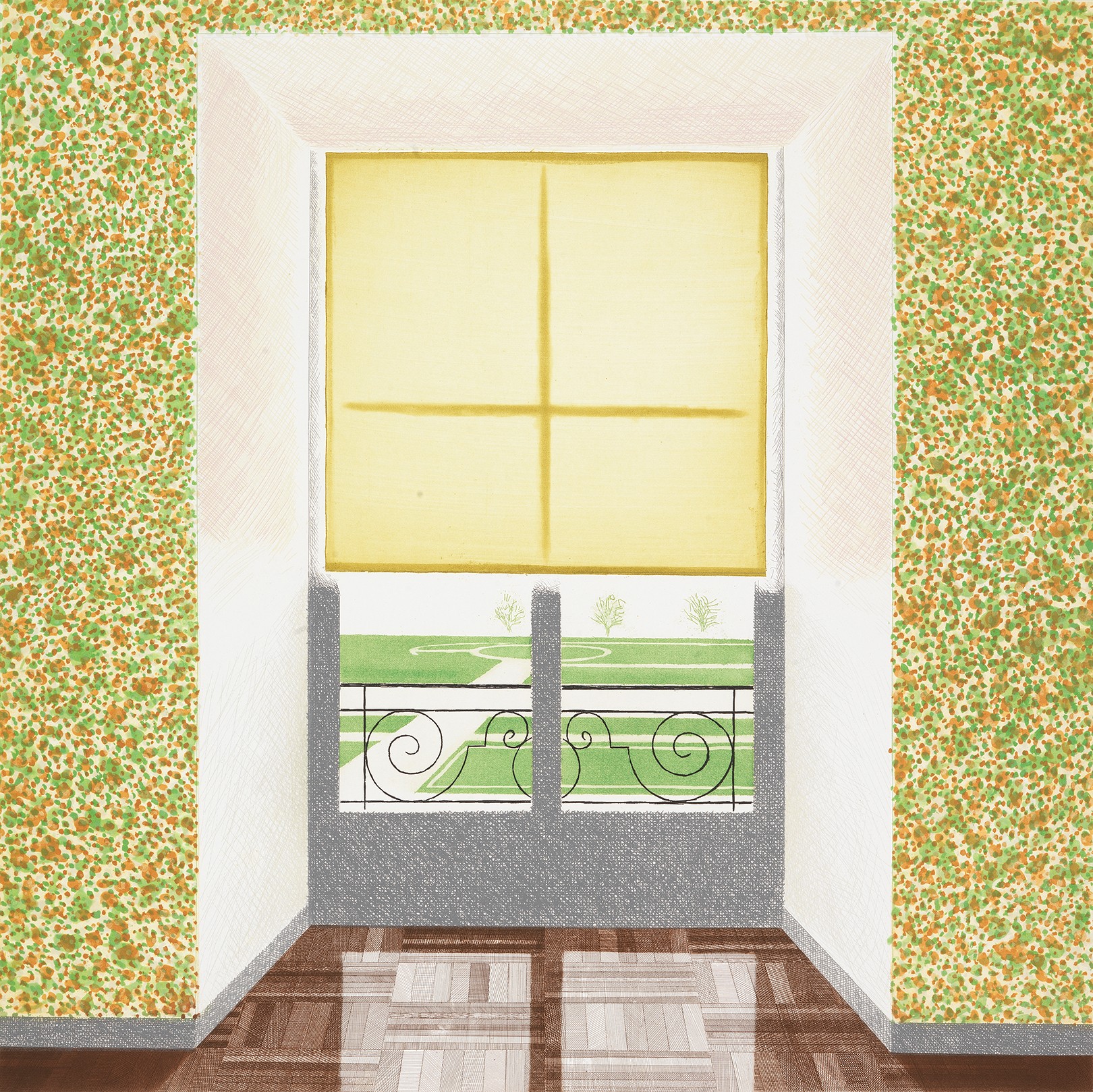
Contrejour in the French Style depicts a window at the Louvre that Hockney encountered shortly after moving to Paris in 1973. With its shade partly drawn, shutting out unwanted sunlight while giving a glimpse of garden, it was, he thought, “a picture in itself.”
Working from a drawing and some photographs, he rebuilt the found scene—tugging here, flattening there. His pathways and parterres are a streamlined echo of the nearby Tuileries, just as his balustrade is a compass-and-protractor enactment of the elegant original. The way the two receding diagonals intersect the wall, window, and walkway to converge at the tree line is an almost perfect diagram of single-point perspective. Hockney used visibly different etching techniques in different territories of the image—soft mats of color for the window blind, meticulous linear hatching for the floor, and splotchy, translucent color for the surrounding wall.
The formal garden, the parquet, the deep window setback, and the dappled wall (a nod to the pointillism of Georges Seurat) all wave the flag of “French Style,” with its distinct history of rules developed in the pursuit of beauty. Soon after Contrejour, Hockney’s own style shifted toward fragmented space, expressive brushwork, and episodic motion. This print, however, still exerts its wistful invitation to bask in quiet emotional weather, and notice the pictorial machinery he was about to dismantle.
This article appears in the September 2026 print edition with the headline “Contrejour in the French Style.”