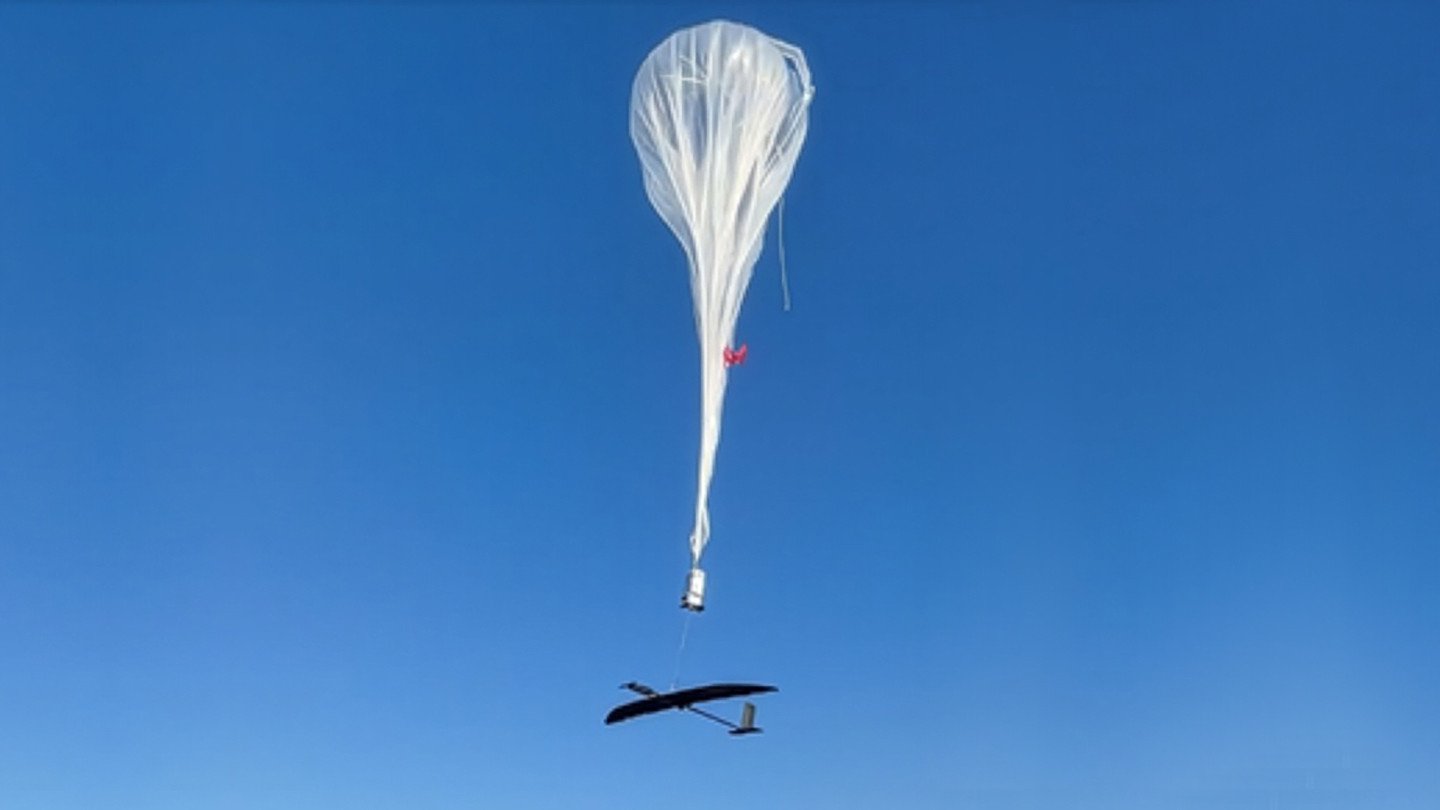
Balloon-maker Aerostar says recent tests of its Lightning design as a launch platform for a single surveillance drone open a path to a larger “mothership” concept. The company envisions its high-altitude balloons carrying multiple high-endurance uncrewed aircraft that could search for targets and otherwise monitor broad swaths of the battlespace, and do so persistently for days or even weeks on end. These balloon motherships could also carry payloads configured for other missions, such as electronic warfare jamming, signal relay, or even attacking targets. These are capabilities the U.S. Army and other branches of the U.S. military are actively pursuing, and that other countries, including China and Ukraine, have been developing and fielding to varying degrees, as well.
Aerostar put out a press release last week regarding the testing of the Lightning balloon paired with the Apollo-R from drone-maker Icarus. TWZ subsequently reached out for more information.
“In the current test configuration with the Aerostar Lightning balloon, it’s one Apollo UAS [uncrewed aerial system] per balloon — the Lightning is our smaller, tactical micro-balloon designed to carry a single payload. However, the architecture is scalable,” Russ Van Der Werff, Aerostar’s Vice President of Stratospheric Solutions, told TWZ. “Our larger Aerostar Thunderhead platform can serve as a ‘mothership,’ carrying multiple Apollo-R’s (or other payloads).”
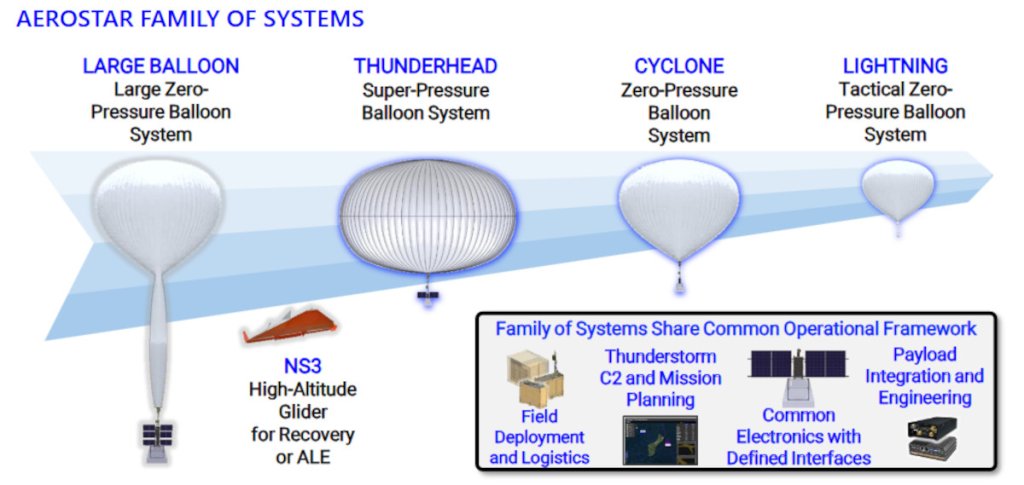
The balloons in Aerostar’s portfolio are modern high-altitude designs with GPS-assisted navigation systems that can transit to areas of interest and then, in many cases, hold their general position despite prevailing winds. By moderating their altitudes, they can remain on station persistently for long periods at a time. Control is exercised via satellite communication suites and/or line-of-sight links, the latter of which can also be used in relay as part of a mesh network made up of multiple balloons.
The Lightning design is capable of operating for up to three days while soaring at typical altitudes between 50,000 and 78,000 feet, and can carry payloads weighing up to 45 pounds, according to a company fact sheet. The larger Thunder has similar altitude performance (typical operations at between 55,000 and 75,000 feet), but can stay aloft for 60 days or more and has a payload capacity of up to 200 pounds.
The Apollo-R drone is a solar-powered, glider-like design that is also optimized for high-endurance flights at very high altitudes. The exact capabilities of the R model are not entirely clear, but Icarus has said in the past that the baseline Apollo design can fly up to 60,000 feet and remain airborne for weeks at a time.
“The Apollo-R is a powered UAS – not a one-way munition – so it’s designed to be recovered after completing its mission. It flies under its own power after separation from the balloon and can land at a designated recovery point,” Aerostar’s Van Der Werff also told us. “This recoverability is part of what makes the system cost-effective for ISR and communications relay missions, where the UAS can be reflown and payloads be recovered and reused. Should the mission dictate, the Apollo-R could be used in a one-way capability, with its price point in the low-six figures, this could be an attractive use case for certain end users.”
“In this case, the Icarus Apollo uses its own BLOS [beyond-line-of-sight] radio so it doesn’t need the balloon for comms after drop. However, in support of other UAS, the Aerostar balloon systems can also serve as a stratospheric communications relay node,” Van Der Werff added. Aerostar’s platforms carry mesh-networking radios that provide high-bandwidth, line-of-sight data links with ranges exceeding 100 miles and throughput up to 40 Mbps. The UAS communicates with the balloon’s onboard radio, and the balloon relays that data back to ground stations — effectively giving the drone a much longer communications reach than it could achieve on its own at lower altitudes.”
“The balloon essentially acts as a high-altitude communications tower, extending the UAS’s effective operating range far beyond what a ground-based radio link could provide for normal military operations,” he also noted.
As already mentioned, Van Der Werff made clear that Aerostar sees the Lightning/Apollo combination as a step toward a larger capability set, and that the company’s Thunderhead could carry several Apollo-R drones on a single mission. The same scalable architecture could potentially support “deploying multiple effects from a single, persistent stratospheric platform,” which might include “multiple ALE kits,” he said.
ALE here is the abbreviation for “air-launched effects,” a term the U.S. military now commonly uses to collectively talk about air-launched drones configured for a wide array of missions. The ALE umbrella encompasses designs that can be used for surveillance and reconnaissance, electronic warfare tasks, or signal relay, as well as act as a decoy. It also includes loitering munitions, also often referred to as kamikaze drones, capable of carrying kinetic attacks. The ALE term has also been broadened more recently to just “launched effects” to cover uncrewed systems that can also be launched from platforms on the ground or at sea.
Aerostar’s Van Der Werff alighting benefits that using high-altitude balloons can offer in terms of flexibility, especially in the context of expeditionary and distributed operations where access to traditional runways to support crewed or uncrewed aircraft may be limited or unavailable entirely. There are also certain advantages in terms of survivability and cost.
“An Aerostar Lightning balloon with an Icarus UAS can be launched by a small team from almost anywhere – no runway, no fixed site. It operates in the stratosphere, above conventional air defense threat envelopes, and provides persistent coverage measured in days or weeks rather than hours,” he explained. “For distributed operations, this means a forward-deployed unit can establish its own organic sensing and communications relay capability without depending on theater-level ISR [intelligence, surveillance, and reconnaissance] assets or vulnerable fixed infrastructure.”
“The system is inherently survivable because it’s small, operates at extreme altitude, is difficult to detect and target, and is inexpensive enough to be treated as attritable if necessary — unlike a[n RQ-4] Global Hawk or [MQ-9] Reaper [drone] that represents hundreds of millions in sunk cost,” he added. “You can distribute many of these across a theater and create a mesh of persistent sensing that’s resilient to individual node loss.”
TWZ has been drawing attention to the military utility of high-altitude balloons for ISR and other missions for exactly these reasons for years now. Aerostar has a long history now in this market space, too, but is not the only company advancing these kinds of capabilities, which are themselves not entirely new.
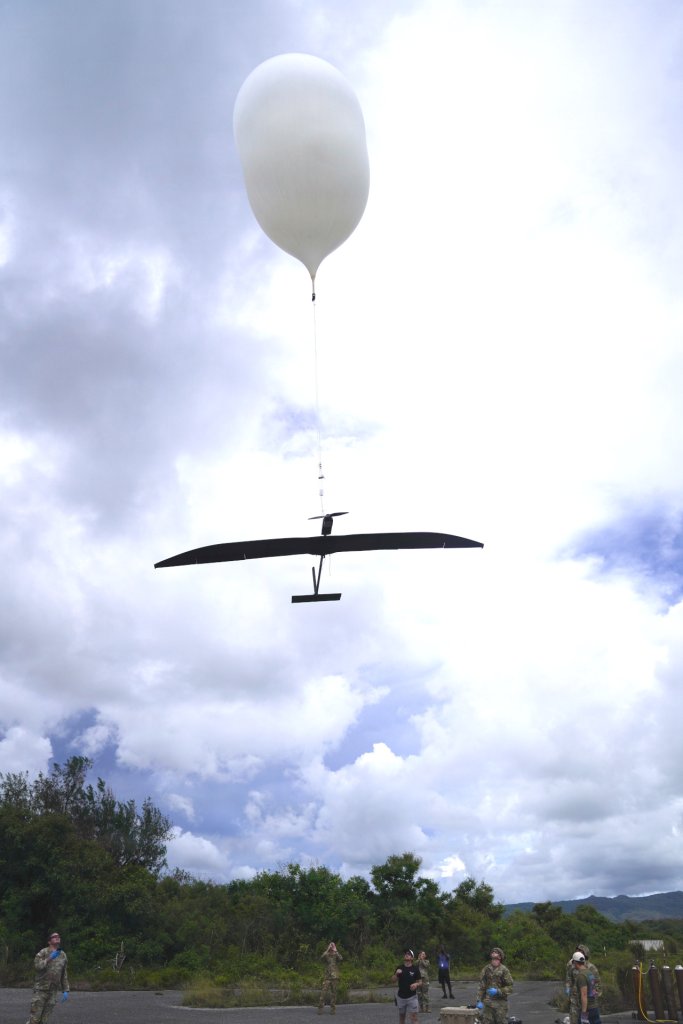
Just last month, the U.S. Army also demonstrated the ability of Apollo-R to be launched from a different high-altitude balloon from a company called Urban Sky during Exercise Valiant Shield 2026 in the Pacific. The Army has directly supported Apollo-R’s development through its xTech innovation challenge initiative.
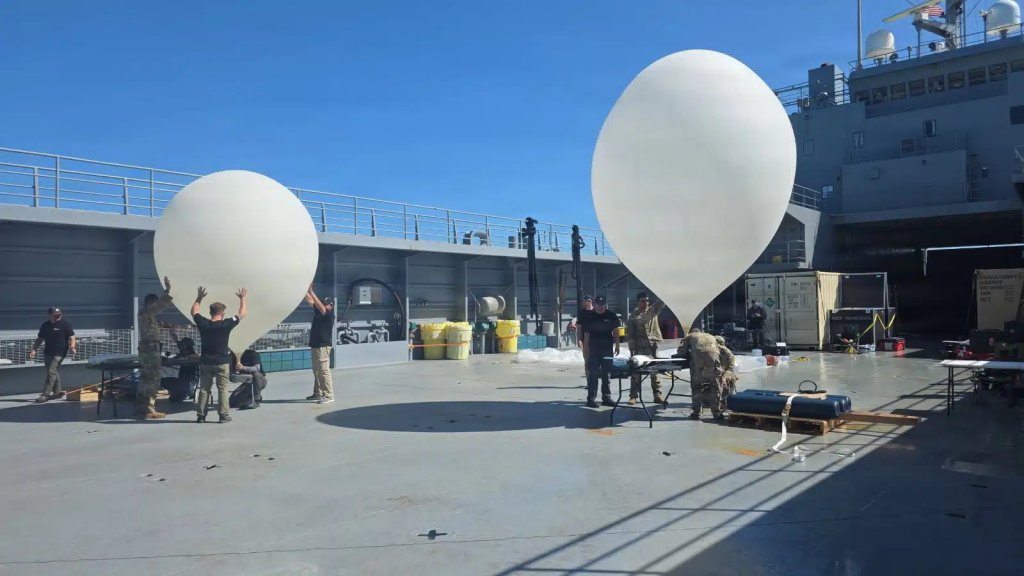
Earlier in the year, during Exercise African Lion 26, high-altitude balloons carrying drones were also launched from the Army’s General Frank S. Besson class Logistics Support Vessel (LSV) USAV Maj. Gen. Charles P. Gross off the coast of Morocco. This also underscores the aforementioned points about the flexibility of where balloons can be deployed from.
The U.S. Marine Corps, the U.S. special operations community, and other elements of the U.S. military are also actively pursuing high-altitude balloon-based systems to perform various missions. The U.S. Naval Research Laboratory (NRL) notably conducted extensive testing of drones launched from single high-altitude balloons in the 2010s as part of a project called Close-in Covert Autonomous Disposable Aircraft (CICADA). Those tests also demonstrated a tiered capability in which slightly larger drones launched the smaller CICADAs after being released from the balloons.
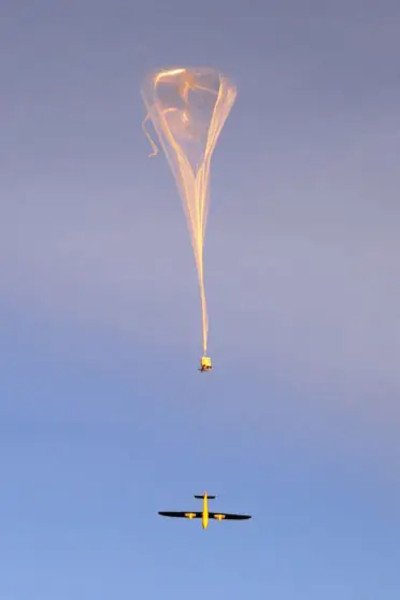
This being said, the Army has been a clear leader in the U.S. military in this regard. The service has previously outlined a vision for establishing “persistent, all-domain sensor architecture for the Indo-Pacific theater” in which high-altitude balloons are a central component. The Army has also talked in the past about using high-altitude balloons to deploy swarms of drones and loitering munitions, as well as seed remotely-operated sensors on the ground, deep inside enemy territory.
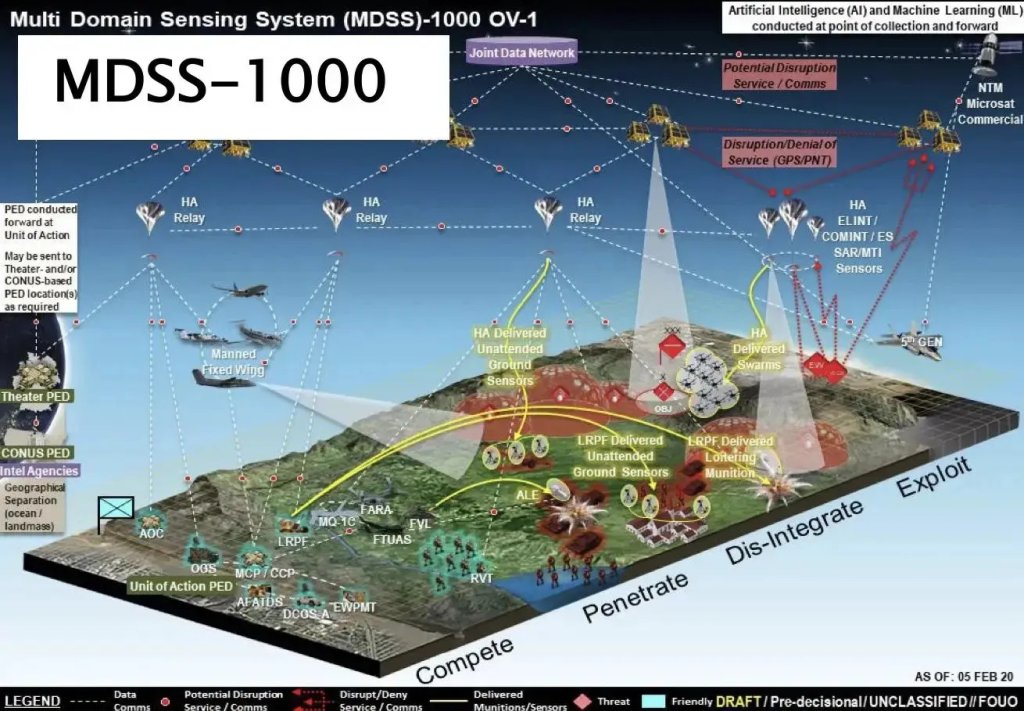
Last year, the Army disclosed plans to launch as many as 100 high-altitude balloons, and maybe even more, in an upcoming exercise. In that instance, the service also highlighted how these lighter-than-air platforms could offer a hedge against the loss of critical space-based capabilities.
“Our primary goal is to demonstrate autonomous swarming capabilities that generate a persistent, cost-effective presence in the stratosphere,” Andrew Evans, Director of Strategy and Transformation with the Office of the Deputy Chief of Staff of the Army, or G-2, told Breaking Defense in an interview in August 2025. “Once operationalized, this type of capability will enable us to conduct a range of military operations including enhanced intelligence, surveillance, and reconnaissance (ISR), the extension of tactical communications, and the rapid reconstitution of on-orbit capabilities when space is denied or degraded.”
These are capabilities that U.S. forces, among others, could employ beyond the Pacific region, too.
“The challenge on the eastern flank [of NATO in Europe] is fundamentally one of persistence, survivability, and logistics. Legacy ISR approaches – manned aircraft, large UAVs, fixed ground sensors – are increasingly vulnerable in contested environments with advanced integrated air defense systems,” Aerostar’s Van Der Werff told us, outlining another regional use case. “They require significant ground infrastructure, large runways, and complex logistics chains. In a distributed operations concept across vast areas like the Baltics or Eastern Europe, those dependencies become liabilities.”
Balloon-launched drones are already seeing use to a degree in the conflict in Ukraine, where lighter-than-air platforms are also being used for surveillance and as decoys. Driven heavily now by the threat of spillover from the fighting in Ukraine, Poland is in the process of establishing a new early warning radar network utilizing tethered aerostats, too.
Ukrainian forces are using balloons to transport kamikaze drones over long distances, then launching the drones toward their targets after delivery. #Ukraine pic.twitter.com/Prz1oMPQol
— NOELREPORTS
(@NOELreports) July 21, 2026
TWZ has previously outlined major investments in balloon-launched drone swarm capabilities in China, as well, as you read more about here. High-altitude-balloons, in general, became a global cause célèbre after a Chinese intelligence-gathering type passed over parts of the United States and Canada, before being shot down over the Atlantic Ocean, in 2023.
For Aerostar, the company now sees ‘drone mothership’ as another important role on the horizon for its Thunderhead high-altitude balloon. The smaller Lightning design paired with the Apollo-R drone is providing a stepping stone toward that concept, while also capability that could still be valuable, if more limited, in the near term.
Contact the author: joe@twz.com
The post Aerostar High-Altitude Balloons Being Turned Into Drone Motherships appeared first on TWZ.