Photographs by Sophie Green
On a Hallmark movie set, it is always Christmas but rarely winter. When you produce dozens of original holiday movies a year, there is only so much year for filming, and so you often find yourself making Christmas in July. As I am doing now in Canterbury, England.
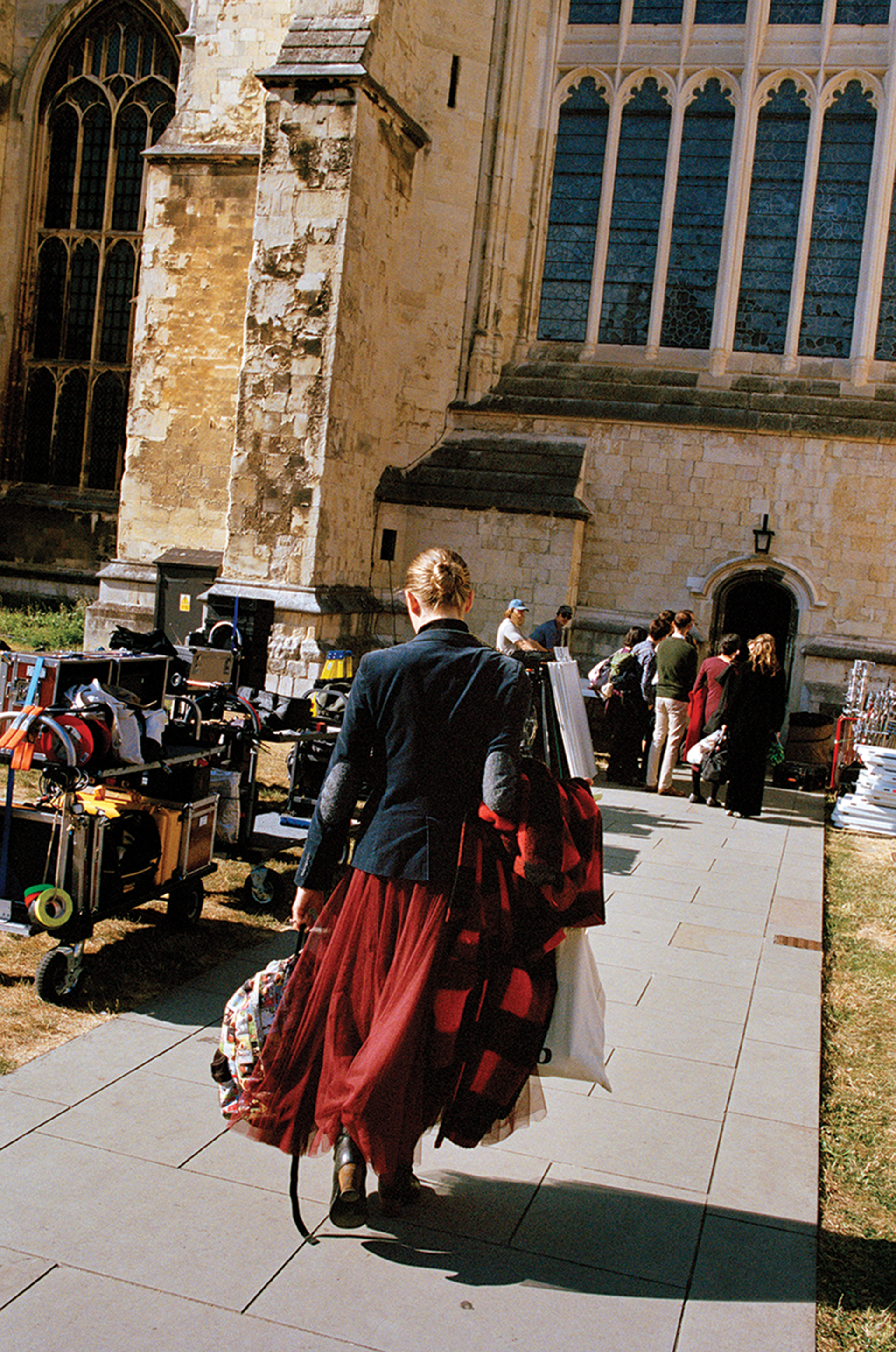
It doesn’t reliably snow in Canterbury anymore, even in actual winter, but there is snow on the ground. A man from Snowboy Systems, a producer of artificial snow from the East Midlands, is hosing down the sidewalk; the artificial snow on the sidewalk looks less artificial, he says, when the sidewalk is damp. This sidewalk snow is made from biodegradable paper and has the consistency of wet string cheese. Lining the sides of the cathedral are long strips of fleecy, fluffy artificial snow, like the kind in a department-store window. We are setting up for the big final kiss in the snow—a Hallmark Christmas needs a big final kiss in the snow—and that snow, falling from on high, will be made of foam. Three different types of fake snow in a single day of filming! That is what I’m here to study: how to make something so expertly fake that it feels real.
The Hallmark Channel turned 25 this year, and the brand is strong—so strong that specifying “Hallmark Christmas movie” feels redundant. On weekends from mid-October through December 2025, more U.S. women were watching Hallmark’s programming than that of all other cable networks, including news and sports, according to Hallmark. Over that period as a whole, Hallmark was the second-most-watched cable network among women, behind only Fox News Channel (do you prefer countdowns to Christmas, or wars on Christmas?).

Netflix is now in the holiday-movie game with steamier concepts such as Hot Frosty, in which a snowman becomes a man with washboard abs. And short Christmas movies are being made just for your phone, in vertical-video form. Have you seen Found a Homeless Billionaire Husband for Christmas on ReelShort, a platform for “microdramas”? The 71 episodes are each less than two minutes long; this microdrama is not even trying to have realistic fake snow. My social-media feeds are now garlanded with AI Christmas videos that purport to be time capsules of the 1970s or ’80s, showing sweater-clad families laughing as their turkey materializes out of thin air. Congratulations, we used all the water that formerly became snow to give you this creepy, plotless fauxstalgia!
Hallmark, despite the available technology, is still something made by humans for humans. The snow may be fake, but at least the fake snow is real. There is something tremendous about being among people who, using three-dimensional matter, make things nice for a living. Washington, D.C., where I live, and the world, where I also live, have both felt not nice lately. Sometimes you want to climb into a Hallmark movie.
So I am at Canterbury Cathedral—mere feet from where the English archbishop Thomas Becket was stabbed by the knights of Henry II—to be a Passerby and a Concert Attendee in a fetching winter coat.
But, as with all things made by humans, there is an element of unpredictability. While on set, I receive word that I have been promoted. I will not just be a Passerby. I will not just be a Concert Attendee. I will be Lord Mayor of Canterbury.
Lord Mayor of Canterbury does not sound like an ornament on the side of the tree that faces the wall. Lord Mayor of Canterbury sounds like someone who’s actually in this movie—who may, in fact, have to act, for real. And this is when, under my fetching winter coat, I start to sweat.
In the beginning, we had winter but no Christmas. Then, during the reign of Roman Emperor Augustus, someone named Jesus was born. It took a while for news of this event to spread, and still longer for this event to become a holiday. Celebrations really got into gear in the fourth century, after Constantine converted to Christianity. By the 12th century, the holiday had sprawled into a period of wassail drinking and jubilant misrule; in some churches, a choirboy was made a fake bishop and allowed to give a sermon. Becket himself gave the Christmas sermon in 1170; the stabbing, on the future Hallmark set, happened four days later.
There were a few evolutionary hops between vassals wassailing and American families zoning out in front of their TV sets, and many of them happened in the 19th century: Charles Dickens’s ghost story staved Christmas into a beloved fable of generosity, and The Nutcracker turned the holiday into a hallucinatory nightmare. The 20th century gave us Bing Crosby’s workhorse playlist, The Muppet Christmas Carol, and Mariah Carey’s jingle-jangling anthem of the pining heart.
And on August 5, 2001, along came the Hallmark Channel, which gift wrapped two millennia of scattered ritual and merriment into a digestible box the size of our TV screens. Its “Countdown to Christmas” helped cement the holiday as a holiseason, which lately begins before Halloween. Turn on your TV at any point during this time and see the modern image of Christmas: a man in a turtleneck sweater kissing a self-possessed heroine in the falling snow.
Before Hallmark, what original TV movies could you watch in the Christmas season? The landscape was pretty dismal. Consider the TV listings for December 2000. There were just a handful of holiday-movie premieres, including Special Delivery, with Andy Dick, and VH1’s A Diva’s Christmas Carol, with Vanessa Williams as Ebony Scrooge. On Fox Family, you could catch an airing of 1996’s The Angel of Pennsylvania Avenue, in which three children try to get President Hoover (President Hoover? ) to pardon their wrongfully convicted father in time for Christmas.
But even Hallmark took a little while to find its stride, as anyone who has watched the 2003 classic A Carol Christmas can attest. Have you ever wanted to see Gary Coleman, William Shatner, and (an uncredited) James Cromwell play the ghosts of Christmases past, present, and future? Or hear Tori Spelling utter the Dickensian paraphrase “I’m gonna hold Christmas in my heart”? Run, don’t walk, to rent this gem.
But then, in 2006, we got The Christmas Card. This is the Hallmark Christmas blueprint, and it is in every way a perfect film. The stereotypical Hallmark-movie plot can sound a bit dystopian: “She was a busy woman from the big city. Then one day the snow trapped her in Christmasville, and she never left …” The Christmas Card inverts this paradigm. Our protagonist, Faith, already lives in a small town. What’s more, she loves this town, and her job at the family lumber mill, more than anything—a fact that is lost on her absentee city-slicker boyfriend, Paul, an international wine broker in a tiny sports car. But, fortunately, Faith has sent a Christmas card to a soldier named Cody, stationed in Afghanistan, and Cody is so charmed by the card that when he gets a break from fighting the War on Terror, he visits her town. He then saves Faith’s dad from an out-of-control speeding car and starts helping at the lumber business. He also picks her up in a sleigh—with her favorite blanket. Wine Broker Paul does not stand a chance. There’s an exquisite scene where Paul spends two hours in the woods yelling into his cellphone about wine while, behind him, Cody takes down Christmas trees with a chainsaw.
As with any great romance, this one makes you like the lead characters instantly and then spend the next 90 minutes shouting, “NO! DON’T MARRY PAUL! ALL HE CARES ABOUT IS RIESLINGS!” Faith’s dad tells Cody that he needs someone to come back to, from the War on Terror, and this movie is about exactly that: the joy of returning to the cozy and familiar. By the end of the movie, you are frothing at the mouth lest something prevent Faith and her soldier beau, who have identical diner orders, from getting together. And of course they do, with a kiss in the snow. You can see why this masterpiece spawned a whole genre, and a legion of fans.
My own mother, who initially refused to be quoted on the record for this article, is one of these fans. But can she remember the name of even one Hallmark movie? Absolutely not. It feels almost rude to ask—like demanding that a fan of winter name a favorite snowflake. The point is not the snowflake (which is unique and exquisite). The point is the flurry, and its overall effect. Does my mother love Hallmark movies individually? Yes. But what she really loves is being surrounded by them all. She is watching one right now, as I type this. (It is August.)
The flurry blurs everything together. In addition to A Carol Christmas, there is It’s Christmas, Carol! (with Carrie Fisher! though not as Carol). Then there’s Time for Me to Come Home for Christmas. Time for You to Come Home for Christmas. Time for Us to Come Home for Christmas. Time for Him to Come Home for Christmas. (These are all real. It’s a franchise.) Time for Her to Come Home for Christmas. Time for Them to Come Home for Christmas. To me, this implies the existence of a more sinister Time for It to Come Home for Christmas (tagline, from Yeats: “What rough beast, its hour come round at last, slouches towards Bethlehem to be born?”).
An unofficial list on IMDb counts 507 Hallmark Christmas movies, from the highest-rated, A Biltmore Christmas (2023), in which a magic hourglass whirls our heroine back to the 1940s, to the lowest-rated, A Christmas Wedding Tail (2011), with Jay Mohr voicing a Labrador named Rusty. (That list of 507 includes several Hanukkah films and a Kwanzaa film.)
This year, “Countdown to Christmas” will feature 34 new movies (a Hallmark record). The flurry is now a blizzard, blanketing our screens with mass-produced mirth and brand partnerships—with the NFL (Holiday Touchdown: A Bears Love Story) and Disney World (what if we locked eyes in the hall of animatronic presidents?). But the key ingredient will always be Christmas, which is an “emotional intensifier” in both Hallmark movies and real life, according to the historian Gerry Bowler, who once wrote a biography of Santa Claus. “We spend maybe 10 percent of our lives under the sway of Christmas,” he told me. “Whether you observe it or not, you have to live in it. It is the one time of the year in which we take magic seriously.” We act nicely, he says, and expect others to act nicely.
So, in May, I sent a couple of emails to the Hallmark publicity team saying it was my dream to write a feature about being an extra in a Hallmark movie. They responded: Can you be in the U.K. in July?
Good news! Maria, the publicist who arranges my Hallmark debut, says she’s read the script for Christmas in Canterbury and “LOVED it.” It is inspired by a true event: the first performance by a girls’ choir at Canterbury Cathedral, which happened in, amazingly, 2014. One of the producers, Oneida Crawford, saw the news and instantly thought: This miniature feminist triumph deserves to be a Hallmark movie.
The Hallmark heroine in Christmas in Canterbury is played by Jessy Schram, blond and blue-eyed and so iridescently sunny that you want to bend over backwards to do nice things for her. This is not her first time being a Hallmark heroine. Remember Time for Them to Come Home for Christmas? She played a woman who, despite amnesia from a bridge-related head injury, is so iridescently sunny that everyone wants to bend over backwards to do nice things for her. Hallmark heroines are a very specific sort of person. They are “smart” and “relatable” and have “1,000-watt smiles” but are “no shrinking poinsettias,” according to the book Hallmark Channel Countdown to Christmas: Celebrate the Movie Magic (Revised Edition), whose cover promises “Recipes, Watch Party Games & More.”
Will Kemp is the Hallmark gentleman in Christmas in Canterbury (he’s also a producer). Besides starring in a substantial number of Hallmark movies, including A Not So Royal Christmas and Christmas Waltz, he was featured in The Scorpion King 4: Quest for Power, which I have not seen but does not sound like a Christmas movie. Will is English, has stunningly green eyes, and looks like he moisturizes exactly the right amount.
And then there are the Hallmark extras, or background actors. In The Christmas Card, the extras buy Christmas trees from Cody, sit in church pews, and attend a dance at a veterans’ hall. In Time for Them to Come Home for Christmas, they walk through town in their winter coats, listen to street performers play the theme song, and then normalize dancing along. They populate the world of Hallmark and make it more real, yet they never draw attention to themselves. The most I have thought about Hallmark extras is: What a nice winter coat. But not as nice as the heroine’s!
Now I need to think about how to be an extra. So I call up an acting coach named Mary Malaney and ask for advice. “I will be dressed as though it is winter, and so I will be very hot,” I tell Mary. “Do you know how to act cool?”
Mary has detailed, smart advice about using my sense memories of moving through city streets in winter, thinking about how I would hold my arms close to my sides and keep my head down to avoid the wind. I furiously take notes.
“I also have to attend a concert,” I tell her.
Easy, Mary says. “If you hear something really beautiful, just allow yourself to hear it. And enjoy. And whatever is on your face in that moment is truth.”
“How ambitious of a backstory can I do?” I ask. “What if I’m, like, the ghost of Thomas Becket and I’ve come back to haunt the cathedral?”
“Maybe not in this instance,” Mary says. “Part of being in an ensemble of any kind is knowing how you serve the story. And unfortunately in this one, Alexandra, you are probably not the main character.”
Extras are supposed to bring their own costumes, so Publicist Maria sends me a mood board of outfits for each of my two characters: Concert Attendee and Passerby. Concertgoers should bring burgundies, creams and whites, forest greens, deep reds, beiges, or other “rich winter tones,” and are to “dress smart, elegant, and subtly festive.” Passersby are instructed to avoid “modern sportswear, activewear, or trainers.” I borrow a magnificent black-and-red-checked coat from a friend with actual taste. I bring boots with heels, even though I hate wearing heels and will be miserable. The boots look wintry, and the suffering will give me character, whatever that character turns out to be.
But wardrobe prep is not enough. I need Hallmark wisdom too, from the woman who wrote that perfect blueprint, The Christmas Card. “Where I live now, you can’t swing a candy cane without hitting a Christmas-tree farm,” Joany Kane says on the phone from her home in Western Massachusetts. Although she still mentors aspiring Hallmark screenwriters, Joany’s main focus these days is Wicked Merry, an original pirate-romance universe inspired, in part, by her love of Jimmy Buffett. (Volume three of her Aargh Is for Romance book series is titled If Hallmark Movies Had Pirates.)
“It always seemed to me that Christmas is the best time for romance, even better than Valentine’s Day,” Joany tells me. “Valentine’s Day is kind of a made-up holiday, but Christmas is all about hope and magic.”
What makes a good Christmas movie? Romance, of course. “I tend to go for swoon,” Joany says. She isn’t into death or trauma. She wants her lead characters to lock eyes and feel something. “Like in The King and I , when he just puts his hand on her waist when they’re dancing? And he pulls her close? Oh my gosh, I just live for those moments. Every single script I write, I write around How can I get to this moment? ”
A moment of swoon. Whatever is on your face in that moment is truth. All I have to do in Canterbury is be in the moment and respond as a normal human would. Doing things with my body, like a person. But anyone who knows me will tell you: This is not where I excel.
Canterbury is a beautiful old English cathedral city. Charles Dickens liked it so much that he set some of David Copperfield in it. The Nazis disliked it so much that they destroyed a chunk of it during the Baedeker Blitz. Today, you can eat at a pub named the Old Weavers House that has been around longer than the city of Cleveland. You can go punting on a trout-filled river past a former priory that was built before the Aztec empire. And you can have fish and chips with Publicist Maria and then walk to a real Canterbury street where the magic—the niceness—is under way.
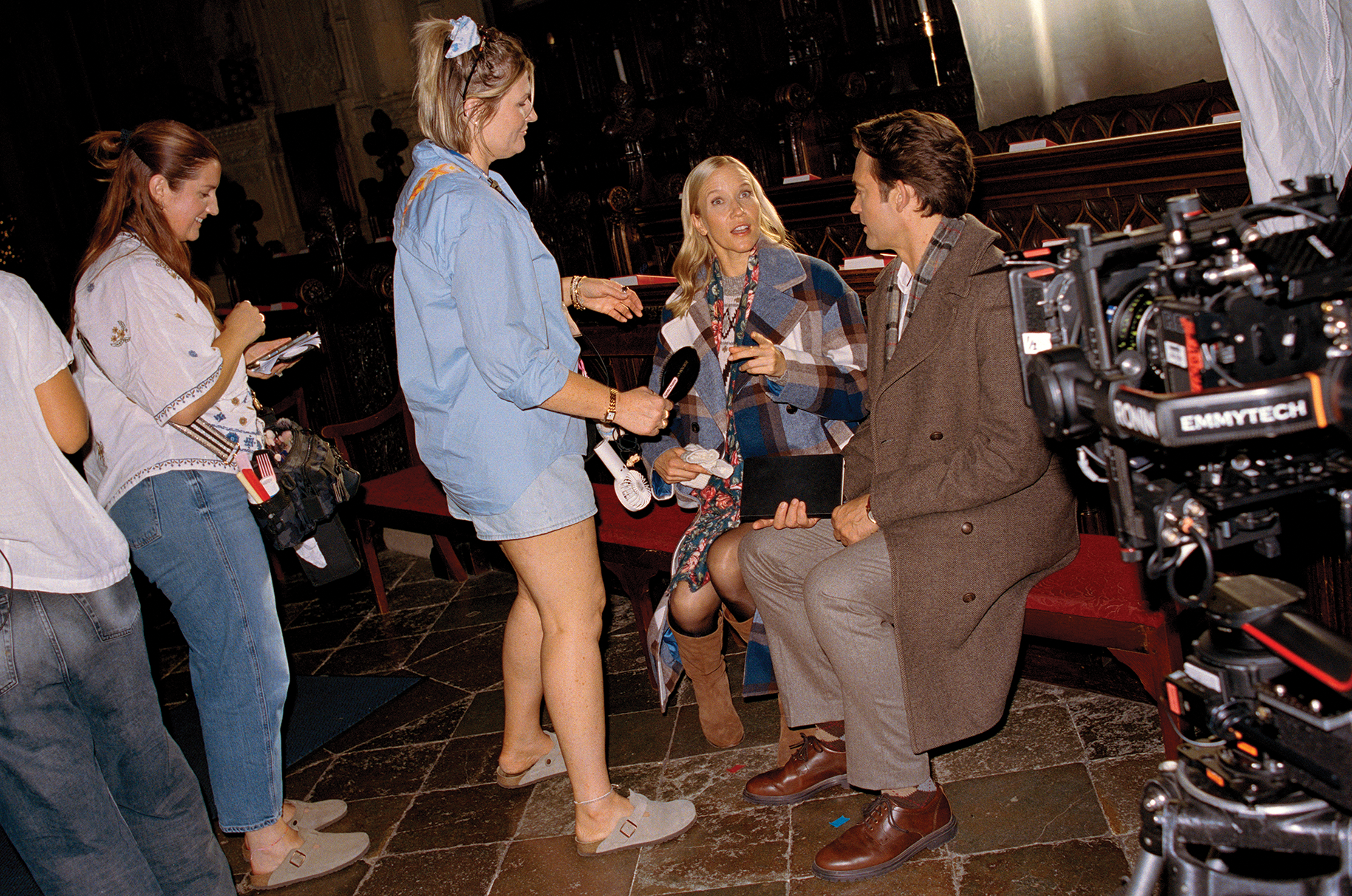
This is day 13 of the 15-day shoot (a typical length for a Hallmark production). The crew has been through a lot together, including choir rehearsals with children and a July heat dome. This film has been shot in roughly chronological order, meaning that tomorrow will be the first half of the climax, a choral concert where I will play Concert Attendee. And day 15 will feature the big final kiss in the snow. (Spoiler alert! Indeed, everything that follows—and some of what precedes—contains mild spoilers for Christmas in Canterbury, which airs December 11.)
Have you ever thought, Theater is fine, but what I really want is to watch just one little scene entirely liberated from its context, eight or nine times in a row. Each time should be slightly different, but also very hard to hear, and there should be a man holding a boom mic standing in the way ? If so, you will love being on a movie set. This particular set is a scenic lane of colorful rowhouses all playing themselves. A light on a cherry picker illuminates the street from above, making this entire block look like it is being abducted by a UFO. The night is quiet and pleasant, but punctuated by bursts of joy or distress from a neighboring pub (the World Cup semifinal is on). Will Kemp is about to walk Jessy Schram to her door, where they will no doubt want to kiss but refrain from doing so, because the climactic choral scene has not happened yet.
I don’t have access to the script, so I can only guess the plot from the snippets of dialogue I hear and the broad outline from Publicist Maria: Jessy Schram is Rose, a choir director from Vienna, Ohio. After her beloved Grandma Bud dies, she leaves home looking for adventure. She travels to Canterbury and stays with her heavily pregnant friend, who is a choir director for girls. When this friend becomes too pregnant to direct, Rose is asked to fill in—because everyone thinks she’s an esteemed choir director from Vienna, Austria. She meets the straitlaced Harrison (Will Kemp), who is also a choir director—for boys. While competing for the coveted Christmas Eve concert slot, Hallmark heroine and Hallmark gentleman feel a spark that inspires them to merge their choirs.
But no merging has yet taken place. So, tonight, Will walks Jessy home to her door (blue, with a Christmas wreath on it). They are discussing whether their night was an adventure? (It’s hard to hear.) Yes, Jessy says, “because we kept our hearts open.” They do multiple takes.
John Barrymore allegedly called love “the delightful interval between meeting a beautiful girl and discovering she looks like a haddock”; similarly, I feel that takes two through nine are the interval between marveling at the heartfelt dialogue and doubting that any human being would ever say these words in this order. But Jessy and Will are making it work. And so are the extras. Two extras walk through the scene, arm in arm, on an unerring path just where the camera needs them to be. I watch them in awe. They appear to be chatting naturally, yet they make no sound. Remarkable. Tomorrow, this is going to be my job.
“Because we both kept our hearts open,” Jessy says again, warmly. Between takes, the team from Snowboy sprays down the street.
“Because we both kept our hearts open,” Jessy says yet again, flirtier this time. She exudes Hallmark energy from every pore. At one point she will curse in front of the children’s choir and immediately revise “FUCK!” to “BUCKETS FULL OF CHRISTMAS!” Even the curses are festive here. That’s how deep the nice is on a Hallmark set.
It is so deep that Will Kemp is looking for ways to help people “level up” in all parts of the production. This, apparently, includes me. Before I leave set for the night, he tells me I’ve been promoted to Lord Mayor of Canterbury.
I will ease into that illustrious station via my first on-camera appearance as a humble Passerby outside the cathedral. (Or am I the Lord Mayor, walking among the people? I am never certain of the answer to this question, so I decide to play Lord Mayor and Passerby as two distinct characters, to show my range.) A shuttle brings us extras to a building full of chairs and tents that serve as changing rooms. There is also a costume rack and a hair-and-makeup area near the window.
The first step for extras (called “supporting artists” in the U.K.) is to show the outfits that we have brought, for approval or rejection by the costume team. The team goes into British raptures over my borrowed black-and-red coat, in the sense that they tell me I have “fit the brief.”
I am surrounded by other extras, and quickly share their conviction that this is one of the most exciting jobs on Earth. There is Helen, a model, who became a supporting artist because Ridley Scott’s Napoleon needed people for an orgy scene. She says the filmmakers decided to go with younger extras for the orgy (rude!), but this near miss got her into the casting database, and she has been having a blast in the background ever since. “You’ll actually find the background is where the interest is,” Helen says. “Without the background, you have no texture.”
Chloe, a Hallmark superfan and certified “Kemper,” is appearing in this movie because Will Kemp messaged her on Instagram and invited her to do so. “I probably sound obsessed,” she says apologetically, after telling me that she has attended six straight Christmas Cons, has been on two Hallmark cruises, and has a tattoo of the Hallmark crown logo on her arm. What is it about Hallmark that she loves so much? “It’s such a community,” she says. “And even the stars, they are so nice.”
Articulating what makes Hallmark magical is indeed tough. Even my mother, with whom I’ve watched so many of these movies, can only offer: “They are predictably upbeat, generally enjoyable, and feature a suite of actors who become familiar faces over time.” Generally enjoyable? As a Star Wars nut myself, I have less difficulty explaining my fandom. “It’s a multigenerational, modern-day myth,” I would say about Star Wars. It’s life, but space. Something similar can be said of Hallmark, which is its own genre of mythology: life, but nice. It’s life, but with someone helping you out of a sleigh in a gentlemanly manner.
It is time to become a Passerby. The assistant directors herd us to the flagstone streets, where we will be captured for posterity walking into the cathedral, then sitting in the cathedral. It is balmy. I am comfortable in my coat and white knit hat, complete with a pom-pom. First, we have a five-second establishing shot of people walking into the cathedral. Simple! All I have to do is walk in a normal manner. Someone shouts at me—I think it is the third assistant director, but I am too excited to be sure—to look up at the cathedral mid-walk, as a person might do. So I put my hands on my hips and tilt my whole body up to the sky like a little teapot. I know that this is not correct, but I have more pressing problems: I have forgotten how to walk. I have the strong sense that it involves my feet, but what if that’s wrong? Maybe it’s some kind of hop? And do you swing your arms while you do it? No, that can’t be. I am being a marionette instead of a person.
This take was either so good or so bad that they do not ask me to do more of them. “I feel like you just forget how to walk, don’t you?” says Nathan, a fellow supporting artist. “I’ve done so many scenes, like, walking down stairs, and that’s the worst for me.” It is amazing how you can do any action hundreds or thousands of times without thinking about it, and the second you have to do it for an audience, you become a hapless lump attempting to walk on dry land for the first time.
Next I have to be two things I’ve never been—a lord and a mayor—simultaneously. What if she, too, has to walk?
My acting experience is somewhat limited. In my youth, I tended to play numbered parts rather than named parts: 23rd Cousin A in a middle-school production called The Land of the Dragon (there was also a 23rd Cousin B who repeated my lines after I said them), and Puck 2 (or possibly 3) of an unspecified number of Pucks at Shakespeare summer camp.
So I would describe my acting level as “exactly correct for a production where many of the featured extras are friends or relatives of the producer.” You see me perform and think, Now, that’s someone who was available on the date they were filming. But there aren’t three Lord Mayors, or even two. There is one.
I email my acting coach in a panic. Due to the time difference, I don’t hear back from her immediately. Instead, I study famous mayors. I pull up Rudy Giuliani and Fiorello La Guardia on my phone. There are many pictures of Fiorello La Guardia standing behind a desk looking like a fish who is about to burst into song. I try to replicate these mayoral expressions.
I also email the actual Lord Mayor of Canterbury, a man named Alister Brady whose photo and contact information I find online: “Do you have any advice for someone who wants to wordlessly convey the essence of Mayor of Canterbury?” Amazingly, I get no response to this email.
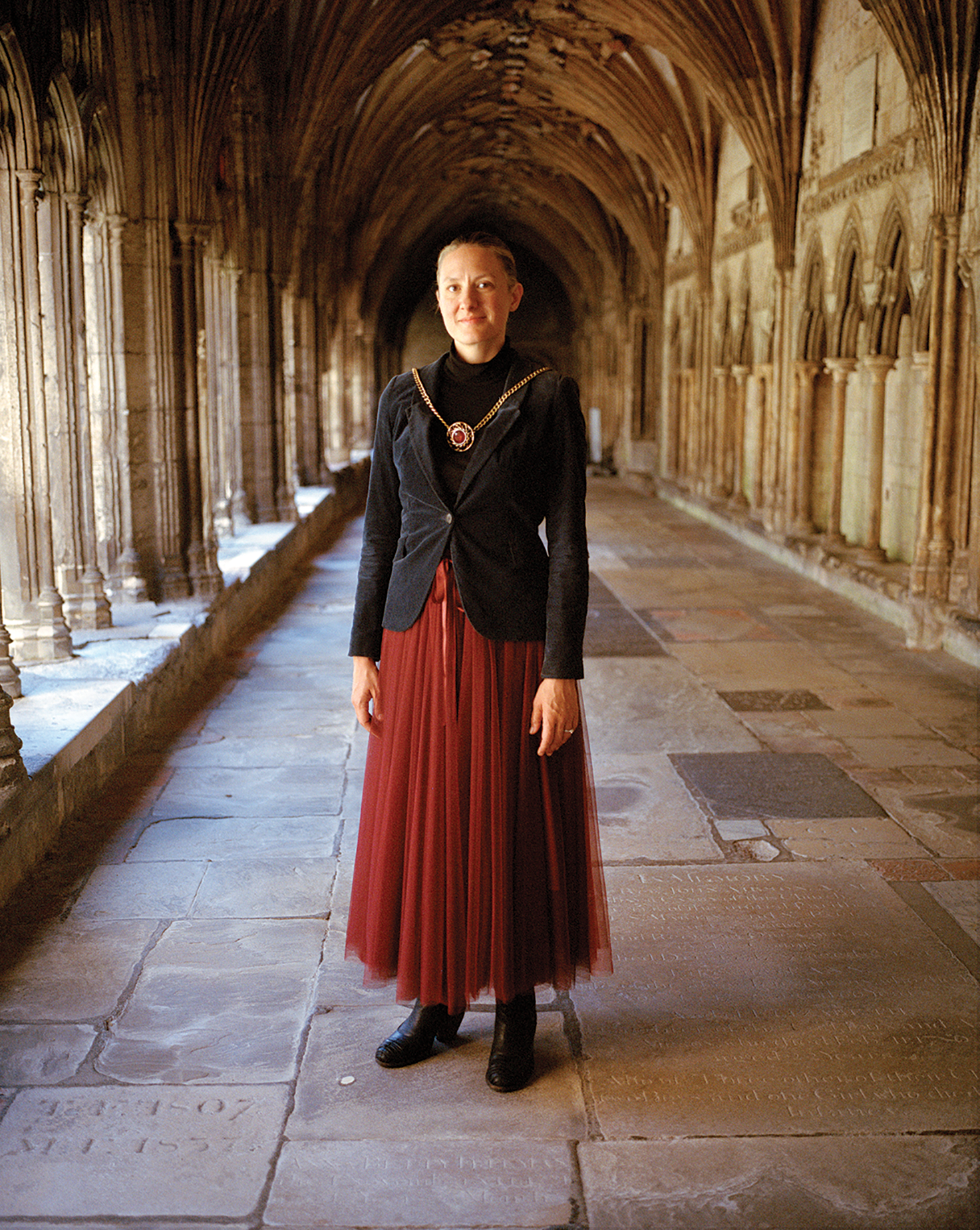
My Lord Mayor outfit includes not a sash but a chain of office, which a costumer carefully stitches onto my costume blazer. Although the chain has a large, sparkling red jewel that vaguely resembles the Eye of Sauron, the accessory is, on closer inspection, held together by a safety pin. My fellow extra Natalie says that viewers will call me the “Temu Mayor,” and I am not sure she’s wrong. Maybe the mayor sold her real chain of office to pay for choir music? (This is me doing character work.) Natalie says she played a dwarf in The Lord of the Rings: The Rings of Power, complete with dwarf ears, so she knows what a powerful talisman should look like.
I get myself into costume, trying to remain calm. Speaking of Natalies, Natalie Portman has said that scents help her get into character. Well, I have brought a scent with me: Dove’s Cinnamon Pumpkin Pie deodorant, a product that exists. Thanks to this product, my armpits smell like someone is cooking Thanksgiving dinner in them. Hopefully, this will add a subtle sense of festivity to all of the mayor’s interactions.
Hair and makeup’s vision for the Lord Mayor is hair pulled back into a severe bun with what feels like 800 hairpins, and no makeup. “I think the Lord Mayor might wear mascara,” I say timidly, and they gently apply some.
The photographer documenting my experience wants to take a portrait of me in my mayor outfit. This takes longer than it should. “Stand normally,” she urges. Unfortunately, I have never in my life stood normally and am not about to break this habit for her. Also, I cannot stop bursting into laughter. “You know, the forbidden laugh,” I say to her, as if this explains anything.
Listen. I have a lifelong condition that causes me to react to serious situations with compounding fits of laughter. In dancing school, I had to write a letter of apology for destroying a lecture with the giggles. I once went to a wedding where the officiant surprised the bride and groom with an arts-and-crafts project during the vows. As the couple began cutting hearts out of red construction paper, I began shaking with laughter, then weeping with laughter. Fortunately, you are supposed to cry at weddings. “It’s just so beautiful,” I managed, through my sobs. (If you are reading this, Chris, it was a lovely wedding, really.)
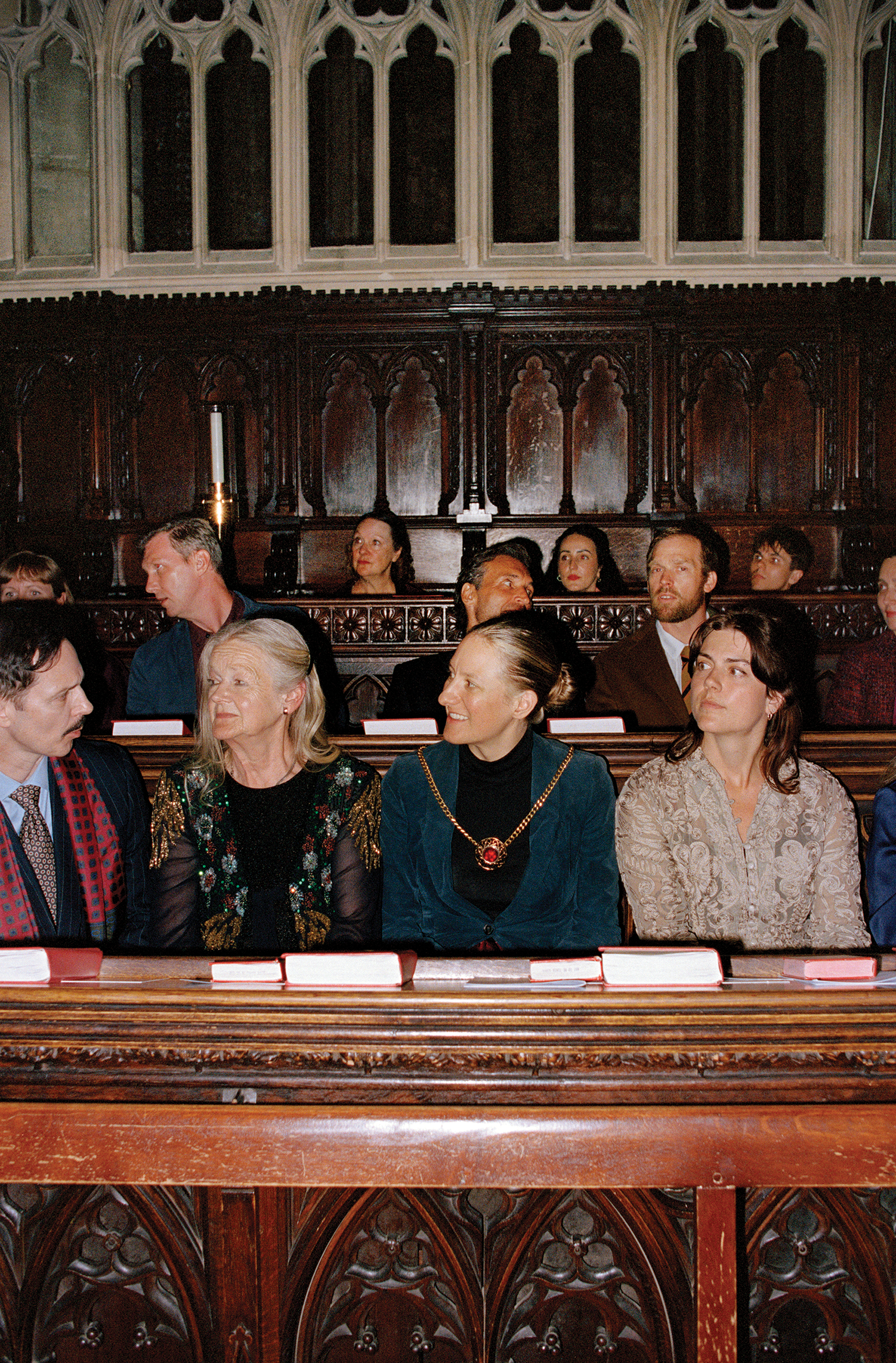
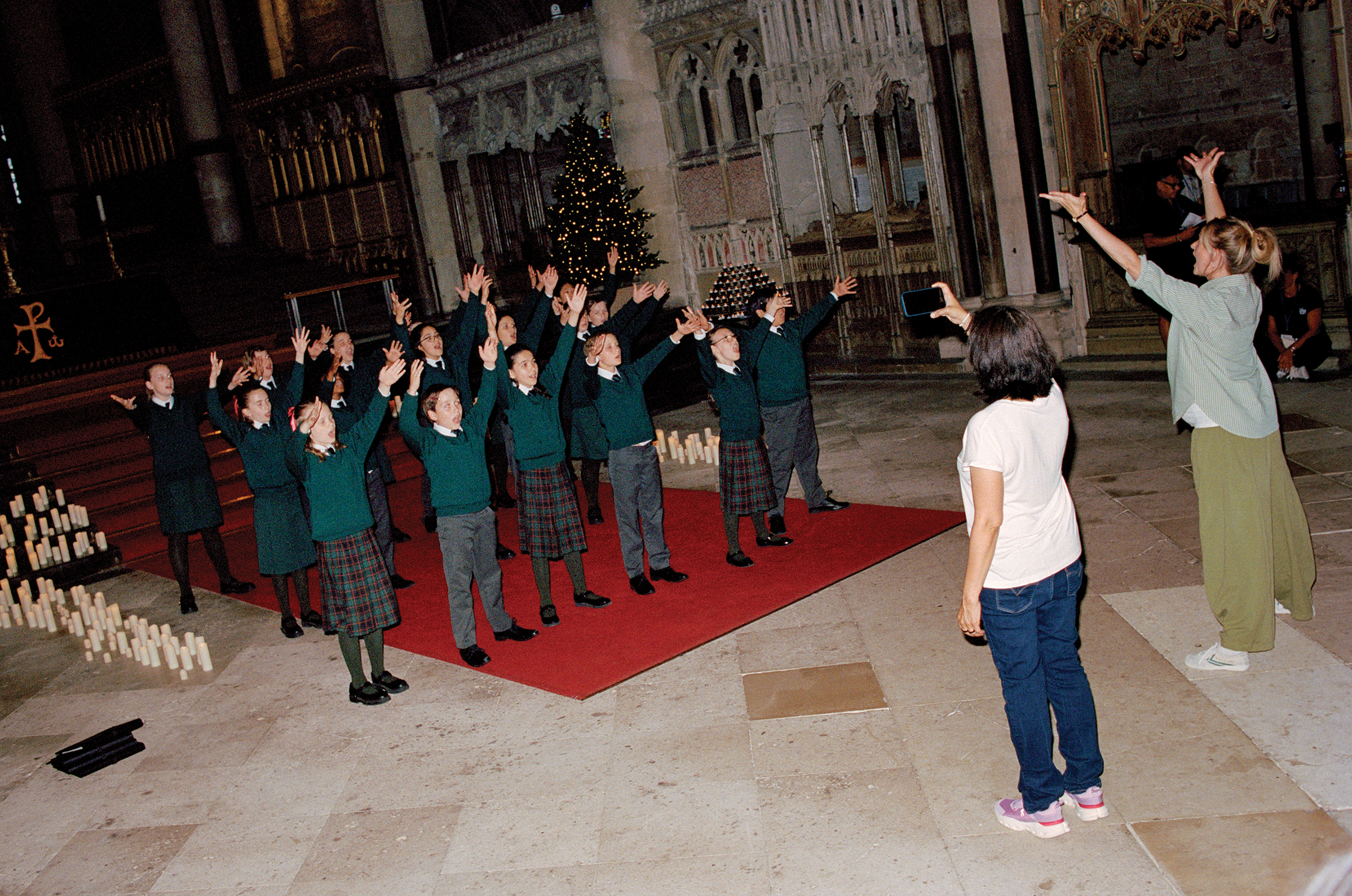
We receive the call to set, which is the actual cathedral, playing itself, but nicer. The cathedral choir looks beautiful, thanks to the lighting team and the strategic placement of dozens of fake candles. The job of Concert Attendee would have been just to sit there, take it in, and applaud at the end. The Lord Mayor’s role is somewhat more involved. Everything, it turns out, hinges on the mayor—and on her ability to make a normal face.
“You’re the mayor?” asks a man with a mustache. He moves to sit next to me, because he says his character would want proximity to power. He is a professional actor named Nigel Pilkington (he played a dog walker on Slow Horses) who is Christmas in Canterbury’s antagonist, Alastair Sinclair. He says that when the camera starts rolling he is going to interact with me. Oh no.
Someone down the choir stall—another professional actor, Emily Swain, playing the school headmistress—indicates that she’s going to look at me in a significant way when the song medley starts, because it includes the mayor’s favorite song. The mayor’s favorite song?! I feel like Jessy Schram as the amnesiac in Time for Them to Come Home for Christmas: I don’t know myself but keep discovering that I mean a lot to other people.
Apparently the mayor is supposed to love this choral performance—information that I am learning right as the camera is about to roll. The mayor loves it so much that Jessy Schram gets to keep her job, despite all of the Vienna confusion. “Our Lord Mayor was in attendance tonight and was delighted with your rendition of her favorite carol” is a line in this movie—a fact I learn in real time as the actor says it, on camera, in front of me.
It is fine. It’s fine! Acting is reacting. I can react. I live to react. All I have to do is make faces. Normal faces. Like Fiorello La Guardia.
One of the ADs now explains what we are meant to do during this choral performance: enjoy it. My acting coach was right! First, we will clap politely for the other, lesser choir that is leaving the stage, and then we will go wild for the collaboration between Jessy’s and Will’s choirs. I can do this.
Clack goes the clapper board. We are rolling. The lesser choir leaves. The boy choir members take their places onstage. The prerecorded vocal track of their singing starts to play, announced by a metronomic click-click-click. “Gaudete, gaudete, Christus est natus.” The choir lip-synchs perfectly. Now the second choir—with girls!—runs onstage to join them. Jessy Schram gets pulled into the mix. To encourage the choir, the movie’s choreographer (Will Kemp’s sister) is gesturing exuberantly off camera. On camera, Jessy Schram is conducting! Will Kemp is also conducting! The choir is singing together.
The camera pans over our row to see how we are taking this. This is the moment. My moment. I have no idea what faces I am making. I feel delirious. Whenever they yell “Cut,” I assume it’s because my face is ruining the sequence. I keep forgetting to look at Nigel. “I am making the weirdest faces I’ve ever made in my life,” I type into my Notes app.
Fortunately, gaping open-mouthed like Fiorello La Guardia is actually correct for this mayor, who is supposed to be delighted by this children’s-choir performance. Oneida Crawford, the producer, drops by and compliments me on my reactions. She later suggests that I become a professional supporting artist.
They … want more of me? I keep getting promoted. We are now going to film some cutaways to the mayor in conversation with Alastair and a character named Hans Mueller, who has arrived from Vienna, Austria, to reveal that Jessy Schram did not. He’s played by Will Kemp’s younger brother, Roland, a Pilates instructor who urges us to do “thoracic breaths” between takes.
We move to a different choir stall. “You’re the Lord Mayor?” one of the children from the choir asks when we’re not rolling. “You’ve been to my house! You’re friends with my mom!” I have? I am? I seem to have completely crossed over to the Hallmark dimension.
The next scene is as follows: Hans Mueller, the Lord Mayor, and Alastair are deep in conversation. A repentant Alastair needs to look up and bow in acknowledgment to Jessy Schram, and then he needs to get back to our conversation. Talking without talking is much harder than those other extras made it look. Here is a sample of our inaudible, improvised dialogue, as far as I can remember:
HANS: Have you been to the beach?
THE LORD MAYOR: I don’t know what you’re saying! I’m the mayor!
HANS: I’ve been to the beach.
THE LORD MAYOR: I am too busy to go to the beach, because I’m the mayor.
This is apparently going so well that they decide to get a close-up of us talking. And they bring the microphone over. A microphone? Are they going to record us talking out loud? The camera starts rolling.
Some moments feel as though they last much longer than they actually do. I imagine Thomas Becket thought that getting stabbed by those knights took a long time.
“This cathedral certainly has a rich history,” Alastair improvises confidently, and I freeze. In this moment I am thinking many things. One is: How did I get here? Another: Do I attempt to do a British accent in conversation with actual British people, one of whom is a professional actor?
I remember opening my mouth. I know that some form of sound must have come out of it. I have no recollection of what this sound was, other than that it did not come out in anything remotely like a British accent, whatever my intentions were. I think I may have said, “Indubitably”?
I hear voices. “Show them your chain!” Is that the director herself, Shamim Sarif? Obediently, I brandish the chain. I can see the safety pin holding it in place. Temu Mayor, I think. “We spent all our budget on choirs,” I say out loud, in what is very clearly not a British accent. This is when I break. The forbidden laugh comes lurching out of me, in great sobs. Tears are pouring down my cheeks. My sweat is redolent of cinnamon.
Somehow we are still rolling.
“Does it have magical powers?” either Hans or Alastair is saying. I am fully hysterical. “It is a talisman,” I mutter, through my tears. I try to rescue the moment, as I did at the wedding, by saying, “I just loved the music so much.” This does not work.
“We’ve lost the Lord Mayor,” someone says.
The next day, I am talking with Jessy Schram. “I didn’t realize that the Lord Mayor was, like, the pivot point,” I tell her. We are standing outside Canterbury Cathedral in the final hours of filming.
“Oh, you are actually a plot point,” she says. The mayor’s love of the choir performance is the only reason her character is allowed a job now in Canterbury.
Jessy notes that, earlier in the script, her character references the existence of the Lord Mayor, saying that the song they’re set to perform (“Once in Royal David’s City”) is his favorite song. Then one of the choir girls corrects her. Not his. The Lord Mayor is a she. “So then when I turned around,” Jessy says, “and I saw you dressed in your beautiful jewel, I was so excited.” She felt that my mayor had a “really good vibe about her.” Is this more great acting from Jessy Schram, or did my acting coach work her own magic?
Will Kemp also offers encouragement after I apologize for my giggle fit. “Sometimes you become so aware of the ridiculousness of what you’re really doing,” he says, “and you have a bit of an out-of-body experience. And then you either giggle, cry, or have to sit down, or you do all three. So you’re not alone.”
A tear dribbles down my cheek. “You’re crying,” my Hallmark gentleman says. Are we having a moment? One of those moments that Joany Kane writes around? In fact, no. There is sunscreen in my eye.
I think about fake things and real things and how Hallmark twists the two into a delicious candy cane. I think about how Joany Kane owes the love of her life to The Christmas Card. She was 34, two years before the Hallmark Channel even existed, working at a lumber mill and writing her screenplay for a Christmas romance. One day, when the loggers came to collect their pay, she locked eyes with one of them. It was a thunderbolt. It was the kind of thing that would happen in a Hallmark movie. And suddenly, not only had she found a love interest in Logger Honey (as she would call him) but also she had realized that her movie needed to be set at a lumber mill. True story and Hallmark story, real and fake, forever blended. When she finished the screenplay, she went to deliver a copy to Logger Honey for him to read and ended up back at his place. He played his favorite music. They danced. She spent the night. “Probably spending the first night together was not Hallmark,” Joany notes. “More like Netflix. Or, you know, Cinemax, 15 years ago. But it was true love for both of us.” She never left. It’s been 27 years.
Maybe it’s possible to bridge the real and the fake. If it weren’t for Joany’s own life, The Christmas Card wouldn’t exist. If it weren’t for The Christmas Card, she wouldn’t have gone over to deliver the script to Logger Honey—and she wouldn’t now be waking up every day next to the love of her life. “Everybody’s chasing that moment of feeling,” Joany says. And if you can’t quite find that moment in real life, Hallmark has you covered.
Now it’s time to catch that moment on film: the final kiss, in front of the cathedral. Our leads approach each other in their perfect coats. Snowboy’s machine blasts its foam into the sky. When the foam falls, it is snowing, even though I know it isn’t really. This winter in July is a kind of Christmas gift—something we are making, together, so that the world will be a little nicer. So that we can turn on the TV and see magic. Made magic. Which is, of course, the only kind we get.
Night falls on Canterbury.
As we get set up for the final shot, I watch the monitors. The crew sits against a wall, watching the monitors too. Will’s luminous, moisturized face is framed by two Christmas trees. For a moment, we are all watching a Hallmark movie. Nowhere on Earth is the artificiality more obvious than here, on the set, with the boom mic just off camera and the Snowboy machine going VOOOOOOOOOOOOM. Yet there, on the screen, it is briefly real. Magic. The ordinary, given back to us, properly illuminated.
Christmas feels so close and tangible that I can almost smell it—a real pumpkin pie, baking very close by.
Wait, never mind. That is my armpit.
This article appears in the December 2026 print edition with the headline “How I Became the Star* of a Hallmark Christmas Movie.”