Photographs by Lisette Poole
Julio Borrell knew he was being deported, but after 47 hours on a bus rattling through Mexico, he still had no idea where the United States was sending him. Through the window, he saw the cities give way to sprawling banana plantations and coffee farms. The passengers were still wearing whatever clothes they’d had on when they were detained by ICE: shirts splattered with paint from their most recent job, pajama pants, landscaping-company uniforms, bathing suits. Borrell had lived in Miami for 46 years. Now he watched as the bus passed a sign for the Guatemala border and then pulled over on the side of the road.
“Where are we?” Borrell asked.
“Tapachula,” a Mexican immigration agent answered.
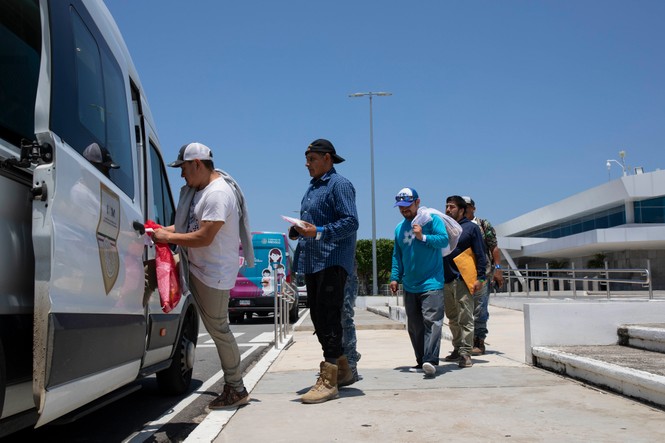
Borrell hadn’t heard of it. Neither had anyone else on the bus. The deportees weren’t from here. They weren’t even from Mexico. They were Cuban, Venezuelan, Nicaraguan, and Haitian—many of them elderly, some stripped of their green card after spending most of their life in the United States. The Trump administration, unable or unwilling to send them to their home country, had bused them 2,000 miles, from the U.S. border to a small city where they don’t have legal status. It’s a practice that started last year without any announcement and has quietly grown since then. “Why the hell did they bring us here?” Borrell, who migrated to Miami from Havana in 1980, asked me while I was in Tapachula this month.
By the time we met, Borrell, a tall, sinewy 72-year-old with a shock of gray hair, had been in Tapachula for about six months, trying to make enough money fixing tires to rent a studio apartment. He knew that a handful of other Cuban deportees had been flown even farther away, to African nations such as Eswatini and South Sudan. But it was Tapachula that had become a mass waiting area for those rebuffed by U.S. immigration policy, out of sight of lawyers and human-rights defenders. This is now where the largest concentration of deportees is dropped in Mexico, and where most migrants traveling through Latin America en route to the U.S. are halted. Donald Trump can claim that the border is “closed” because it has effectively been relocated to Tapachula. The city looks and feels the way towns in northern Mexico along the U.S. border once did—a dumping ground for those expelled from the United States and a gathering place for those snagged on their way north.
Mexican agents pull migrants out of commercial buses and cars on the freeway leaving the city, making sure the deportees don’t attempt to return to the United States. Another set of agents waits for the next busload of Cubans, Venezuelans, and Haitians to arrive so they can be processed. It’s what experts call externalization: the outsourcing of migration management to other countries.
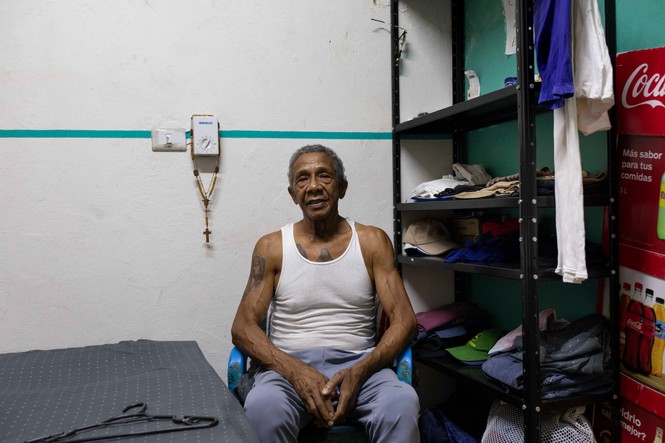
Borrell told me that he’d come to the United States when he was 26 as part of the Mariel boatlift, the mass exodus of Cubans who traveled on crowded boats to Miami in 1980. He had seven American children, 11 grandchildren, and a great-grandchild. He had run a mechanic shop and renewed his visa each time it neared expiration. He could feel his body breaking down after years of physical labor and had been looking forward to retirement and more time with his family in South Florida.
Then, last December, he went to his scheduled immigration check-in, as he had done dozens of times before. This time, he was detained by ICE agents. They sent Borrell to Florida’s Alligator Alcatraz for four months and then to Eloy Detention Center, in Arizona. From there, he was put on a bus for the U.S.-Mexico border and then another, bound for Tapachula. He walked on the side of the road for an hour before borrowing a cellphone to call his family back in Miami. “I’m in some place called Tapachula, Chiapas,” he told his daughter.
Borrell, like thousands of other non-Mexicans deported here, arrived without clear legal status and with nowhere to stay. Many deportees sleep on the street for their first few nights. Mexico denies that it is facilitating deportations from the United States to Tapachula, even though more than a dozen migrants described to me the cooperation between U.S. and Mexican immigration agents in their expulsions. According to data from the Mexican Institute for Migration, 12,977 non-Mexicans were deported to Mexico from January 2025 to March 2026, largely to southern Mexico. They joined the tens of thousands of other migrants from all over the world who have been stranded in Tapachula during their journey to the United States, after being blocked by Mexican immigration agents from moving farther north. The mix of nationalities here has prompted officials at the United Nations’ International Organization for Migration to begin informally referring to the city as TapaYork—a kind of reverse Ellis Island. There are roughly 350,000 permanent residents of Tapachula and approximately 60,000 migrants living here. Some have tried to flee Tapachula multiple times, only to be deported back over and over again after being caught by Mexican agents.
[Read: The rushed, blundering effort to send deportees to third countries]
U.S. officials have consistently said that their goal is “zero border crossings”—a more absolutist project than Trump articulated during his first term, when it was easier for migrants to advance beyond Tapachula. This month, Department of Homeland Security Secretary Markwayne Mullin claimed that his department was accomplishing that goal. (Crossings are indeed way down, but they’re not at zero.) In meetings with their Mexican counterparts, U.S. officials continue to ask for more stringent immigration enforcement and accommodation for long-distance deportations, according to Mexican officials. The Mexicans, who fear unilateral U.S. military action, have generally complied. The Cubans, Venezuelans, and Haitians who are expelled here in buses that typically arrive a few times a week are evidence of Mexico’s acquiescence. In addition to the buses filled with foreigners, Tapachula’s tiny airport sometimes receives as many as five flights of Mexican deportees a day. (There have been more than 196 so far this year.) Most of the Mexicans arriving by plane head straight to the local bus station and return to their home state or to the border again. Some are minors and need to wait for their parents to pick them up.
In his first weeks here, Borrell, disoriented, was walking to an ATM to see whether he could withdraw cash when he saw a face he recognized. It was a Cuban friend from Miami, who ran a tile business.
“What are you doing here, man?” Borrell asked.
His friend, who had moved to the U.S. from Cuba when he was 6 and held a green card, had also been deported by bus. Borrell told him what he has said many times since: “We’ve got to get out of here. I’m not going to die in Tapachula.”
From his small stand selling bread in downtown Tapachula, Mervil Wisdael, 43, sees the groups of deportees arrive a few times a week. “They’re lost,” he told me. “They’re just dragging their feet. They don’t even know where they are.”
Wisdael, from Port-au-Prince, is part of a different population of migrants here, one that intended to pass through on the way to the United States. Tapachula has historically been a way station for migrants traveling north, including those who navigated the jungle of Panama’s Darién Gap before continuing to Mexico. I spent a week in Tapachula in 2018, when a caravan of migrants amassed there on their way north, early in Trump’s first term. Migrants slept in the central plaza, in the bus station, in rented rooms and shelters. It quickly became a media spectacle. Trump claimed that the group leaving Tapachula, which included many young Central American families, was full of criminals. He demanded that Mexico intercept them. A few days later, I walked with the migrants to the edge of the town, where Mexican immigration authorities had blocked the road. Hundreds of people were detained. Taking a break, one officer said to me, “We’re doing what your president asked.”
Since then, the Mexican government has again and again bent to the will of the U.S. government on immigration enforcement. It signed off on the “Remain in Mexico” policy in 2019, which forced asylum seekers to wait for their immigration appointments from Mexico’s northern border rather than from within the United States. Under the Joe Biden–era CBP One program, it agreed to host asylum seekers even farther south, including in Tapachula. Then, during Trump’s second term, Mexico agreed to mass deportations to the city. Mexican officials told me that the main consideration for the Americans was Tapachula’s distance from the U.S. border and the way agents could create a choke hold on the only highway leaving the city. I came back to Tapachula to see how that series of capitulations had changed the city, a gritty commercial hub surrounded by miles of farmland, where near-daily afternoon storms briefly break the tropical heat.
Read: A planeload of informants
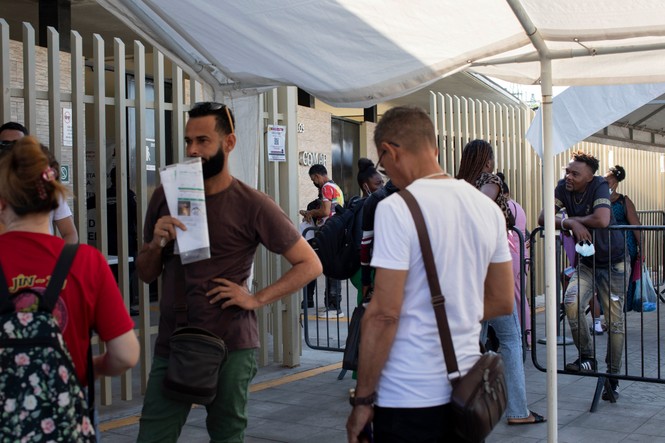
Wisdael had planned to make his way to the U.S. to reunite with his family and apply for asylum. But by the time he arrived in Tapachula, six years ago, Mexico was no longer allowing migrants to transit through the country without a humanitarian visa or refugee status, which could take months or years to get. He stayed until he got his papers, and then he waited longer to see whether it might get easier to cross the U.S. border. Many other Haitians stayed too. Roughly 10 percent of the city’s public-school students are now from Haiti. Each of its three semiprofessional basketball teams has Haitian players. The city’s market is peppered with stalls selling Haitian food. Employees of the municipal immigration office have taught themselves Creole.
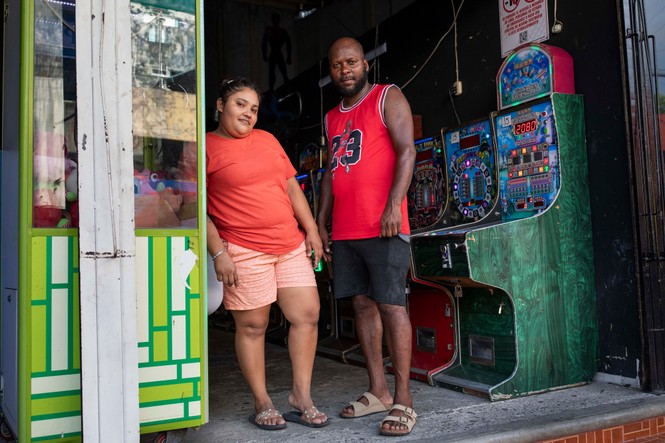
Wisdael has been in Tapachula longer than most of his countrymen. He speaks fluent Spanish. He met a Guatemalan woman, Ericka Leonardo, while working on a construction crew there. She was walking down the street.
“You’re pretty,” he said.
“I’ve never dated a Black guy,” she said.
“Maybe you should try,” he said.
They’re now married and live together in Tapachula. She works at an arcade around the corner from his bread stall. They’ve become informal sources of information about Mexico’s archaic immigration system. Wisdael explains to newly arrived Haitians that they need to line up at Mexico’s refugee office every 15 days so that a bureaucrat can sign a document proving that they have not absconded from Tapachula. After 30 or 40 or 50 signatures—anywhere from one to two years—most Haitians will have refugee status in Mexico. “They don’t want to wait that long. No one wants to wait that long here,” he said.
But Wisdael knows that it’s not a good time to attempt to cross the U.S. border. Most people don’t even get that far. Haitians without Mexican papers are typically caught by Mexican immigration agents at a checkpoint just north of Tapachula. The city once felt like a stepping stone. Now it feels like a dead end.
Almost every immigrant community in Tapachula has its own Wisdael—someone who has been around long enough to explain the rules to the newly arrived. Aside from the Cubans and Venezuelans, there are thousands of Central Americans, along with smaller groups of Congolese, Senegalese, Bangladeshis, and Nepalese. There’s a Cameroonian bar and a Ghanaian restaurant within walking distance of the 19th-century colonial church in the city center. The man guarding the door at one of the migrant shelters is Ukrainian. Most people have learned just enough Spanish to ask at least two questions: How long have you been here? And when are you leaving?
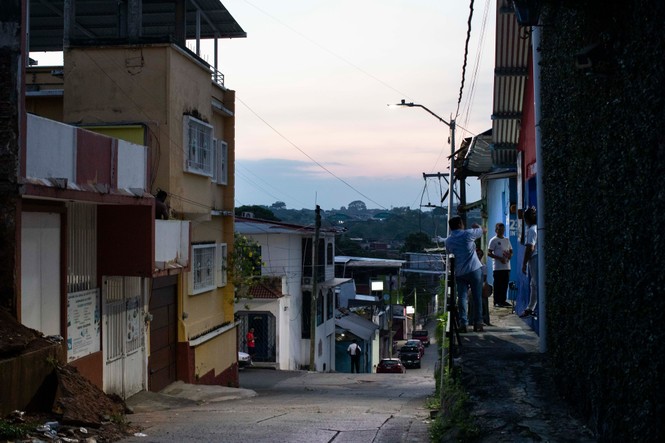
Before I left Tapachula, I was curious to meet the city employees running the municipal migrant-assistance center. I followed directions to a mostly abandoned covered market at the edge of town. I was sure I was lost. Then an enthusiastic 28-year-old, Kevin Figueroa, leapt out of his office holding a laptop. He had a PowerPoint presentation on migration in Tapachula. Did I want to see it?
He flipped through the slides on the large numbers of migrant arrivals here and all of the ways the city had integrated them into municipal life. I knew that there had been protests over the past few years by locals upset about the way their city was changing. In 2022, Roberto Fuentes, the city council’s general secretary, told reporters that “the city is in a state of siege, a state of chaos.” At least once, Haitian street vendors like Wisdael have been physically removed from the city center by local police.
But Figueroa assured me that Tapachulans had become accustomed to the way their city had been transformed. The economy was growing. The food was better. I partially believed him. In some ways, the city did seem to have settled into its new demographics. But there were still frequent confrontations between migrants and municipal employees—triggered, for example, by migrants using public electricity outlets to charge their phones. This month, several migrants set their mattresses on fire in the city’s migrant-detention center, leading the military to intervene. Two Venezuelans were arrested. Mexico’s immigration agency said obliquely in a press release that the protest was in response to “the dissatisfaction of a group of foreign nationals regarding their immigration process.”
What seems to bother those trapped in Tapachula most is not the way they are treated in the city, but that they are here at all, in a no-man’s-land, far from any place they ever lived. It’s an approach the Trump administration plans to expand to more remote locations. Not long after I left Tapachula, the Liberian government announced that it would accept 1,200 non-Liberian deportees from the United States. Such an announcement would, until recently, have been a radical departure from decades of immigration policy. But there has been little outcry. The U.S. has kept the desperation of deportees and asylum seekers at a great distance. Some of the Cubans I spoke with in Tapachula told me that in the next week or two, they will begin marching north in their own migrant caravan. They know their chances of getting to the border are close to zero. But they think the effort might be enough to remind Americans that they are there, waiting at the southern tip of Mexico.