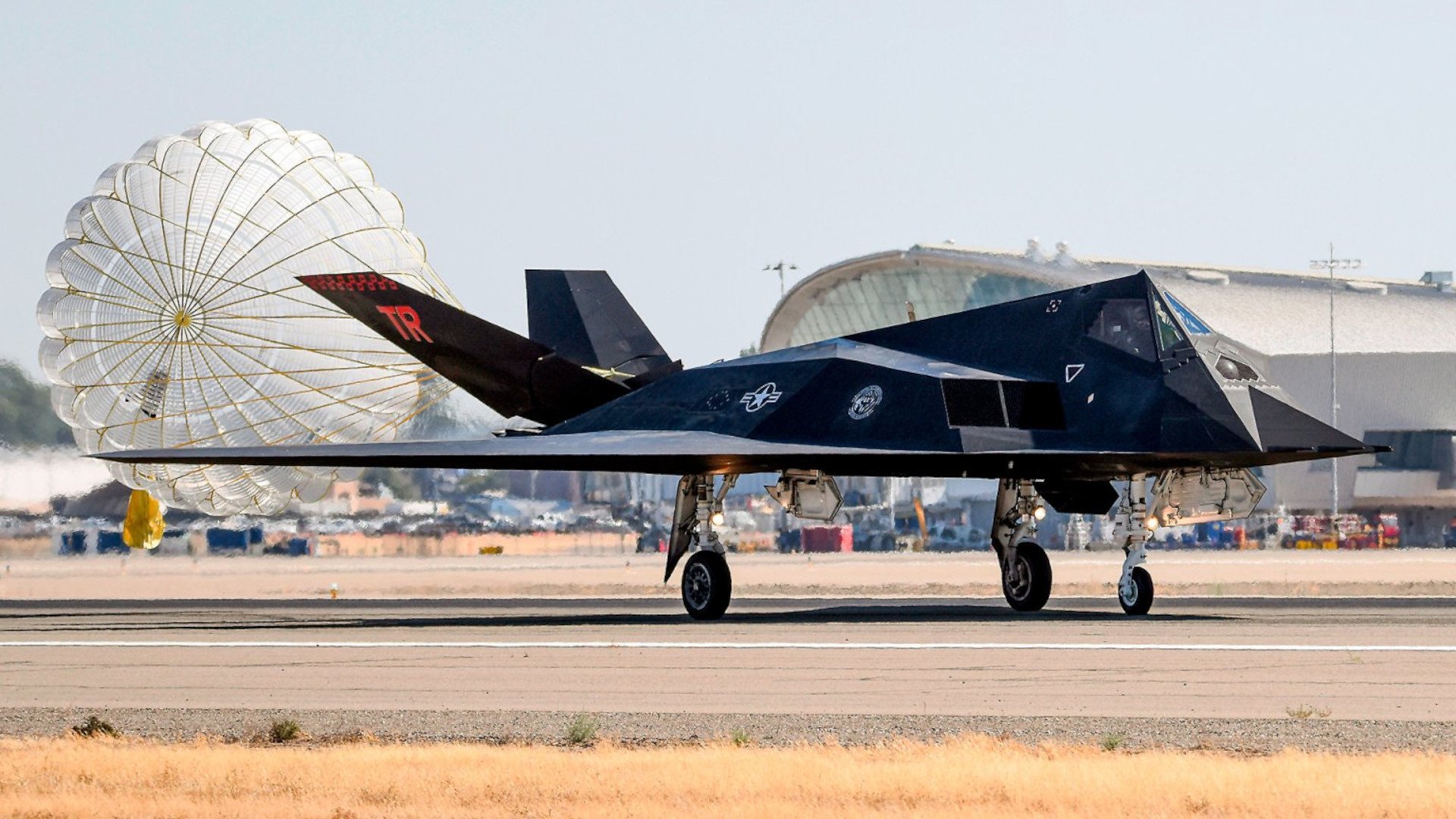
Despite being officially retired in 2008, a pocket fleet of U.S. Air Force F-117 Nighthawk stealth jets has continued to operate from the secretive Tonopah Test Range Airport in Nevada. The service has said it plans to keep flying the aircraft for research and development, test and evaluation, and especially training purposes through at least 2034. This, in turn, requires continued maintenance and logistics support, and a recent contracting notice has now put a spotlight on one of the aircraft’s more obscure features: an emergency tailhook that deploys with the help of explosive charges.
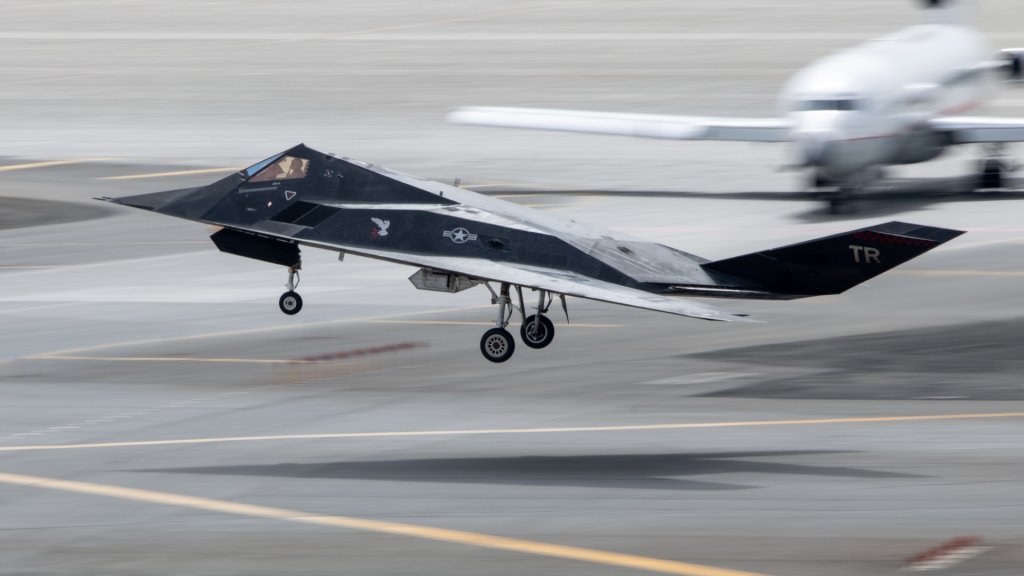
Earlier this week, the Air Force released additional details regarding a planned sole-source contract for new “CAD/PAD” – cartridge-actuated devices and propellant-actuated devices – in support of the F-117 fleet. CAD/PAD is a broad category of explosive and other pyrotechnic ‘devices,’ all of which have a shelf life and have to be regularly replaced for reliability and safety reasons.
CAD/PADs found on modern military aircraft are most typically associated with emergency egress systems, especially ejection seats. The Air Force’s planned order for these ‘devices’ for the F-117 fleet does include ones that help blast the canopy clear away from the aircraft so the pilot can safely eject. The Nighthawk’s canopy is a notably heavy component, as highlighted in the video below.
The F-117 CAD/PAD order list also includes what are described as the “Tail Hook Panel Pyrotechnic Assembly” and “Tail Hook Panel Initiator.” These small shaped explosive charges and electrically-initiated detonators, respectively, and are completely unrelated to the F-117’s ejection system.
To take a step back quickly, most land-based combat jets in U.S. service today, as well as many in service elsewhere globally, have tailhooks. Unlike their carrier-based counterparts, these aircraft have the hooks for emergency use in combination with arresting gear installed on runways on land.
On non-stealthy land-based combat jets, the integration of an emergency tailhook system is relatively straightforward since it can simply be installed externally or semi-externally at the rear end of the aircraft. It is a more complicated proposition for stealth designs where a hook protruding, even partially, from the underside of the fuselage would negatively impact the jet’s radar cross section.
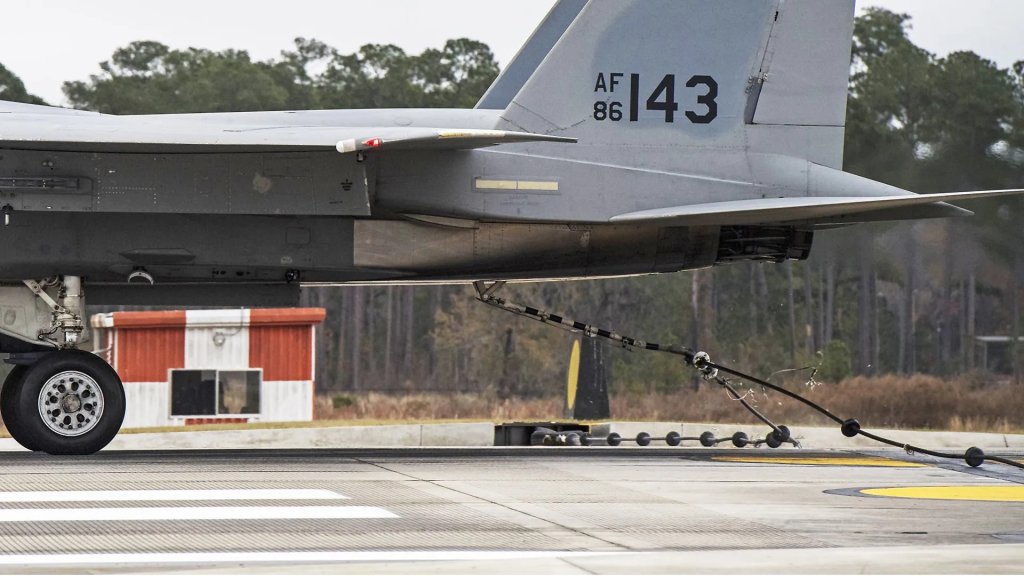
On the F-117, the solution to this was to fully encase the emergency tailhook inside a compartment behind a fixed, flush-mounted panel. When the decision is made to deploy the hook, the aforementioned explosive charges send that panel flying, and then it drops down. After deployment, the system has to be reset on the ground.
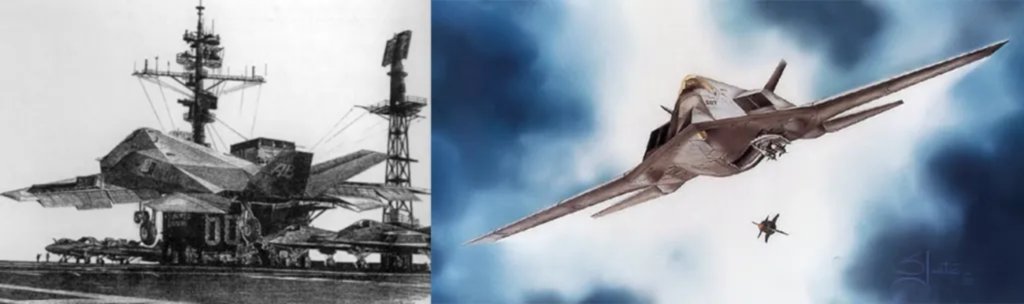
An actual carrier-based derivative of the Nighthawk, referred to variously as the F-117N/X and the Seahawk, was proposed to the U.S. Navy in the 1980s. The Navy did not ultimately pursue this aircraft, which would have featured a more robust tailhook among a host of other major changes compared to the original F-117.
There are many more fascinating and sometimes obscure aspects of the F-117’s design. This includes accommodation for radar locator antennas that were also designed to flip down only when in use to help preserve the jet’s low-observable (stealthy) characteristics. As the first-ever operational stealth combat jet, the Nighthawk played an extremely important role in laying out basic parameters for what the design of any such aircraft would entail, inside and out.
Today, the Air Force’s F-22 Raptors and F-35A Joint Strike Fighters also have emergency tailhooks tucked away inside compartments with flush coverings to avoid disrupting their stealthy moldlines. It is not immediately clear whether CAD/PADs are part of the tailhook systems on either of those aircraft. As an aside, the carrier-based F-35C variant of the Joint Strike Fighter has a completely different and more robust tailhook system designed for routine use.
As noted, the Air Force continues to operate the F-117 despite the type’s official retirement, now nearly two decades ago. While the Nighthawk’s design is dated, the jets have distinct radar, infrared, and other signature profiles that continue to offer benefits for various testing and training purposes. Since 2008, the aircraft are known to have been used as ‘red air’ aggressors and as surrogates for stealthy cruise missiles during large-scale exercises. In many of these contexts, the F-117’s signatures are likely to be extremely dissimilar to what pilots and air defense system operators are used to encountering. As a test platform, the Nighthawk also offers something of a control variable, as its baseline signatures are extremely well studied.
Keeping a pocket fleet of F-117s operational has had other knock-on effects, too. This includes the certification of the KC-46 Pegasus tanker to refuel the Nighthawks in flight. The first KC-46 was delivered to the Air Force in 2019, more than a decade after the F-117 left frontline service.
Altogether, the CAD/PAD contracting notice offers a little insight into what must be a fascinating boutique maintenance shop that keeps the remaining F-117s, and their subsystems and stealthy skins, in an operational status.
With the F-117 now set to remain in this more limited service for nearly another decade, at least, the Nighthawk’s story is still far from over. The Air Force will continue to need to sustain the remaining pocket fleet of jets during that time, including with orders for new explosive charges to make sure their emergency tailhook systems remain reliable and safe.
Contact the author: joe@twz.com
The post F-117 Nighthawk Needs Fresh Explosives For Its Tailhook Nearly Two Decades After ‘Retirement’ appeared first on TWZ.