
An SBD Dauntless dive bomber flies over Roudnice Nad Labem, Czech Republic, during an airshow in June 2020. The Dauntless’ finest hour came during the Battle of Midway, when it helped to sink four Japanese aircraft carriers. (Shutterstock/chorche de prigo)
A Dauntless Dive Bomber Survived Pearl Harbor—and Got Its Revenge at Midway
The BuNo 2106 aircraft had a remarkable life: it survived Pearl Harbor and fought at Midway, was later lost in an accident in the Great Lakes, and was eventually resurrected.
With a top speed of just 250 miles per hour, the Douglas SBD Dauntless certainly wasn’t the fastest aircraft of World War II. Yet despite its modest performance envelope, the Dauntless became one of the most successful naval attack aircraft ever built—sinking hundreds of Japanese ships throughout the course of the Pacific War.
But the Dauntless’ finest hour came during the Battle of Midway in June 1942, when it helped to sink all four Japanese fleet carriers, fundamentally changing the course of the war in the Allies’ favor. Remarkably, one of the Dauntless bombers involved in the battle had been stationed at the US naval airbase at Pearl Harbor on December 7, 1941. That aircraft—designated BuNo 2106—escaped destruction at the time, but had been powerless to fight back against the Japanese planes ravaging the US battleship fleet. Six months later, the tables were turned.
Introducing the SBD Dauntless
- Year Introduced: 1940 (SBD-1)
- Number Built: 5,936
- Length: 33 ft 1 in (10.1 m)
- Wingspan: 41 ft 6 in (12.6 m)
- Weight (MTOW): 10,700 lb (4,853 kg)
- Engine: One Wright R-1820 Cyclone radial piston engine
- Top Speed: 255 mph (410 km/h)
- Range: 1,115 mi (1,794 km) ferry range
- Service Ceiling: 25,530 ft (7,780 m)
- Loadout: Two forward-firing .50 cal machine guns; two rear .30 cal machine guns; up to 2,250 lb (1,020 kg) of bombs
- Aircrew: 2
The SBD Dauntless was a carrier-based dive bomber developed by US aircraft manufacturer Douglas. Making its maiden flight on May 1, 1940, nearly 5,000 of the planes were built during World War II, serving with both the Navy and the Marine Corps. Designed primarily for precision dive bombing against ships, troop concentrations, and ground targets, the Dauntless served throughout the entire Pacific War, although it was eventually replaced aboard carriers by the more advanced SB2C Helldiver.
How a Dive Bomber Works
A dive bomber’s function is straightforward. The aircraft flies to a high altitude, finds a target, and dives downward at a steep angle, picking up speed. Near to the ground, the aircraft releases its bombs, then activates airbrakes on its wings, dramatically slowing down, and pulls up. Dive bombers enjoyed far greater accuracy than heavy bombers dropping larger quantities of bombs from high altitudes, making them useful against individual targets such as enemy ground positions or ships.
The downside, of course, was that dive bombers were far more exposed to enemy ground fire than aircraft that stayed at a safer altitude. Indeed, dive bombers rapidly became obsolete after the war, with the rise of longer-range precision munitions and improved anti-aircraft ground weapons. But in the early 1940s, they were used by all sides to terrifying effect. Even before the Pacific War began, Nazi dive bombers had brought devastation to Europe—most notably the infamous Ju 87 Stuka, which became notorious for its ear-piercing siren during bombing runs. The United States had studied the war in Europe, and understood how effective the dive bomber could be. So had Japan, which used Aichi D3A “Val” dive bombers against the US battleship fleet at Pearl Harbor.
The Dauntless was one of the finest dive bombers in the world. With a rugged airframe, excellent handling, and a reliable Wright R-1820 radial engine, the Dauntless was built for its mission. Although it lacked speed or heavy armor, the Dauntless made up for it with a massive payload capacity, around twice as heavy as the Stuka’s and three times heavier than the Val’s. A rear gunner also provided limited defense against enemy fighters.
How the Dauntless Took On Japan at Midway
The aircraft’s greatest test would come in June 1942.
Six months into the Pacific War, Japanese admiral Isoroku Yamamoto, the mastermind of Pearl Harbor, had sought to draw the United States into a pitched battle—intended to sink the carrier fleet that his forces had narrowly missed in Hawaii. Yamamoto selected Midway Atoll as his target, and attempted to bait the carrier force into a trap. Unbeknownst to him, the US Navy had already broken Japan’s naval codes, and some of Yamamoto’s strategic choices—namely to disperse his fleet to make it appear weaker, at the cost of making each unit more difficult to protect—backfired after US codebreakers learned about them.
The two sides’ carriers met near Midway starting on June 3, 1942. Over the next five days, the US and Japanese carriers traded blows via aircraft; at no point were any of the aircraft carriers within sight of each other. By the end of the battle on June 7—six months to the day after Pearl Harbor, fulfilling Yamamoto’s prophetic claim that his ships could “run wild” in the Pacific for six months but no longer—the US carriers’ Dauntless squadrons had attacked and sank the Japanese carriers Akagi, Kaga, Soryu, and Hiryu, alongside a handful of smaller Japanese vessels. Perhaps just as importantly, Japan lost hundreds of experienced aviators during the battle, which it proved unable to replace. The battle shocked Japan’s leaders and turned the tide of World War II against Japan for good.
BuNo 2106: The Most Famous Dauntless Ever?
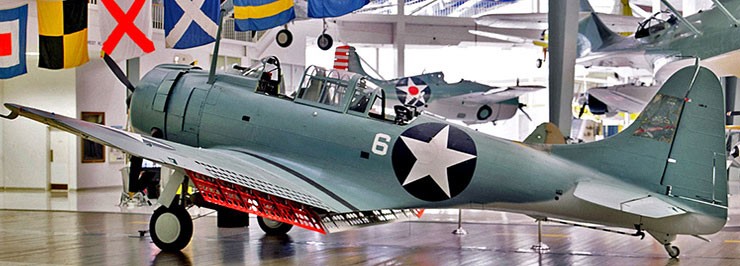
Arguably the most famous Dauntless of all time was the airframe given the designation “Bureau No. 2106,” or BuNo 2106. Manufactured at Douglas’ El Segundo plant in December 1940 and assigned to the USS Lexington before Pearl Harbor, BuNo 2106 remained ashore when the Japanese attacked on December 7, avoiding destruction with the carrier air group. Later, the aircraft flew a combat mission during the Japanese invasion of Salamaua and Lae in New Guinea in March 1942. On the eve of the Battle of Midway, it was transferred to a Marine squadron on Midway Atoll, where the aircraft flew combat missions against the Japanese during the critical battle, including a bombing run against the Japanese aircraft carrier Hiryu.
During the battle, enemy fire damaged BuNo 2106’s hydraulics and landing gear, but the plane still returned to the atoll safely, despite hydraulic damage and landing gear problems. It was returned to the United States, repaired, and reassigned as a training aircraft after the battle—but was accidentally ditched into Lake Michigan in June 1943 during carrier qualification trialing aboard the USS Sable. The pilot survived, but the aircraft sank.
Remarkably, over 50 years later, BuNo 2106 was recovered from the lake in 1994. It was extensively restored, with over 70,000 hours of labor from more than 100 volunteers, and returned to display in 2001. Visitors can now see the aircraft—one of the only surviving pieces of equipment from Midway—at the National Naval Aviation Museum in Pensacola, Florida.
About the Author: Harrison Kass
Harrison Kass is a writer and attorney focused on national security, technology, and political culture. His work has appeared in Tablet, City Journal, The Hill, The Spectator, and The Cipher Brief. He holds a JD from the University of Oregon and a master’s in Global & Joint Program Studies from NYU. More at harrisonkass.com.
The post A Dauntless Dive Bomber Survived Pearl Harbor—and Got Its Revenge at Midway appeared first on The National Interest.