As renewed fighting between the U.S. and Iran has entered a seventh day with no signs of letting up, the Pentagon appears to be sending more forces to the region. The move comes as the conflict took a sharp turn overnight, with both sides carrying through on threats to hit infrastructure targets. That marks a major change from the previous tit-for-tat barrages as the two sides continue to struggle for control over the Strait of Hormuz.
“The Trump administration notified Israel it is sending dozens more refueling planes to the country ahead of a potential expansion of military operations against Iran,” Axios reported, citing three U.S. and Israeli officials.
“Israeli officials say the U.S. wants to send several dozen more refueling planes in the coming days, bringing the number of planes to the same level it had at the beginning of the war,” Axios added. “Israeli officials say the U.S. military prefers operating the refueling planes from Ben Gurion Airport, because other air bases in the region are more exposed to Iranian attacks and less safe for U.S. planes. At the moment, the Iranians are still deterred from launching attacks on Israel, because it will likely trigger a massive retaliation.”
This move comes after Israel placed a limit of 20 on the number of tankers at Ben Gurion Airport due to the impact all those jets were having on passenger air service operations. There are currently about 30 KC-46 Pegasus and KC-135 Stratotanker aerial refueling jets at the airport. There had about 75 refuelers and cargo planes there during the height of Operation Epic Fury.
It remains unclear how that issue will be resolved, however, boosting the number of tankers in Israel will certainly give the U.S. greater flexibility in being able to refuel aircraft attacking and surveilling Iran. As we noted yesterday, there was a concern that moving aircraft around to other bases farther away could cause sortie rates and durations for receiver aircraft missions to suffer in a sudden crisis.
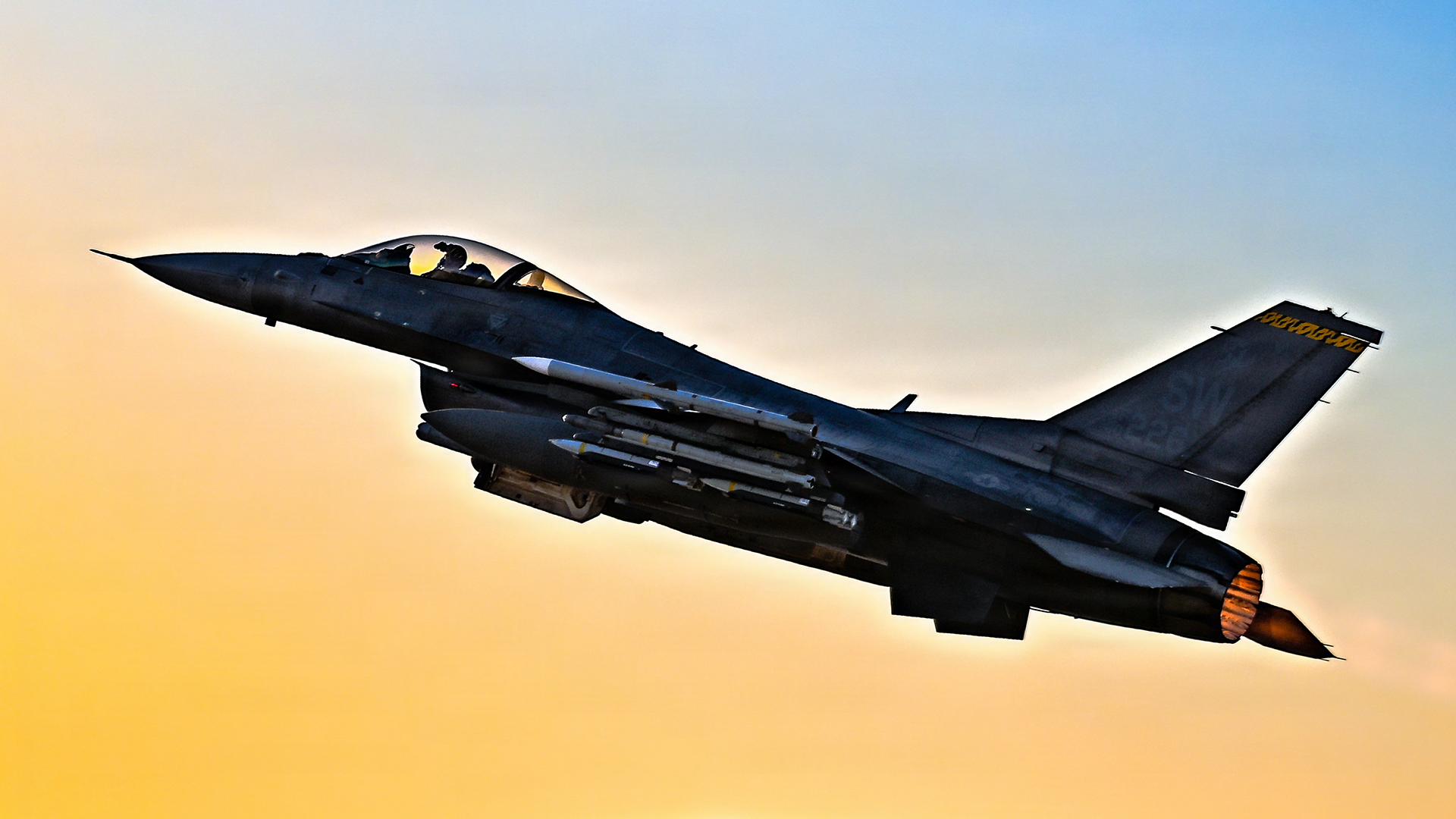
In addition, more combat jets appear to be headed back to the Middle East. According to online open-source flight trackers, at least 12 F-16 Fighting Falcons are heading to Muwaffaq Salti Air Base in Jordan from Spangdahlem Air Base in Germany. Whether this is a plus-up or a routine rotation is unclear, but either way it shows that the U.S. is continuing to add assets to the region.
Meanwhile, as we have noted in earlier reporting, the U.S. has already returned F-22 Raptors that were flying out of Ovda Air Base in Israel back to the United States. Other aircraft, such as A-10s and F-15Es, have also returned home from or have been replaced in the CENTCOM region. So clearly there is a lot of shifting of aviation assets taking place even amid current operations.
Video of Massive US airforce airlift activity above Europe today towards bases in the Middle East in particular the transfer of many fighter jets to Jordan and Israel.
— WarMonitor
Somethings up… pic.twitter.com/TDze87BpnY(@WarMonitor3) July 17, 2026


Friday afternoon, CENTCOM announced a new wave of strikes on Iran.
“CENTCOM launched a round of strikes against Iran at 3 p.m. ET today for the seventh consecutive night,” the command stated on X. “The strikes are designed to continue degrading Iranian military capabilities at the Commander in Chief’s direction.”
Last night, American forces struck several bridges and energy plants in the southern part of the country, according to Iranian media. In retaliation, Iran hit several targets across the region, including what Kuwait says is a desalination plant, another step up the escalation ladder. In this arid part of the world, countries rely heavily on desalination plants to provide potable water.
— Amichai Stein (@AmichaiStein1) July 17, 2026
US targets in Iran tonight:
• A total of 5-6 bridges in Hormozgan province were targeted:
• Chabahar maritime tower was targeted (again) and destroyed by the US
• A railway station, west of Bandar Abbas
• Civilian airport in Iranshahr, southeastern Iran pic.twitter.com/DT4f2uP9M7

Officials in Hormozgan province, where Bandar Abbas is the capital, say six bridges were hit in the latest attacks, along key transport routes linking the city with surrounding towns, Al Jazeera reported. Bandar Abbas, which has a key naval base on the Strait of Hormuz and is frequently targeted, was also reportedly struck again.
The attacks appear to be isolating Bandar Abbas and other parts of the south along the Strait, which has been a key flash-point. Iran claims control of the strategic chokepoint while the U.S. says it remains under international auspices.
Former CENTCOM commander Joseph Votel told us that while it “may be possible” that the U.S. is preparing for a ground invasion of southern Iran, “I don’t really think that is what this is about. I think our kinetic targeting is principally focused on elimination of IRGC capacity to influence the Strait of Hormuz or attack our partners in the region.”
Friday morning, U.S. Central Command (CENTCOM) declined to comment on the claims that it struck bridges, referring us to its X post from the previous night.
“U.S. forces, including fighter jets, aerial drones, and warships, launched precision munitions that hit dozens of Iranian military targets such as coastal surveillance and air defense sites, military logistics infrastructure, and maritime capabilities,” the command wrote. “This was the sixth consecutive night of U.S. strikes against Iran. At the Commander in Chief’s direction, CENTCOM is further degrading Iranian military capabilities and holding Iran accountable for recent attacks on commercial shipping.”
Several videos emerged on social media showing the destroyed and damaged bridges.
— Raylan Givens (@JewishWarrior13) July 17, 2026
WATCH: A long line of tankers near a bridge that the US struck in Iran https://t.co/qzJAzSV0Zj pic.twitter.com/ZnddfKI51U
CENTCOM on Friday did acknowledge destroying the Chah Bahar Shahid Kalantari Port surveillance tower.
It was “part of a maritime surveillance network along Iran’s Gulf of Oman coastline used for decades by the Islamic Revolutionary Guard Corps (IRGC) to track and target commercial vessels transiting the Strait of Hormuz,” the command stated on X. “The destruction of the tower directly degrades IRGC’s ability to coordinate attacks on innocent civilian crew members. Furthermore, the strike protects freedom of navigation in regional waters for all vessels, except for ships attempting to violate the ongoing U.S. naval blockade against Iran.”
Meanwhile, as we noted earlier in this story, officials in Kuwait said one of the country’s power and water desalination plants “was attacked as a result of the Iranian aggression…leading to a fire and damage to the plant’s facilities and several electricity generating units.”
“The fire is now under control and repairs are ongoing,” the Kuwait government added.
Officials in Bahrain said its air defenses intercepted and destroyed several Iranian aerial attacks on Friday.
“The General Command of the Bahrain Defense Force announces that Iran is continuing its systematic, hostile approach through its attacks,” the Bahrain Defense Force stated on Instagram. “The General Command clarifies that, with strong will and high combat readiness, the air defense systems with Bahrain’s defense force, intercepted and destroyed a number of treacherous Iranian air strikes today, Friday, July 17, 2026. The General Command assures that all its weapons and units are at the highest readiness and on defensive readiness to protect the kingdom.”
— Al Arabiya English (@AlArabiya_Eng) July 17, 2026
Bahrain’s air defenses intercepted and destroyed several Iranian aerial threats on Friday
There were also claims from Iran that it again struck Al Udeid Air Base in Qatar, the largest U.S. installation in the region. The IRGC Aerospace Force claimed it destroyed several aerial refueling jets as well as radars, however, it provided no visual evidence. When we asked about the claim, CENTCOM declined comment.
— Press TV
(@PressTV) July 17, 2026
Satellite imagery emerged on social media purporting to show the destruction of two hardened storage facilities and a warehouse at the Zayed Military City in Abu Dhabi. The scale of the damage appears to show what could be the results of an Iranian missile or drone strike.
UAE authorities, however, chalked it up to a mishap.
On Monday, UAE authorities claimed “firefighting teams of the UAE armed forces dealt with a fire which broke out in one of the warehouses of the Zayed Military City,” according to Khaleej Times. “The fire was caused by the burning of some wood and old ammunition, the country’s Ministry of Defense reported.”
— Egypt's Intel Observer (@EGYOSINT) July 17, 2026
Sentinel-2L imagery and enhanced satellite imagery from @SoarAtlas show that two hardened storage facilities and a warehouse at 24°29'44.87"N 54°58'57.10"E inside Zayed Military City in Abu Dhabi were completely destroyed.
The scale of the damage points to an Iranian missile… pic.twitter.com/NJEAv1hBA4
Iran struck eastern Syria on Friday, Iranian state media and a Syrian military source said, Reuters reported. It was the first known attack by Tehran on Syrian territory since a regional war erupted earlier this year.
The IRGC said it attacked a U.S. special operations command center at al-Tanf in Syria in retaliation for the killing of Iranian soldiers in Iranshahr, state media reported.
However, the U.S. in February, CENTCOM said it had withdrawn from the facility at the border of Syria, Jordan and Iraq.
CENTCOM declined to comment when we asked about it, but minutes later posted a denial on X of any American casualties.
“CLAIM: Iranian forces claim they attacked al-Tanf Garrison in Syria and captured or killed American troops in the process. FALSE,” the command stated. “FACTS: No U.S. troops in the region have recently been killed or captured.”
— U.S. Central Command (@CENTCOM) July 17, 2026
CLAIM: Iranian forces claim they attacked al-Tanf Garrison in Syria and captured or killed American troops in the process. FALSE.
FACTS: No U.S. troops in the region have recently been killed or captured. pic.twitter.com/gIBgq1HYnK
CENTCOM declined to say if any U.S. troops had been killed or injured in any overnight attacks. According to the Pentagon’s casualty website, there have been 14 troops killed and 427 wounded since the launch of Epic Fury Feb. 28, but no recent deaths.
Six troops were killed in a drone strike on a base in Kuwait in March and six aircrew were killed when their KC-135 aerial refueling tanker reportedly collided with another over Iraq about 10 days later.
The latest round of strikes came after President Donald Trump promised to strike infrastructure and the Iranians promised to retaliate.
“We’re going to hit them very hard tomorrow night,” Trump proclaimed in an interview with Fox News on July 15. “We’re going to hit them very hard the night after, and then next week it gets really bad for them, because next week comes the power plants. Next week comes the bridges. We’re going to knock out all their power plants. We’re going to knock out all their bridges unless they get to the table and negotiate.”
Last night, Trump claimed “…we are winning big in Iran and you will see the fruits of that labor very, very shortly.”
Trump: "We are winning big in Iran"
— Aaron Rupar (@atrupar) July 17, 2026pic.twitter.com/adHnYHGmO0
Amid the renewed fighting, the number of transits in the Strait of Hormuz reached a three-week low, according to a MarineTraffic.com post on X, falling to eight yesterday, down from 15 the day before.
Meanwhile, the per barrel price of Brent crude hit a new high for the past 30 days on Friday, reaching almost $87.
Meanwhile, a new threat to oil exports from the region is looming. Iran has asked the Houthi rebels of Yemen, one of its main proxies, “to stand ready to close the Red Sea oil route if the United States strikes Iranian power infrastructure,” Reuters reported, citing three sources. “The idea has been discussed within the Islamic Republic’s leadership, and the message has been conveyed to Iran’s Houthi allies.”
As we have previously explained, a Houthi shut down of the Bab el-Mandeb (BAM) strait, a narrow stretch of water between Yemen and Djibouti, would choke off a flow of oil exports from Saudi Arabia, especially to the east, and from southern Gulf states west, exacerbating the above-mentioned spike in oil prices. Having both straits closed at once is something of a ‘sum of all fears’ scenario for the global energy marketplace.
— Reuters (@Reuters) July 17, 2026
Iran asked the Houthis to stand ready to close the Red Sea gateway. ‘That has the potential to severely exacerbate what is already the worst energy supply disruption in history.’ Commodities and energy editor Simon Webb on Reuters World News https://t.co/cuyI7h2PSe pic.twitter.com/k6TYgVoHOJ
It is unknown whether the U.S. and Iran will return to the bargaining table as both nations careen to a resumption of all-out war. We will continue to monitor this situation and provide updates when warranted.
Contact the author: howard@twz.com
The post U.S.-Iran Fight Heats Up With Mutual Strikes On Infrastructure Targets appeared first on TWZ.