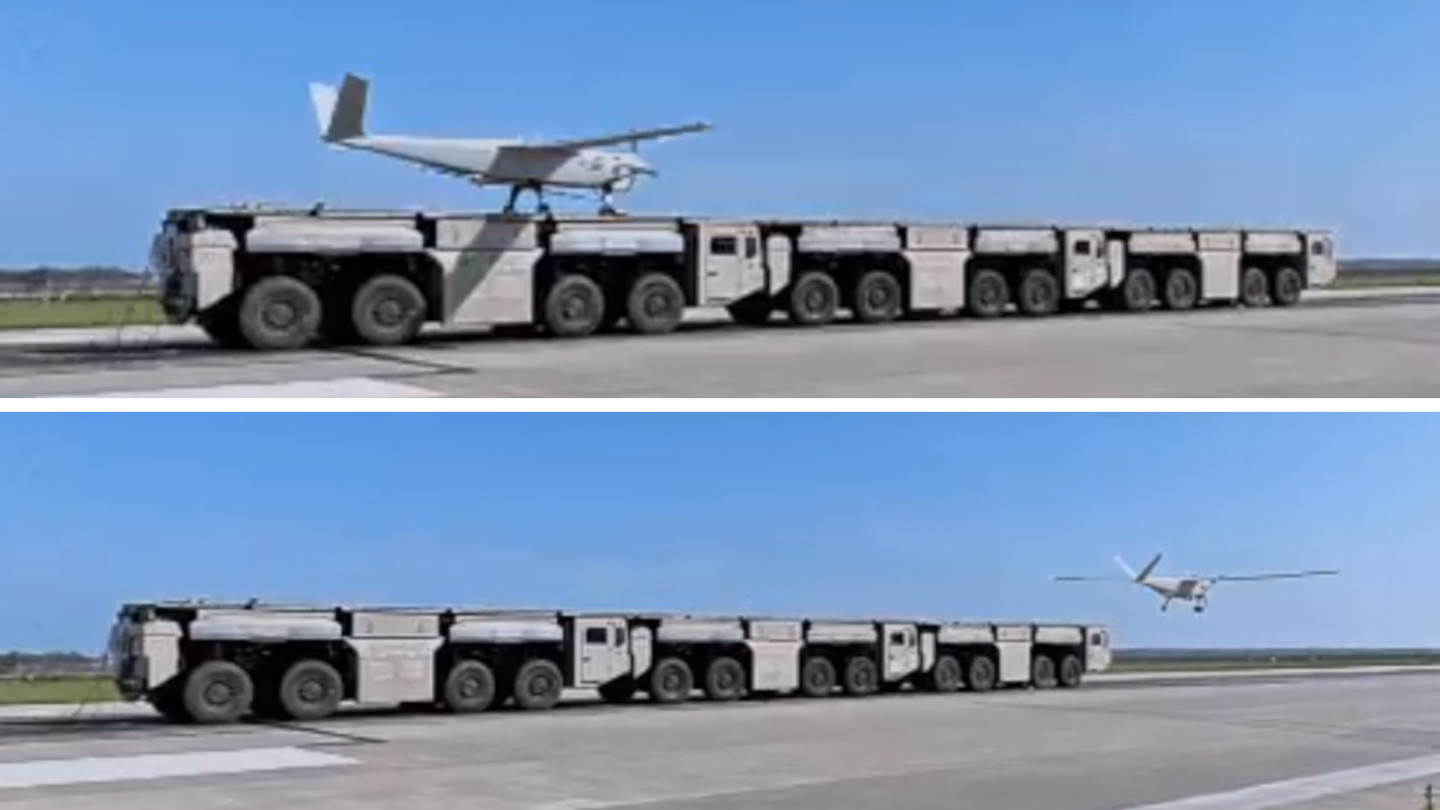
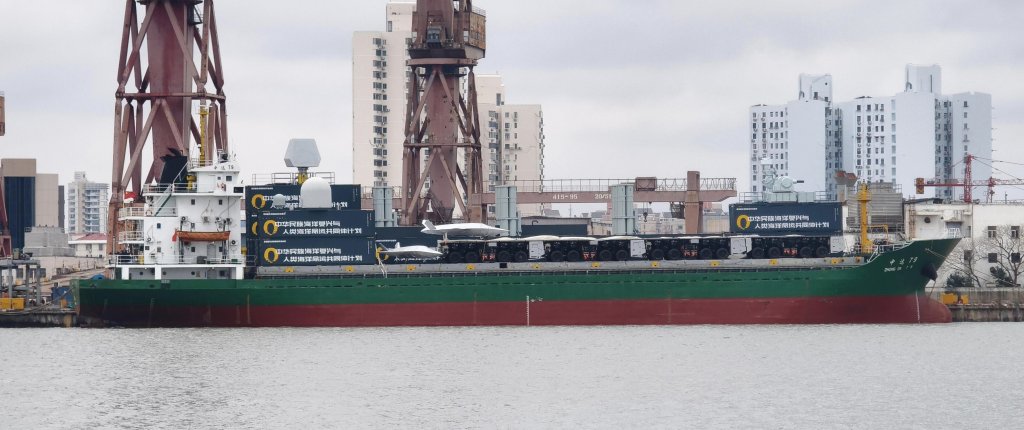
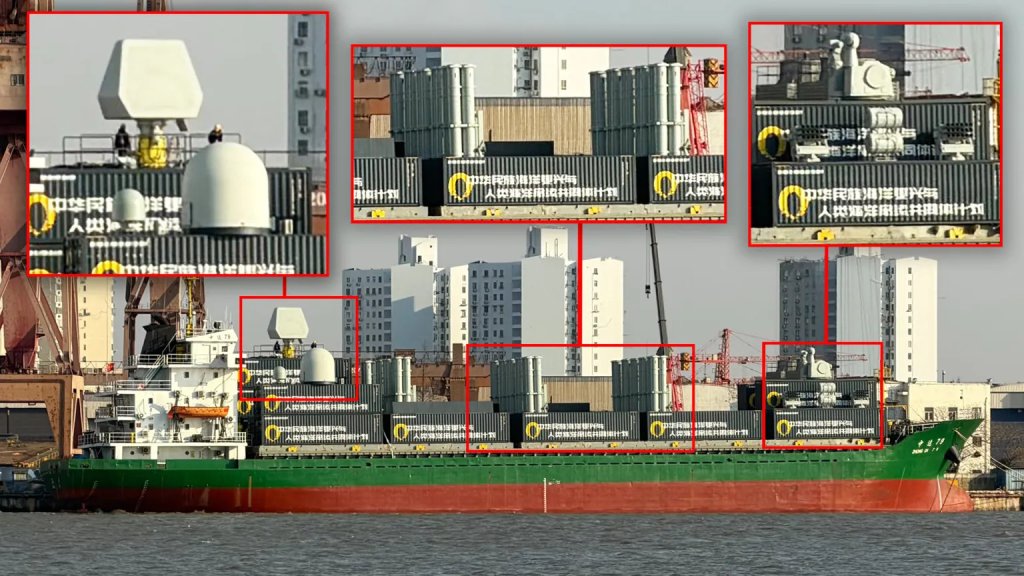
We now have our first look at a Chinese modular, road-mobile, electromagnetic aircraft launch system (EMALS) catapult actually launching a drone. The system, which consists of multiple specially-designed trucks linked together, first emerged right at the end of last year and was soon loaded onto the deck of a cargo ship. The same vessel, named Zhong Da 79, was used to showcase a new family of containerized weapons, sensors, and other systems, images of which went viral in a big way online. It has now also been confirmed that the truck-mounted EMALS catapult is part of that family.
Video of the truck-mounted EMALS catapult in use first began circulating widely on social media earlier today, but exactly where or when it was shot is unclear. The footage looks to have originally accompanied a Chinese-language social media post from the Beijing Institute of Technology’s School of Mechanical Engineering. Screenshots said to be of the post show it was primarily on news about the development of the full family of containerized weapons and other systems, which we will come back to later on.
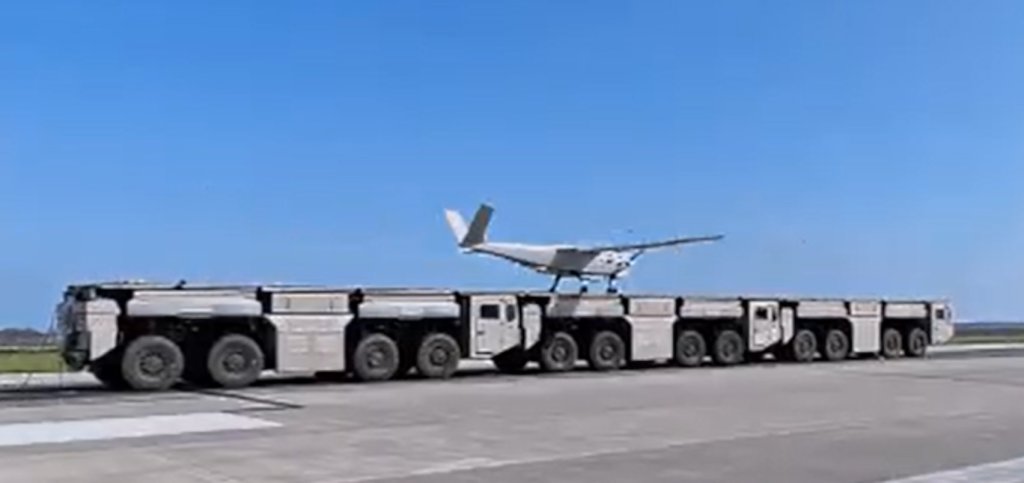
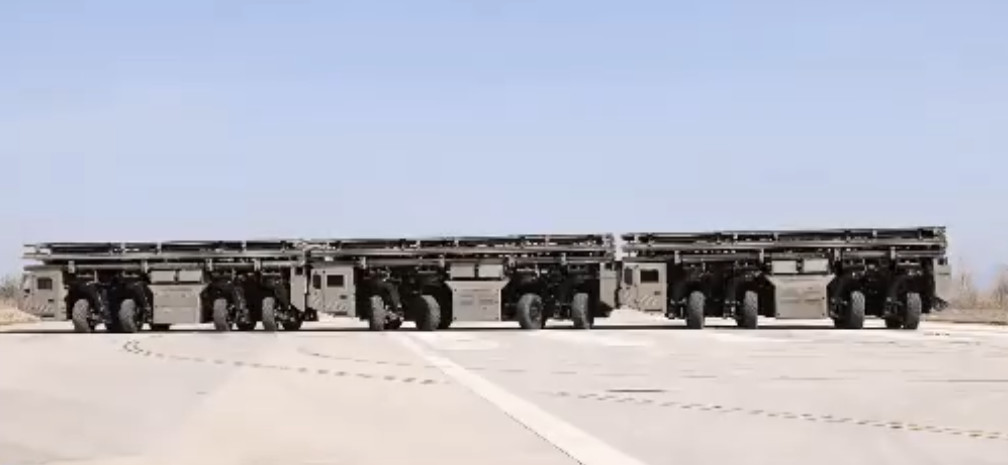
The video, seen in full in the social media post below, starts by showing a propeller-driven drone being launched from a mobile EMALS catapult made up of three trucks. The drone in question has a high-wing monoplane planform with a v-tail and tricycle landing gear. When the system first appeared publicly last year, it was shown in a four-truck configuration, and paired with stealthy collaborative combat aircraft (CCA)-like drones, or what were more likely mockups thereof.
The footage continues on, showing three EMALS catapult trucks traveling in a group, unlinked, in a convoy, before joining together. The convoy clip notably shows what look to be covers on top of the trucks that do not appear to have been previously seen. There are what appear to be hinges or at least large straps on the side to hold them in place.
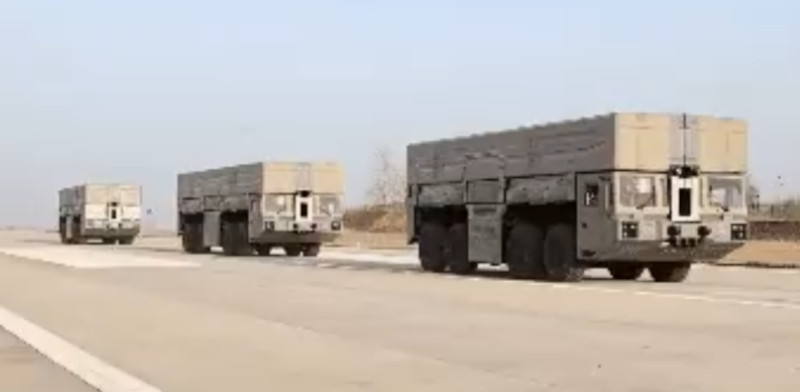
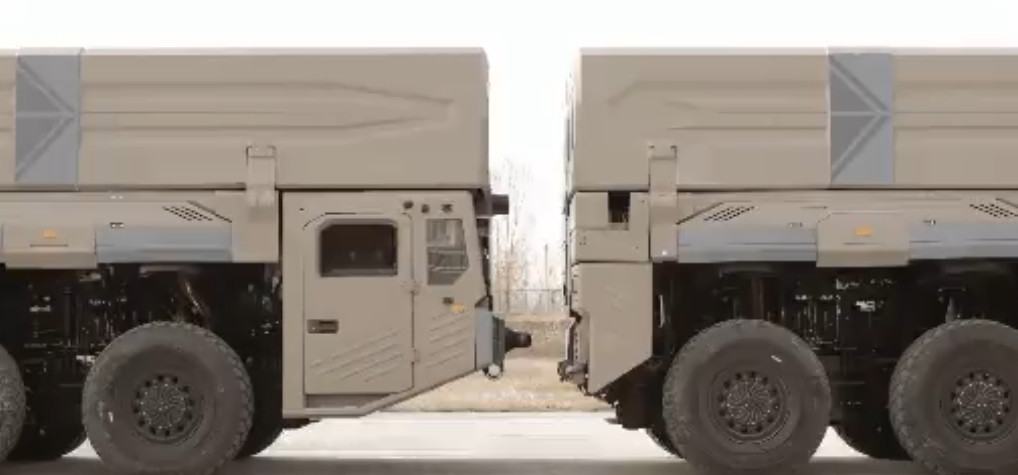
Covers would help protect the system from the elements during transit. It might also help mask its true purpose, though the trucks have other very distinct features, including a very prominent locking point at the front. The possibility that the covers hinge to either side also raises the question of whether the system could be configured to fold out to create a wider runway, though there is no evidence of this so far.
The video also reveals that the trucks have an extreme all-wheel steering capability that allows them to turn in a roughly flat circle, even when joined together. This would allow for the launching of aircraft in any direction as long as their sufficent space to turn the complete system. This would be key for pointing aircraft into the wind ahead of launches, especially in confined spaces with limited room to maneuver. This is an essential capability for enabling this concept overall. It would be extremely hard, if not impossible, to do this with normal steering, especially to account for any major shift in the wind’s direction.
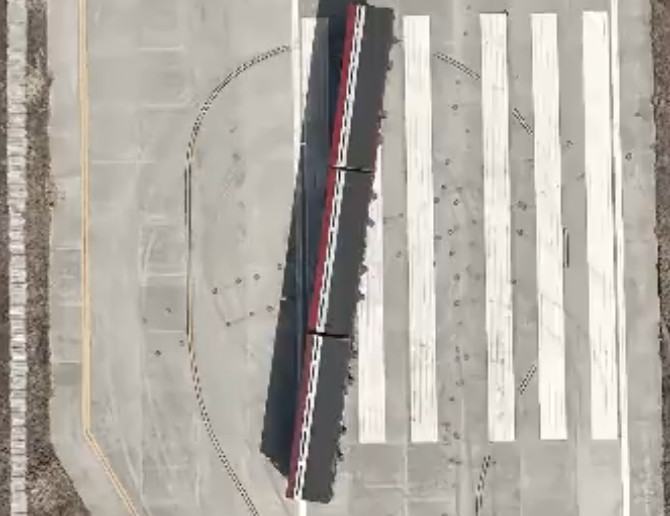
The footage caps off with another clip of the drone being launched and then one of Zhong Da 79 as it was seen earlier this year with the various containerized systems, at least some of which turned out to be mockups, onboard.
As seen earlier in this story, the video is circulating along with a graphic showing the full family of containerized weapons and other capabilities. This includes versions armed with launchers for land-attack and anti-ship cruise missiles, as well as surface-to-air missiles. There are also ones that contain either a single Type 1130 30mm close-in-weapon system (CIWS) or two Type 726 close-in defensive launchers. There are also containerized radars, electronic warfare systems, and command and control suites. The graphic also notably shows a container loaded with a single EMALS catapult truck and another with a disassembled drone inside that looks very much like the one seen being launched in the opening clip.
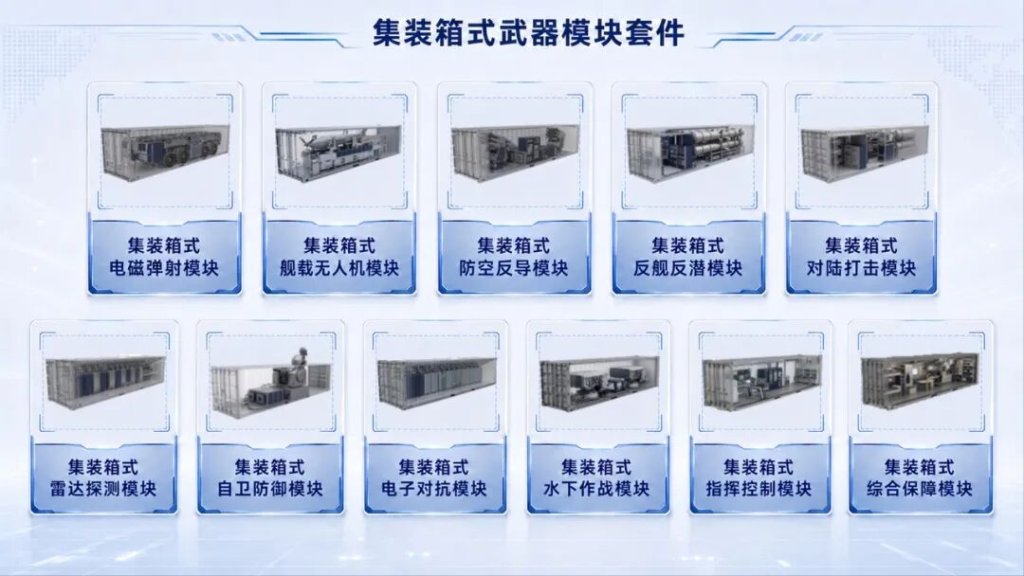

Annual production of 2,000 of these containerized systems, collectively, is now being targeted, according to a machine translation of the apparent social media post from the Beijing Institute of Technology’s School of Mechanical Engineering that is the original source of the video.
The social media post from Beijing Institute of Technology’s School of Mechanical Engineering also says 70 other entities were also involved in the development of the various systems showcased on the Zhong Da 79. The China State Shipbuilding Corporation (CSSC), China North Industries Group Corporation (NORINCO), China Aerospace Science and Industry Corporation (CASIC), China Aerospace Science and Technology Corporation (CASC), China Electronics Technology Group Corporation (CETC), and the Aviation Industry Corporation of China (AVIC) are explicitly named.
Not on this list of named organizations is Tiantao Technology, a company that has been publicly discussing plans for a ground-based electromagnetic catapult system made up of modular wheeled segments since at least August 2025. As TWZ previously noted, Tiantao Technology’s renderings have shown a system that is visually different from the one now tied to the Beijing Institute of Technology’s School of Mechanical Engineering. However, its expected capabilities are in line with what have now seen in the video, especially the ability to drones weighing up to around 2.2 tons (two metric tons). The drone seen being launched is notably smaller and lighter than the CCA-type designs previously displayed with the system.

As TWZ wrote in our initial reporting on the truck-mounted EMALS catapult after it emerged last year:
“This [2.2 tons] is lighter than the expected takeoff weights of ‘loyal wingman’ type drones China has shown to date, based on the known specifications of comparably-sized Western designs. For example, the stated maximum launch weight of the XQ-58 is three tons, according to Kratos. As another point of comparison, the Chinese GJ-11, a larger flying-wing uncrewed combat air vehicle (UCAV), a catapult-capable version of which is now in development, reportedly has a payload capacity of around two tons. China’s J-15 family of crewed carrier-based fighters, derived from the Su-33 Flanker, each weighs around 19 tons (17.5 metric tons) empty without any fuel or ordnance, as well.”
“It is possible that the modular design of Tiantao Technology’s ground-based catapult system could allow for configurations capable of launching heavier designs. A core benefit of electromagnetic catapults over steam-powered ones, in general, is their ability to be more fine-tuned in terms of the forces they exert on any aircraft during launch. The capabilities of a modular system would also be dependent on its exact configuration, including how long the catapult track is overall. Tiantao Technology has said the total length of its system could be scaled between roughly 65 and 196 feet (20 and 60 meters). What limitations there might be on simply adding more segments to increase launch capacity are unknown.”
“Tiantao Technology has also shown models and renderings of truck and trailer-mounted electromagnetic catapults for launching even smaller drones. How much progress it has made in the actual development of any of the systems to date is unclear.”
As we noted at that time, other companies in China could very well have been working along similar lines. There’s also the distinct possibility that Tiantao Technology is among the dozens of unnamed partners that are said to have been working with Beijing Institute of Technology’s School of Mechanical Engineering on this project.

There is still an outstanding question about how drones are loaded onto the truck-mounted EMALS catapult to begin with, which would impact the launch tempo. TWZ has noted previously that a cycle could be established using trucks carrying drones that would drive up, one at a time, locking into the rear of an existing track, and then detaching after launch.
What kind of power and logistical footprint is required to support the mobile EMALS catapult, either on land or at sea, is also unknown. The system is not intended to support a traditional carrier air wing, and would therefore inherently have lower capability demands. It’s worth pointing out here that questions about power demands and logistical requirements would also apply to other parts of the family of containerized systems that are now in development, as well.
What limitations might exist when it comes to employing the catapult system from the deck of a ship that was not designed to have this capability from the start is another open question. Whether the truck-mounted arrangement would be stable enough for launches with the ship rocking back and forth at sea is unclear.
Overall, much more is still to be learned about the modular EMALS catapult and its capabilities. At the same time, what we’ve learned now underscores points that TWZ has made in the past about the new operational possibilities this system could enable, both in shipboard and ground-based modes. It is tailor-made for expeditionary scenarios or other situations in which traditional runways may not be available. As a mobile system that can be moved on the ground or embarked on ships, it would allow for at least a certain tier of airpower to be more readily positioned closer to operating areas.
The system’s mobility and ability to stay in relatively close proximity to the forces it is supporting would make this a very responsive capability, even as the overall operational picture and battlespace demands evolve. The less time any aircraft has to spend in transit means more on-station endurance, which could be especially valuable when employing smaller, shorter-range drones. The choice of an electromagnetic catapult system versus a steam-powered one also means shorter reset times between launches and, by extension, increased sortie generation rates.
Since it is made up of multiple modular truck-mounted segments, it would be easier for the system to disperse when not in use, creating targeting challenges for opponents and helping to increase survivability. Being able to store components of the catapult system, as well as drones to launch from it, concealed inside unassuming shipping containers would create further benefits in this regard.
All of this is relevant for a Chinese People’s Liberation Army (PLA) that has significant standing requirements to be able to provide airpower and other support during island-hopping campaigns against various potential opponents in the Pacific, where established runways may be few and far between. Another key focus area for the PLA is supporting operations in highly remote and high-altitude areas along its disputed western border with India, where runway access is also often constrained. The truck-mounted catapult could also be combined with the elements of the full family of containerized systems to help establish more robust and defensible operating locations on land, as well as rapidly turn any ship with suitable deck space into a multi-purpose naval vessel.
As an aside, the fact that the new details about the truck-mounted EMALS catapult and the other containerized system have come via Beijing Institute of Technology underscores the strong ties that state-run research institutions in China often have to the country’s government-owned defense industry and to the People’s Liberation Army (PLA). This is something TWZ regularly calls attention to, especially in advanced aerospace development realms, where the academic side of the ecosystem has been shown to be very deeply involved.
With the release of the video showing actual testing of the mobile EMALS catapult, and other insights into the full family of containerized weapons and other systems, more details about these new capabilities may now start coming more rapidly.
Contact the author: joe@twz.com
The post China’s Truck-Mounted Electromagnetic Aircraft Catapult Seen In Action For The First Time appeared first on TWZ.