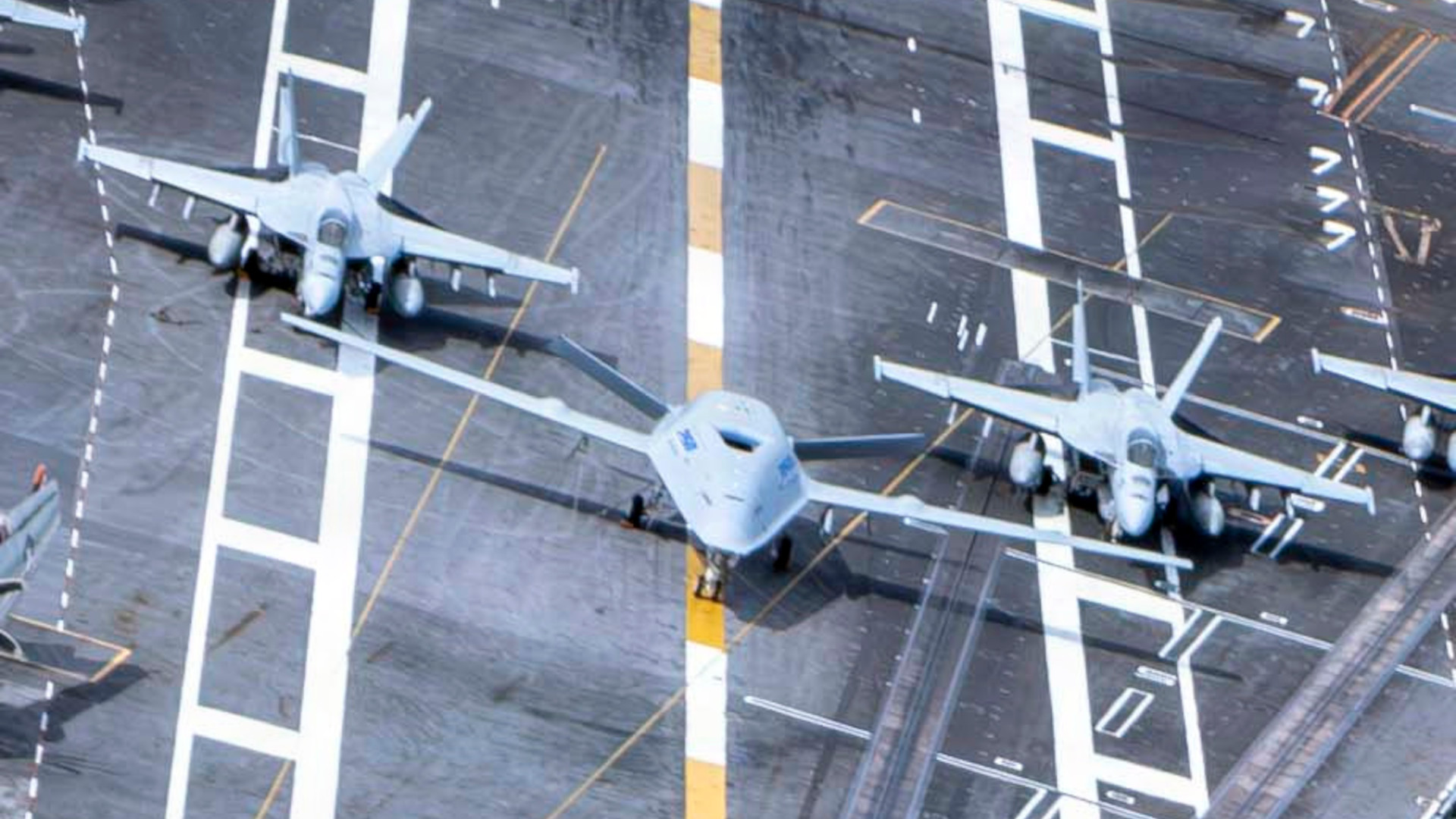
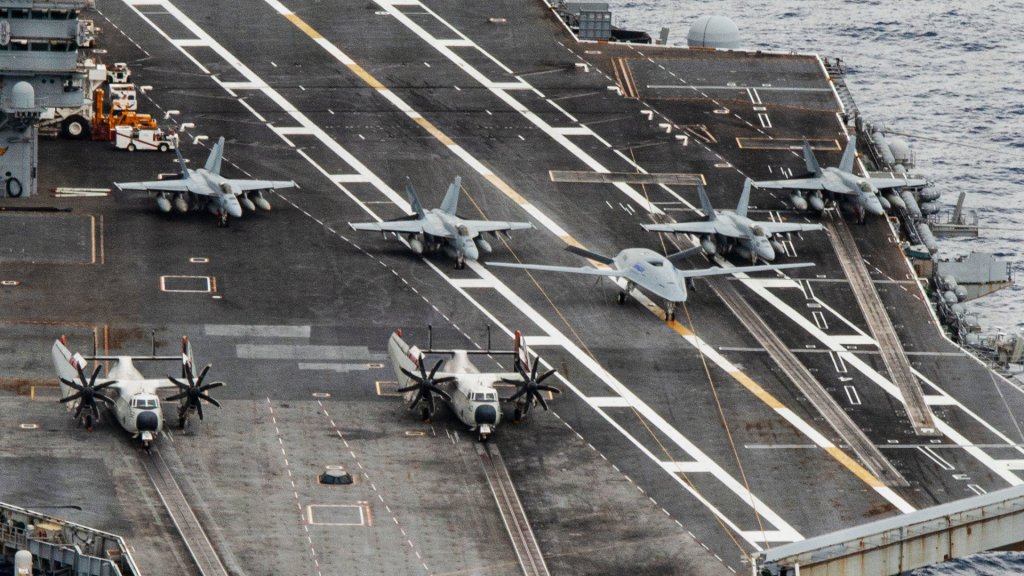
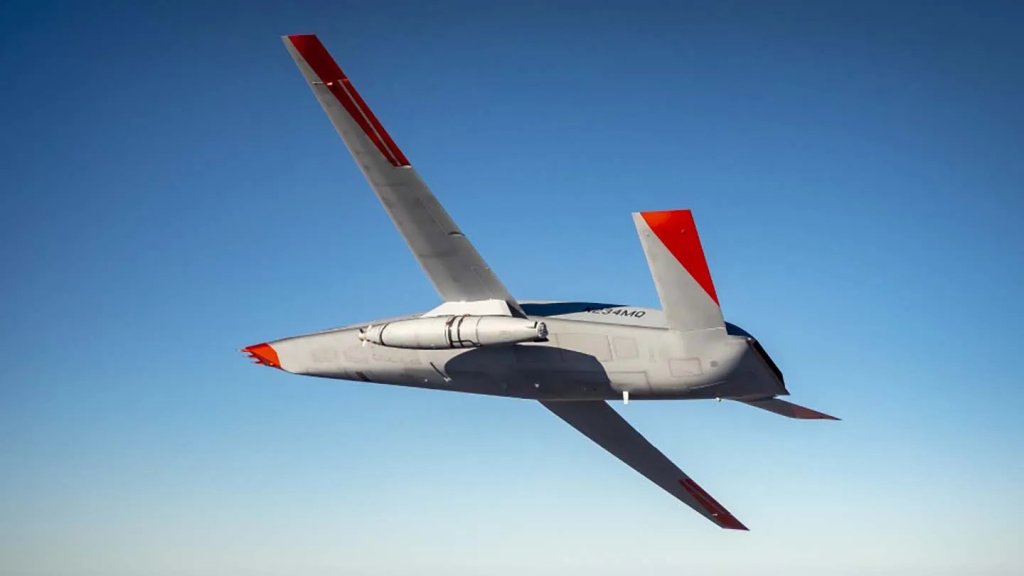
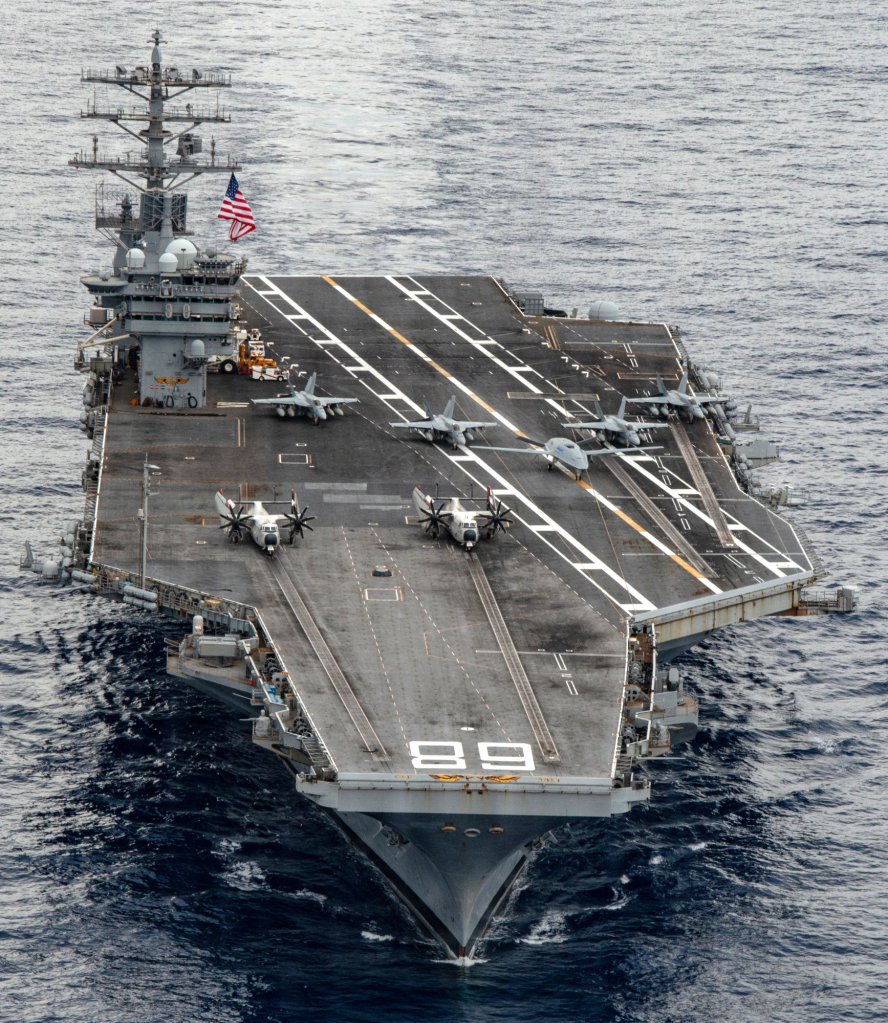
The U.S. Navy has confirmed to TWZ that the MQ-25 Stingray demonstrator drone, also known as T-1, is embarked on the supercarrier USS Nimitz. Pictures of Nimitz with the uncrewed aircraft on its deck had prompted questions about whether the initial production representative MQ-25, which made its maiden flight in April, had now gone aboard a carrier for the first time. We now know that is not the case. Regardless, the images of T-1 aboard Nimitz still underscore just how big the Navy’s first advanced carrier-based drone actually is, especially when placed next to other aircraft in the air wings. Production MQ-25s will be an important and imposing presence when they enter operational service, something the service hopes will finally start next year.
“We do indeed have a Boeing-owned T-1 prototype currently onboard,” a Navy spokesperson told TWZ today when asked about the drone seen on Nimitz‘s deck.
The spokesperson directed us to contact Naval Air Systems Command (NAVAIR) for more information about the current status of the MQ-25 program. T-1 has been flying since 2019 and has taken part in a slew of testing in support of the development of the Stingray in the air and on the ground. This also includes deck handling testing aboard the Nimitz class carrier USS George H.W. Bush in December 2021, something we will come back to later on. T-1 has never taken off from or landed aboard a Navy carrier, and would have had to have been carried aboard Nimitz.
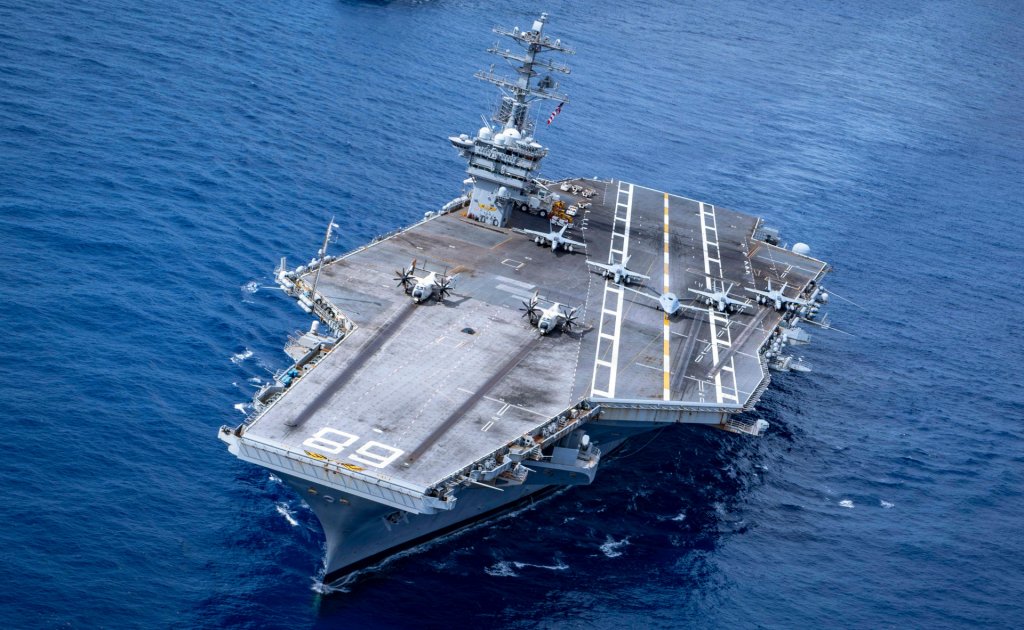
“To honor the United States’ 250th anniversary, the MQ-25A T1 prototype is aboard the USS Nimitz, offering a glimpse of the Navy’s carrier air wing of the future,” Boeing has now also written in a post on X. “The special ‘Boeing Backs America’ mark highlights our support for U.S. aviation.”
The USS Nimitz has been sailing in the Atlantic Ocean as part of Fleet Exercise 250 (FLEETEX 250). This is a large, multi-national event that is running concurrently with several celebrations marking the 250th anniversary of the United States. In addition to the United States, Belgium, Brazil, Canada, Cameroon, Côte d’Ivoire, Cyprus, Denmark, France, Germany, Mexico, Morocco, the Netherlands, Norway, Peru, Senegal, Spain, Turkey, and the United Kingdom are also taking part, according to the Navy. As part of FLEETEX 250 activities last week, Nimitz had taken the lead in a group sail photo exercise that included 25 other naval vessels from 13 of the participating countries.
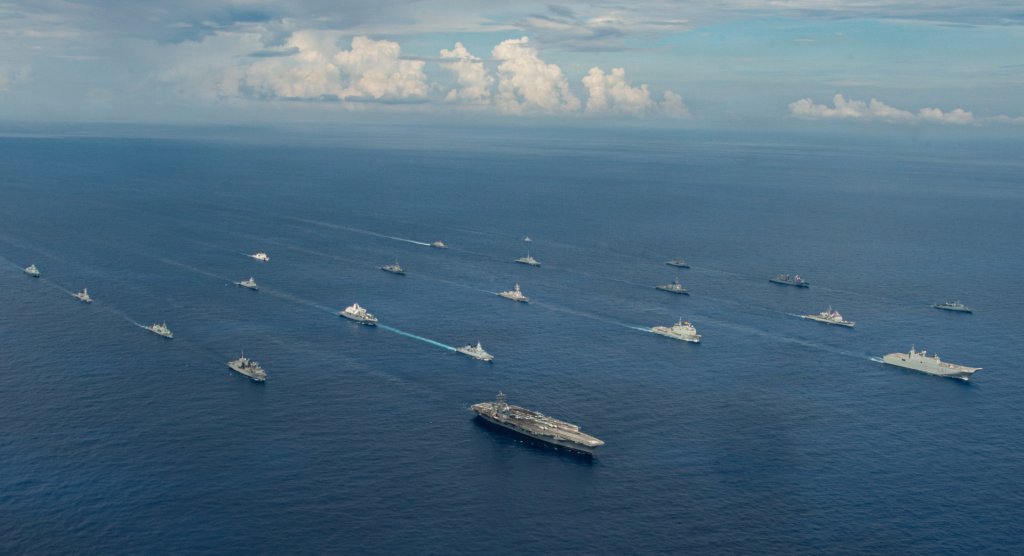
“USS Nimitz is underway taking part in Fleet Exercise (FLEETEX) 250 alongside 25 other warships, multi-national aircraft, and their crews, conducting a series of structured training events at-sea,” a Navy spokesperson had also told TWZ last week in response to queries about that ship after it was spotted leaving Mayport, Florida, on June 25. “Following FLEETEX, we are scheduled to take part in another major event celebrating our nation’s 250th birthday.”
The T-1 demonstrator was lashed to the carrier’s deck for the pictures, along with four F/A-18E Super Hornet fighters and two C-2A Greyhound carrier onboard delivery aircraft. The drone notably has new “250” markings written in blue on both sides of the fuselage.
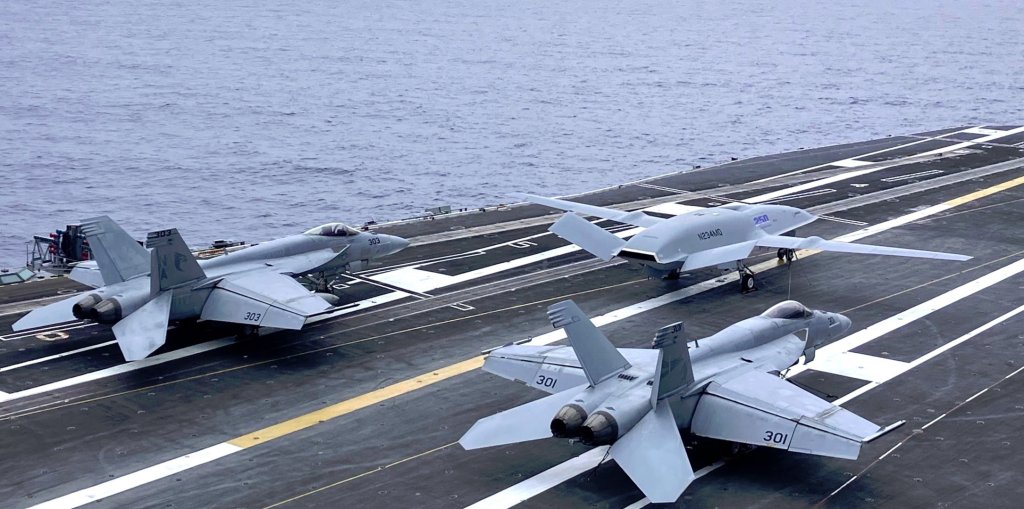
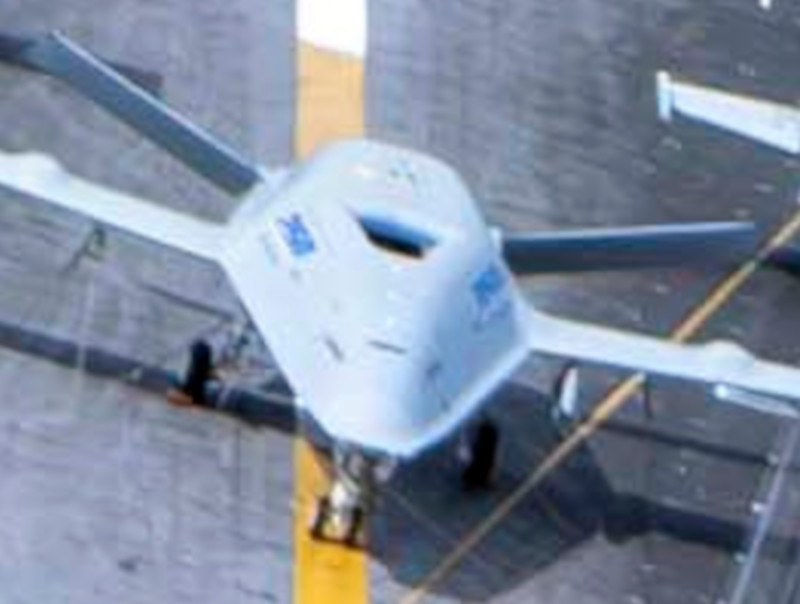
As noted, T-1’s size stands out when parked next to the F/A-18Es, which are themselves not small aircraft. The production MQ-25 has a wingspan of 75 feet, according to Boeing. With its wings folded, the drone is still 31.3 feet across, as well as 51 feet long. For comparison, the Super Hornet’s wingspan is nearly 45 feet and it is just over 60 feet long, per the Navy.
T-1 looks large even when contrasted with the C-2As, at least with their wings folded. With its wings extended, the Greyhound is 80 feet, seven inches from tip to tip, according to the Navy. It is also 56 feet, 10 inches in length.
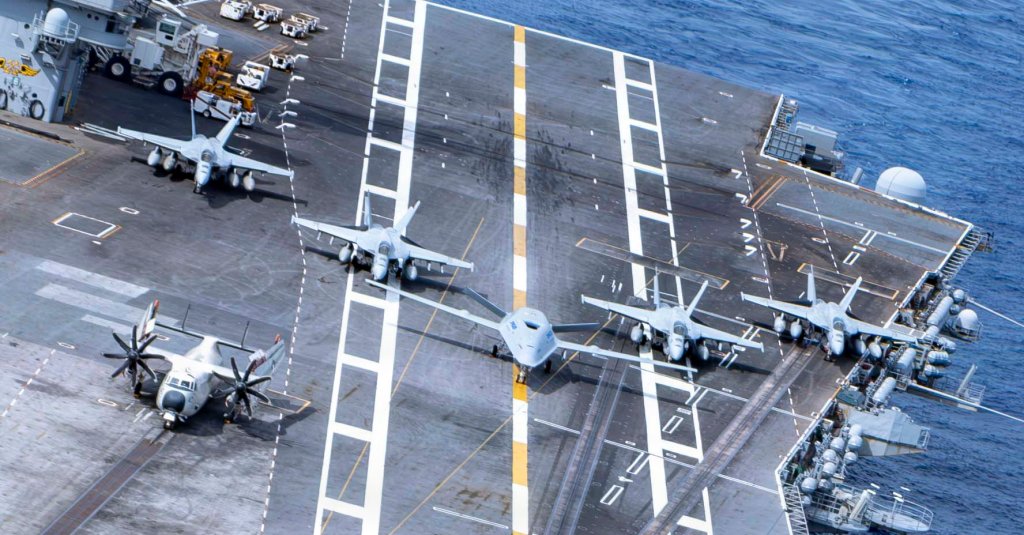
All of this underscores the amount of work the Navy will have to do to get production MQ-25s ready for routine operational use. As we wrote roughly a year ago, when the start of ground testing of the production representative Stingray was announced:
The Stingrays will also have to be woven into the existing cadence of flight deck operations, including just figuring out how to move them around amid the hustle and bustle of other activity. Carrier decks are very constrained environments physically, and present very different conditions to operate in compared to bases on land. This is true even for crewed aircraft operations, where individuals onboard can provide additional situational awareness. A wearable glove-like system that personnel could use for deck handling was notably used during testing of the X-47B. A different kind of portable control device has been used in testing of the T-1 MQ-25 demonstrator in the past, as well. The video released today does not appear to offer any major new insights into how the Navy plans to maneuver the Stingray around on carrier decks.
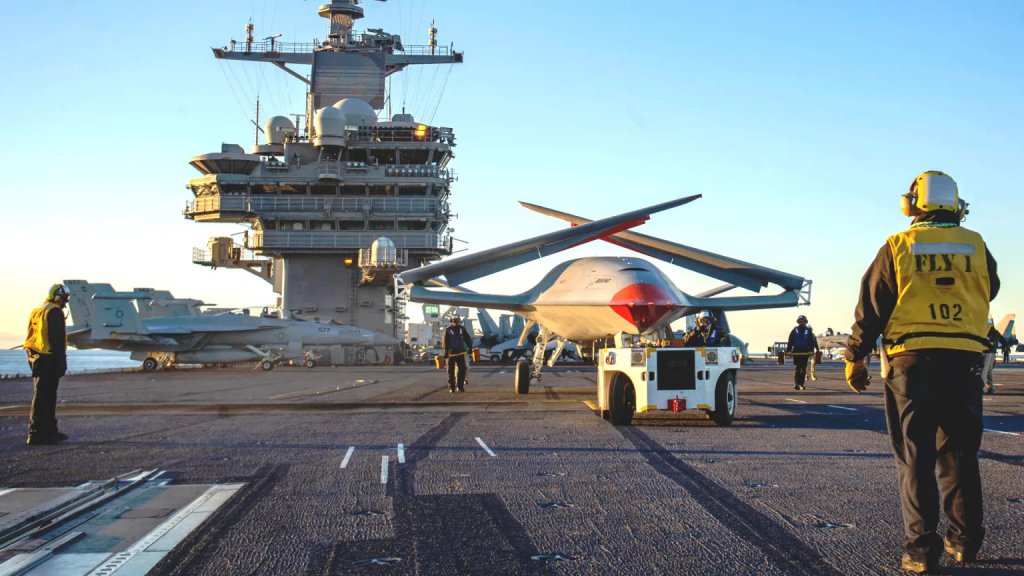
This is on top of more general flight testing, including demonstrating that the drones can safely take off from and land on Navy carriers, as well as integration with the control systems on those ships. The MQ-25 will bring new tactics, techniques, and procedures to the service’s carrier air wings, as well as open the door to further operational developments.
Right now, the MQ-25’s principal mission will be extending the reach of other aircraft in the carrier air wing. This is a critical capability for the Navy as adversary anti-access and area denial bubbles, especially ones that China’s People’s Liberation Army (PLA) has established and continues to expand, threaten to push carriers out of reach of target areas.
By extension, the Stingray will also eliminate the need to use crewed F/A-18F Super Hornets in the tanker role, freeing them up for other missions and other reducing wear and tear on those airframes.
The drones will also come with a built-in secondary intelligence, surveillance, and reconnaissance (ISR) capability, thanks primarily to a sensor turret under the nose. The size of the MQ-25, its extreme range potential, and other attributes of the design could well lead it to be adapted to other roles in the future, such as a long-range strike platform, as TWZ has previously explored in detail.
Showcasing the T-1 during FLEETEX 250 does highlight the Stingray program and its importance to the Navy. The effort has faced significant delays and cost growth in recent years, with the original goal being for the MQ-25 to have reached initial operational capability (IOC) in 2024. As noted, the first production representative example only flew in April, despite a major push by the Navy and Boeing to hit that milestone before the end of 2025. When that drone might make its first appearance on a carrier deck remains to be seen, but the Navy is now aiming to reach IOC sometime next year.
As an aside, carrying T-1 for display during FLEETEX 250 and associated events may be the extent to which Nimitz ever embarks any MQ-25s. The Navy has extended the carrier’s service life due to a number of factors, but only into March of next year. The USS George H.W. Bush received a first-of-its-kind drone control center in 2024. The Navy subsequently moved to install that equipment on the USS Carl Vinson, USS Theodore Roosevelt, and USS Ronald Reagan, creating an initial group of Nimitz class carriers that will be able to operate the Stingrays.
The Navy also sees the MQ-25 as a ‘pathfinder’ to future uncrewed additions to its carrier air wings. This is set to include carrier-based Collaborative Combat Aircraft (CCA) drones, an effort that is still very much in its infancy. Navy officials have talked in the past about a goal to see the makeup of future carrier air wings be 60 percent or more uncrewed.
In the meantime, T-1’s latest appearance on the deck of the USS Nimitz has already underscored the big changes coming to Navy carrier air wings, both figuratively and literally.
Contact the author: joe@twz.com
The post MQ-25 Stingray Demonstrator Goes Aboard USS Nimitz For 250th U.S. Anniversary Celebrations appeared first on TWZ.