This is an edition of The Atlantic Daily, a newsletter that guides you through the biggest stories of the day, helps you discover new ideas, and recommends the best in culture. Sign up for it here.
If there’s one thing Donald Trump wants Americans to understand, it’s that he knows how to build.
At a Pennsylvania petrochemical plant in 2019, he told workers, “I was a good builder. I built good. I love building.” Talking to reporters in the spring: “What I do best in life is build.” During last year’s Kennedy Center Honors, Trump joked that he has “two jobs”—the second being, naturally, construction.
Even as past ventures have flopped, Trump continues to position himself as the kind of big-shot developer who blasts through red tape and never takes no for an answer. This is the president who once wooed voters by promising to build a “big, beautiful” wall along the southern border. Who, he argued on the 2016 campaign trail, was better positioned to make it happen? In his second term, he’s been focused on redesigning the landscape of Washington, D.C., in his own image.
But earlier this week, Trump showed he’s willing to delay the construction of something that Americans have clearly indicated they need. On Tuesday, lawmakers passed the biggest housing bill in a generation, the 21st Century ROAD to Housing Act. Co-sponsored by Senators Elizabeth Warren and Tim Scott, it’s a bipartisan omnibus with reforms meant to encourage development and push down prices. Trump needs the win; at the moment, most Americans disapprove of the president’s handling of the economy. But on Wednesday, Trump abruptly canceled the signing ceremony for the bill. It will remain canceled, he wrote on Truth Social, until Congress passes the SAVE America Act, a completely unrelated and highly controversial piece of voter-ID legislation. (He’s called it his “No. 1 priority” ahead of the midterm elections.)
The stalled bill targets a pressing national concern. About a third of American households spend more than a third of their income on rent and mortgage payments, and almost four out of five voters identify the cost of housing as an extremely or very important issue. That Trump halted the signing shows that he’s willing to use a bipartisan bill as collateral—even if it means sacrificing the prospect of affordable housing for Americans. Although the move is within his procedural rights, it’s also toothless: Because the bill has passed both the House and the Senate, it is set to become law in 10 days with or without the president’s signature. And even if Trump decides to veto it, Congress (barring a sudden reversal) has the supermajority required to override a veto. Plus, the president can’t unilaterally force the passage of the SAVE America Act, which faces staunch opposition from Democrats.
Quantifying the extent of the country’s housing crisis is difficult (some analysts think the United States is short 6 million units, whereas others think the number is closer to 2 million), but experts tend to agree that building more housing in high-need areas could help. The ROAD to Housing Act isn’t a panacea, and many of its proposals will take effect only in the long term. But by fast-tracking environmental reviews and encouraging legislators to loosen zoning restrictions, among other proposals, the bill aims to incentivize new construction.
Trump has delivered mixed messages on housing affordability throughout his second term. White House press releases make passing mention of increasing housing supply, and Trump released an executive order in March directing agencies to loosen regulatory barriers to building homes. His push for Fannie Mae and Freddie Mac to buy up mortgage bonds turned out to have little lasting effect on rates. But lately, the president’s own comments have focused on the needs of existing homeowners. “I don’t want to drive housing prices down; I want to drive housing prices up for people that own their homes,” he said earlier this year. Homeowners of course do want their investments protected, but the housing bill’s incentives for developers to build would not automatically depress the value of all American homes. And in some cases, encouraging more construction could promote economic growth and increase land values in the long run.
Although the administration has taken steps to address the housing crisis, its efforts have at times been misdirected. In an attempt to protect individual landlords (known as mom-and-pop owners), who currently dominate the real-estate market, Trump issued an executive order in January aimed at curbing the influence of institutional investors—a nebulous umbrella term for some larger firms. Parts of the housing bill echo this idea. But, as my colleagues have explained, the panic over institutional buying’s effect on housing prices seems to be overblown. Although big corporate landlords pose a real problem in certain communities (corporations are more likely to evict tenants, and can neglect maintenance and upkeep), institutional investors own less than 1 percent of single-family homes nationwide.
Whether Trump is a “good” builder is a question best left to architecture critics, and perhaps to his creditors. But it’s undeniable that he builds. With his proposed triumphal arch, his modifications to the Reflecting Pool, and his renovation of the White House, he has attempted to reorganize the seat of government around his own aesthetic preferences. His recently announced presidential library, which may also be a hotel, could permanently alter the Miami skyline.
The ROAD to Housing Act may still be a victory for this administration—and the president may even claim credit for the effort to make housing more affordable. But he has yet to prove to the American people that he will build for them, and not just for himself.
Related:
Here are four new stories from The Atlantic:
- Jonathan Lemire and Russell Berman on Trump’s meltdown
- Trump is draining the national parks to pay for his projects.
- The Supreme Court’s era of meaningless rights
- Here come Trump’s “Freedom Trucks.”
Today’s News
- The United States struck Iranian missile and drone-storage locations in response to Iran’s drone attack on a ship in the Strait of Hormuz yesterday.
- John Bolton, a former adviser to President Trump and the author of a book criticizing him, pleaded guilty to a charge of illegally retaining classified information.
- A judge declared a mistrial in the case against a man accused of committing an act of arson that later became the Palisades Fire; federal prosecutors said that they will retry him.
Dispatches
- The Books Briefing: Charles Darwin’s story isn’t as simple as it seems, Emma Sarappo writes.
Explore all of our newsletters here.
More From The Atlantic
- Americans deserve answers from Hegseth.
- Trump’s peeling green gift to America
- Europe’s come-to-AC moment
- The record executive who understood the power of ego
Evening Read
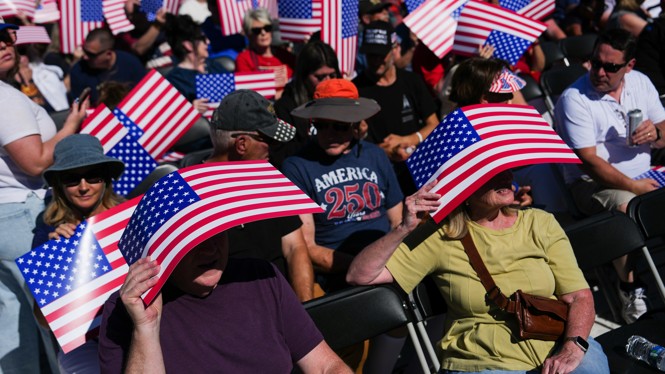
Julia Demaree Nikhinson / AP
The True Believers at the Great MAGA Fair
By Marie-Rose Sheinerman
For one night, in the heart of deep-blue Washington, D.C., a fenced-off section of the National Mall became an oasis for members of the MAGA base. They had believed in President Trump from the beginning and carried him triumphantly back to power in 2024, and now they came to the grand opening of America’s 250th-birthday celebration in red-white-and-blue headbands, draped in flags, and sporting dangly blue “America” earrings. Doubts about anything related to Trump—his abysmal approval ratings, inflation accelerated by the war he started in Iran, his clashes with Republican senators earlier in the day—were, for an evening, drowned out by the roar of fighter jets overhead.
Culture Break

Watch (or skip). Supergirl (out now in theaters) is the newest installment in the DC Universe—and it struggles to live up to its predecessor, David Sims writes.
Check out. Train Dog, a weird, awkwardly fused creature, has somehow become the meme of the summer, Megan Garber writes.
Stephanie Bai contributed to this newsletter.
When you buy a book using a link in this newsletter, we receive a commission. Thank you for supporting The Atlantic.