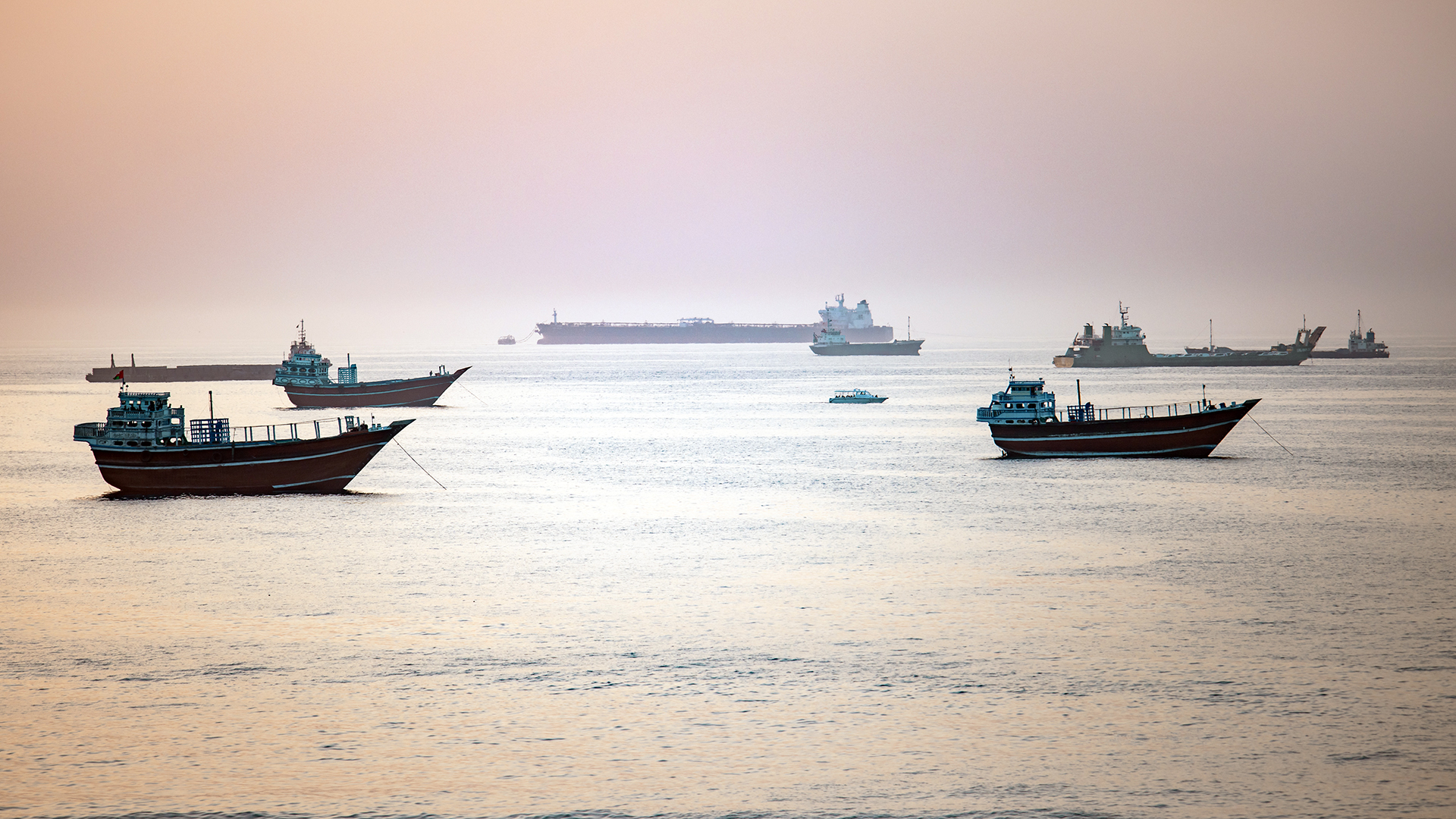
The U.N. International Maritime Organization (IMO) paused its plan to evacuate hundreds of ships stuck in the Persian Gulf after a vessel was attacked in the Strait of Hormuz on Thursday. A U.S. official told us the attack was carried out by an Iranian drone, which was confirmed by Iranian officials.
The evacuation plan, which IMO developed with Oman, was designed to provide safe passage to vessels in the Persian Gulf that are still unable to transit the Strait, which has been largely closed since Iran was attacked by the U.S. and Israel. The announcement came as traffic was beginning to move through the Strait again amid ongoing, albeit tense peace talks between the U.S. and Iran. However, these transits represent a tiny fraction of what took place before the war.
The IMO decision today also came after a warning earlier on Thursday by the Islamic Revolutionary Guard Corps Navy (IRGC-N) that safe passage through the Strait was limited to routes designated by Tehran and that other routes were “unacceptable and completely dangerous,” according to The Washington Post. The publication cited Iranian state-run media. The IRGC-N also claimed it turned back several ships trying to transit the Strait through the southern route suggested by IMO. There is also a northern route, near the Iranian coastline while concerns remain about mines in the main route, down the middle of the Strait.
IMO said it is pausing its evacuation plan even though the ship that was attacked was not taking part in that nascent effort.
“Following the launch of the IMO’s evacuation plan, through which several vessels have already been successfully evacuated, I have decided to temporarily pause its implementation in order to reconfirm that the necessary safety guarantees continue to be in place for the ships on our evacuation list and all those in the region,” IMO Secretary-General Mr. Arsenio Dominguez said in a statement. “I have been informed of an attack today in the Gulf of Oman on a vessel which passed through the Strait of Hormuz. This vessel did not transit under IMO’s evacuation framework. I have always reiterated that the safety of the seafarers remains paramount. Therefore, to ensure a coordinated approach and navigational safety, the evacuation plan will be paused until further clarity is obtained.”
“Today marks the Day of the Seafarer, underlining the importance of ensuring that the continued evacuation of the thousands of seafarers stranded in the Persian Gulf can proceed without the risk of them becoming collateral victims in this geopolitical conflict,” Dominguez added.
A maritime security official told us the ship that was attacked was the Ever Lovely, a Singapore-flagged cargo ship, according to MarineTraffic. The incident occurred about 7.5 nautical miles southeast of Dahit, Oman, according to the United Kingdom Maritime Trade Operations (UKMTO) center.
“A cargo vessel has been hit on the starboard side by an unknown projectile, causing damage to the bridge,” UKMTO stated on X. “Master has reported no casualties and no environmental impact. Authorities are investigating. Vessels are advised to transit with caution and report any suspicious activity to UKMTO.”
UKMTO WARNING 074-26 – ATTACK
— UKMTO Operations Centre (@UK_MTO) June 25, 2026
Click here to view the full warning.https://t.co/0hDEAb7xO9#MaritimeSecurity #MarSec pic.twitter.com/HlPzQDLBja
As we reported yesterday, IMO along with Oman devised a plan to allow vessels to leave the Persian Gulf through a southern route along the Omani coastline. The southern route is clear of mines and is the preferred route, according to the Joint Maritime Information Center.
A second route, to the north along the Iranian coastline, is controlled by the Islamic Republic.
In its initial unveiling of the evacuation plan, IMO said “this large-scale operation will be carried out in close cooperation with Iran, Oman, all other coastal States in the region, the United States and the maritime industry.”
We reached out to IMO for more information given that the IRGC-N is apparently not cooperating.
As we noted earlier in this story, there has been a spike in traffic through the Strait since last week’s signing of the Memorandum of Understanding (MoU) between Washington and Tehran.
However, the IRGC-N’s new stance “marks a reversal in the normalization trajectory building since the MoU signing,” the Windward maritime intelligence firm warned on Thursday.
“The IRGC published a claim on its official Telegram channel that three tankers transiting the southern corridor had been ordered to turn back. Windward identified five vessels exhibiting behavior consistent with that claim, with a sixth losing AIS signal during the incident,” the intelligence firm noted.
“A VHF Channel 16 broadcast warned all vessels that transit without AIS or IRGC permission would be at their own risk,” Windward added. “The southern corridor, previously described as not requiring Iranian approval, is now subject to active IRGC enforcement, eliminating the only route operators believed to be free of Iranian control.”
It remains to be seen how or if this latest turn of events will alter what has been a positive trajectory for commercial shipping in the Strait. Simmering frictions between the IRGC and Iranian government that have emerged in recent months make it difficult to assess just who is in control in Iran and who has the final say in operations on this strategic waterway. Regardless, a pause in the evacuation plan and a new kinetic strike on shipping are not good omens.
Contact the author: howard@twz.com
The post Plan To Move Ships Through Strait Of Hormuz Paused After Iran Strikes Cargo Vessel appeared first on TWZ.