“We know of nothing,” Henry James observed in 1875, “that is a better proof of the essential impotence of criticism, in the last resort, than Mr. Church’s pictures.” James wasn’t (in this instance) being spiteful. He was trying to sort out a real problem: What did the work of America’s preeminent painter actually mean? Serious art is supposed to mean something—that’s a given—but really, what is there to say about Frederic Church’s Valley of Santa Ysabel, New Granada? You see distant mountains, an effulgent sky reflected in placid water, lots of greenery, and tiny people not doing much besides establishing the scale of an adjacent palm. You can feel the stillness and weight of the air. “Why not accept this lovely tropic scene as a very pretty picture,” James asked, “and have done with it?” A century and a half later, we’re still stumped.
Church, whose 200th birthday rolled around in May, was America’s first art star. He won accolades in England and a silver medal at the 1867 Exposition Universelle in Paris at a time when “American painting” was still an oxymoron among many cognoscenti. In city after city, people queued up in the tens of thousands and paid good money to stand in front of his pictures. Queen Victoria secured a private viewing of The Heart of the Andes. Audiences marveled at the exactitude, the passage of light, the almost palpable presence of a distant place. “He ranges with a steady eye and an unwavering hand,” The New York Times intoned. Church’s death, in 1900, was marked by a six-month retrospective at the Metropolitan Museum of Art, an institution he had helped found, housed in the great public park for which he had served as a commissioner.
By then, however, the world was moving on. In the years that followed, American landscape painting was shuffled off to storage to make room for modernism, and paintings like Church’s, with their glassy finishes and profuse detail, came to seem the embodiment of fuddy-duddy. When Olana, Church’s visionary 250-acre estate on the Hudson River, was threatened with destruction in the 1960s, a Times headline referenced the “Italian‐Moorish Home of U.S. Artist of Mid‐1800’s,” presumably because so few readers would recognize Church’s name. Some respect was regained in the ’70s, when scholars connected Church and his peers to the intellectual currents of Transcendentalism. But even now, if you’re looking for an empty bench in a crowded museum, the rooms housing American landscapes are a good place to start.
Church’s bicentennial offers a chance to reconsider our prolonged indifference to the man and his art. A new biography by Victoria Johnson, Glorious Country: How the Artist Frederic Church Brought the World to America and America to the World, makes a case for her subject as anything but a fuddy-duddy—a heroic adventurer, a public servant, a scientific ecologist, and a wildly ambitious orchestrator of pictorial magic. At Olana, which was rescued from the auction block and is now a New York State Historic Site, a wide-ranging exhibition, “Frederic Church: Global Artist,” incorporates dozens of beguiling oil sketches, larger paintings, and books and photographs from his omnivorous collection. It is accompanied by a book of essays addressing his global outlook, an erudite field guide to the estate, and a picture-filled hardback celebrating Olana’s landscape and architecture. All of this convincingly portrays Church as a relatable and appealing figure for the 21st century. How much it helps us understand his painting is another question.
The American art world that Church entered in the 1840s was more an aspiration than an entity. Great painting, everybody knew, was Europe’s bailiwick. American collectors bought European art, and many talented American painters hightailed it to Europe at the first opportunity. Beyond how-to books, the United States offered few means of studying art, few great paintings to imitate, and, thanks to American prudery, few chances to master the complex arrangements of human bodies considered indispensable to art’s most profound forms.
What America did have was land, and landscape painters enjoyed a status here rarely accorded them in Europe. There was Asher Durand, master of the winsome glade; John Frederick Kensett, poet of still waters; and, above all, Thomas Cole, the philosopher-king of landscape, with whom an 18-year-old Church arranged to study privately. Largely self-taught, Cole was a relentless observer of material fact. He instructed Church to depict nature’s objects as individuals—not just a tree, or even a hickory, but a specific hickory, with its own history and place in the world. The same went for rocks and weather. When Cole took his paints and easel outdoors, he was not, like the plein air artists of France, aiming to capture a subjective experience; he was taking lab notes on God’s handiwork.
[From the May 2022 issue: Susan Tallman on Winslow Homer, the Melville of American painting]
With a deft hand and remarkable visual memory, the young Church was a natural. By 19, he was exhibiting in New York City; at 22, he was the youngest artist ever elected to the National Academy of Design. Handsome, well-bred, and outdoorsy, he had the kind of looks that would suit the cocky football captain in a prep-school farce, yet by all accounts he was kind, well-liked, and witty. (It’s hard to top his description of 19th-century Hartford, Connecticut, as a “city of pleasant faces and office chairs.”) Church, his friend Worthington Whittredge wrote, was “fortune’s favorite from the beginning.”
Inspired by the German polymath Alexander von Humboldt’s travels in South America and his ensuing argument for the interdependence of all natural entities, the young Church embarked on a nearly seven-month expedition in Humboldt’s footsteps. Paints and sketch pads in tow, he made his way by boat, by mule, and on foot through the jungles of New Granada (now Colombia) and across the Cordilleras to the Ecuadoran volcanoes Cotopaxi and Chimborazo. The sketches he brought back became fodder for his 1855 breakout painting, The Andes of Ecuador.
Cinematic before there was cinema to compare it to, the painted vista slides over mountainous terrain, meandering streams, grasslands, and waterfalls to reach the snow-capped Cotopaxi under a sky throbbing with golden light. “From the rifted heavens the southern sunshine pours, like God’s benediction on my temples,” a critic for Harper’s Weekly effused, as if standing bareheaded atop one of his mountains. God was undoubtedly on Church’s mind—he planted a small wayside cross in the verdure at lower left—but so was Humboldt. Every pictured biome, from subtropical to highland plateau to alpine, is fitted with its appropriate flora, fauna, and geology. Every detail is accurate, though the picture as a whole is an invention, concocted from multiple views, locations, and studies. It told the truth, though not necessarily nothing but the truth.
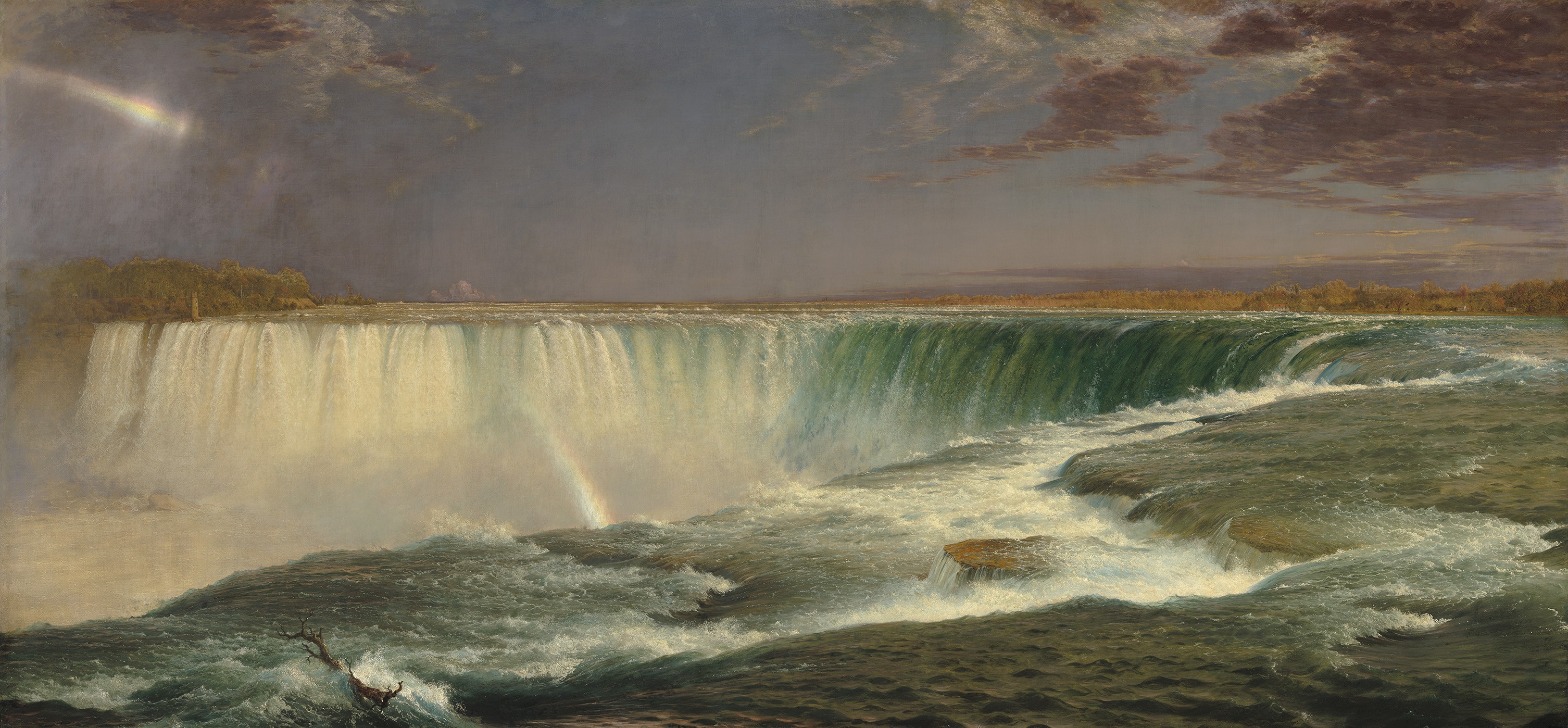
For a decade, Church went from adventure to adventure and from strength to strength. His operatic paean to Niagara Falls was proclaimed “incontestably the finest oil picture ever painted on this side of the Atlantic” (reproductions became a common wedding gift across the nation). In 1859, following a return to South America, where he’d hoped to witness volcanoes actively erupting, he unveiled The Heart of the Andes—a 50-square-foot statement of cosmological interconnectedness, painted in his New York studio with a portrait of Humboldt looking on. For exhibition, he placed it in a massive, casement-like frame, draped with curtains and accompanied by potted palms and gaslights to enhance the illusion of looking out a window into another world.
Reproduced on a book page or laptop screen, The Heart of the Andes can look deceptively ordinary—a bunch of trees, a waterfall, some distant mountains. Seen in person, however, it’s an immersive spectacle: Tiny butterflies, identifiable by species, flit among blooming epiphytes; red-breasted meadowlarks take to the air; an emerald-green quetzal perches on a branch. An Indigenous couple pay a visit to another makeshift cross, mist rises from a waterfall, and mountains rear up, first green, then brown, and finally glittering white. The painting was “a miracle,” Samuel Clemens (not yet Mark Twain) wrote to his brother when the picture reached St. Louis. “We took the opera glass, and examined its beauties minutely,” but a single viewing was not enough: “Your third visit will find your brain gasping and straining with futile efforts to take all the wonder in.” Even Londoners were enthralled, crediting Church with “a gaze of extraordinary clearness and vigilance; a gifted hand,” as well as “a tender and capacious spirit, which unites harmoniously the minute and the vast.”
This kind of attention was no accident. Church kept the press strategically apprised of his travel plans and his subsequent progress in the studio, ginning up excitement about forthcoming pictures. By 1860, he was enough of a celebrity that even his wooing made the papers—a “Page Six ” item avant la lettre. And although his travels were certainly motivated by a genuine urge to see and understand, he was not unaware of which destinations were likely to capture public imagination.
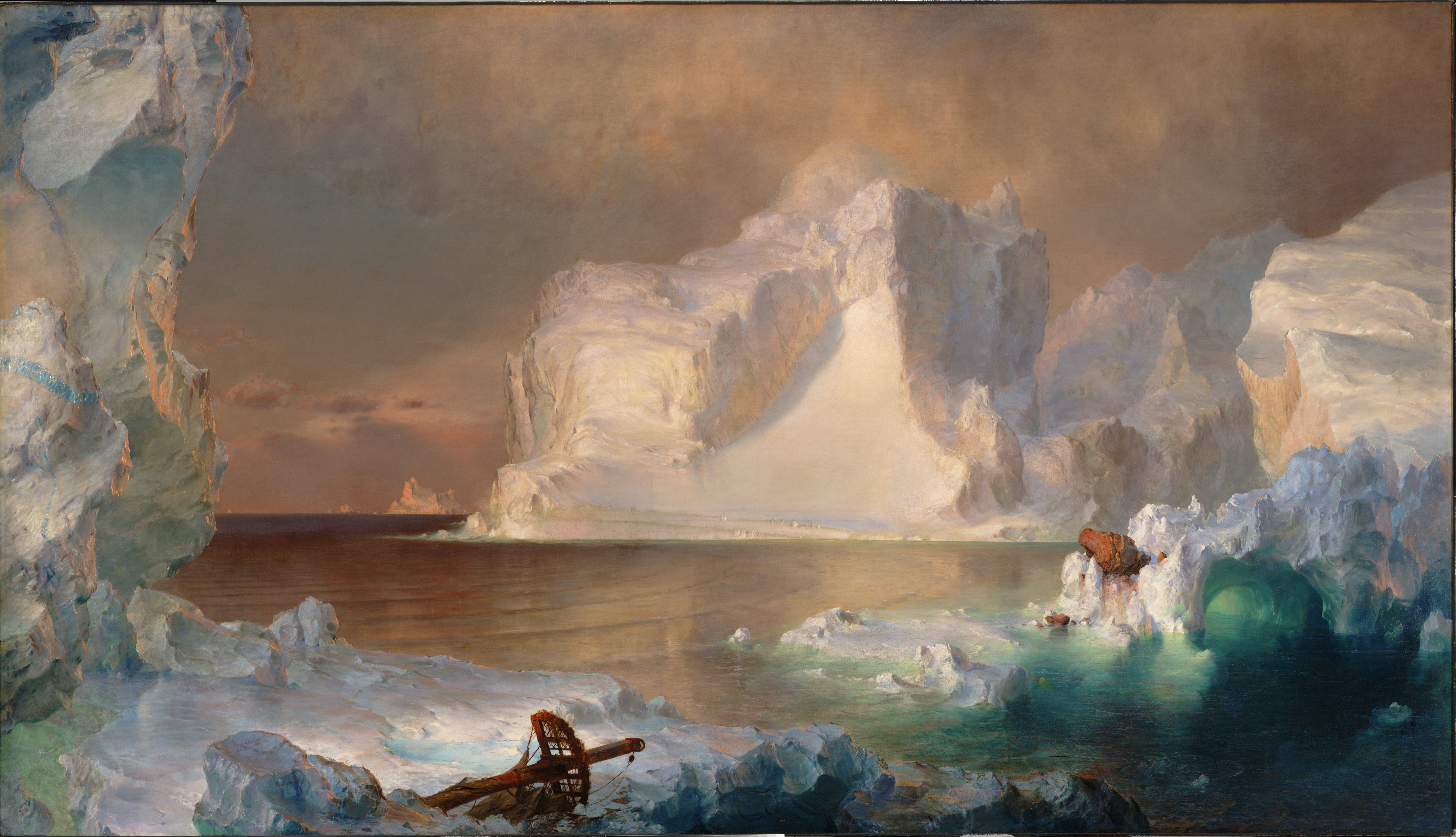
When the perilous search for the Northwest Passage sparked a wave of popular interest in the Arctic, Church set off by schooner in search of icebergs. In heaving seas and frigid cold, beset by violent seasickness, he rowed out in a dinghy to record them close-up. The payoff was a bevy of remarkable oil and pencil sketches (a stunning oil study can be seen in the Olana exhibition) as well as paintings. The standout is a grand, otherworldly picture, devoid of human and animal life but suffused with strange light, and the majesty and menace of colossal ice in moving water. When, two weeks before the painting’s debut, the United States went to war against itself, Church promptly changed its title from The Icebergs to The North.
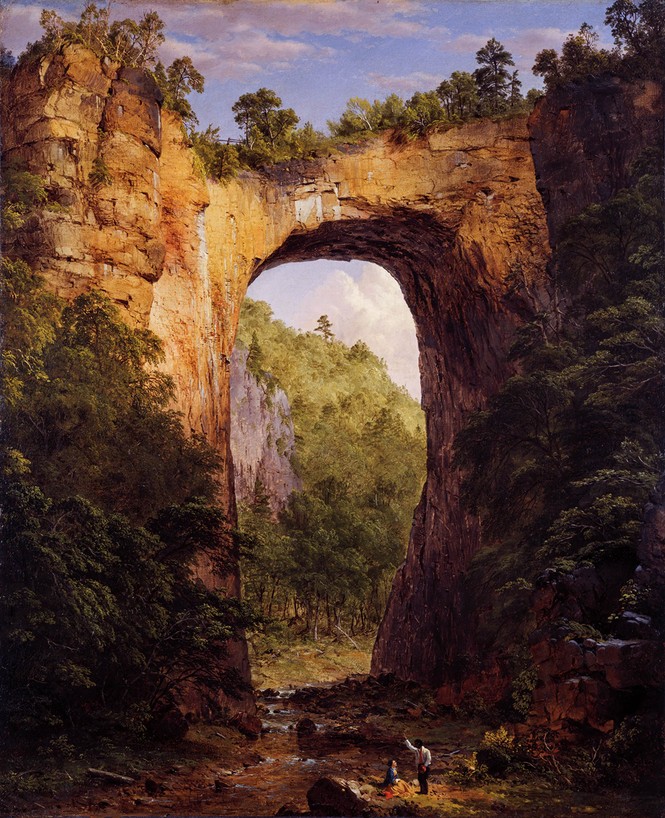
This gesture was undoubtedly patriotic in sentiment—he was a staunch supporter of the Union cause—though confusing in argument. Exactly how does a calved iceberg signify the ideals of emancipation and a unified nation-state? Church’s antislavery bona fides seem solid: As far back as 1852, he had painted a white woman and a free Black man in casual conversation at the base of the Natural Bridge rock formation in Virginia—a provocative choice even if the figures are diminutive. Having political convictions, however, is different from being able to express them clearly in paint.
His wartime polemic, Our Banner in the Sky (1861), is a visual pun in which morning stars and sunrise clouds conspire to suggest a tattered American flag. It isn’t a good painting, but the lithographs sold well, and, like generations of successful artists, Church may have recognized that his most effective contribution to the cause would be money. He donated exhibition income, supplied paintings for fundraising auctions, and finagled loans of his three blockbusters—Niagara, The Andes of Ecuador, and The Heart of the Andes—to New York’s 1864 Metropolitan Fair for the benefit of Union soldiers.
The eventual victory was eclipsed for Church and his wife, Isabel, by the loss of both their young children to diphtheria within days of each other. Travel now served as a palliative—first a trip to Jamaica, then a year and a half voyage to Europe and the Levant, where Church painted the Holy Land, another subject with reliable sales. With a new baby and Isabel’s mother, they settled happily in Beirut for several months, making excursions to Jerusalem, Bethlehem, Damascus, and Baalbek. On his own, Church embarked on a dicey journey under Bedouin guard to Petra by horse and camel. (Ever attentive to the particular, he left us a winning sketch of his dromedary, inscribed with the animal’s name, Zraigan.)
The epic sky of his Jerusalem From the Mount of Olives (1870) races from furious clouds to radiant sun above an array of biblical landmarks so thorough, it required a crib sheet. But Church’s dominance of American art had begun to slip. Jerusalem was faulted for its lack of “atmospheric effect.” There were complaints of didacticism. He was also attacked by American Pre-Raphaelites (far more dogmatic than the English originals) who objected to what they saw as the flashy artifice of the dramatic light and weather in his work. And for sheer showmanship, he found himself overtaken by Albert Bierstadt, whose mountains rose more vertiginously, whose rays of godly light shone more theatrically, and whose claimed territory was not the exotic South or North or Middle East, but a West that the United States was coming to see as its own. Harper’s Weekly reflected the national mood when it contrasted the “sadness and desolation” in Church’s Andes with what it described as the “temperate cheerfulness” of Bierstadt’s Rockies, and their invitation to look upon Native lands as “the possible seat of supreme civilization” (one not, presumably, of Native design).
In 1875, trying to put a finger on his own dissatisfaction, Henry James described Church’s paintings as “the kind of art which seems perpetually skirting the edge of something worse than itself.” He wasn’t wholly wrong. Church’s numinous-sun-over-still-water routine had begun to look a bit like a shtick, equally applicable to scenes of the Hudson or those worked up from 20-year-old sketches of South America. The details were still there, but the thrill was gone. The River of Light (1877) is sufficiently anodyne that the National Gallery of Art’s website offers a three-minute online guided meditation focused on it.
Church’s priorities had shifted. Now a family man with four children, he was also deeply engaged in public endeavors such as the Met. Church took annual camping trips to Maine with friends and family, and he continued painting and traveling internationally until his death, but he had begun to feel the effects of what would become crippling rheumatoid arthritis. Church denied newspaper reports that he had lost the use of his right hand, but he does seem to have learned to paint with his left as well. The paintings grew smaller, but his landscape ambitions only grew larger.
Church had fallen in love with the Hudson River Valley as a teenager studying with Thomas Cole, and had been buying land there since 1860. Being short of neither confidence nor money, he set about building a familial “Feudal Castle” and transforming the surrounding property into living art. He dredged swampland to create a 10-acre lake and initiated a reforestation project that emphasized native species—planting hemlocks, maples, and hickories in the tens of thousands, some positioned to draw the eye as individual subjects of contemplation, others massed in color schemes that shift with the seasons. He laid out miles of winding roads that rise and dip, eventually opening onto a bell-towered, ogee-arched, polychrome mini-palace on a hill so high that its views stretch into four states. He and Isabel named it Olana for an elevated stronghold in a region of ancient Persia rumored to be the site of the Garden of Eden.
Contra the New York Times headline, the house isn’t so much “Italian-Moorish” as Persian-Japanese-Mexican-Kashmiri. Church had found London “big and dirty” and the ornamentation of Paris “very tiresome”; as for Rome, he wrote, “The Tiber is not the Hudson.” But he and Isabel had been smitten with the Middle East and its architecture, particularly the flow between indoors and outdoors. Formidable on approach, the Church house is unexpectedly porous once you’re inside, punched through with porches, balconies, atria, and outlooks, each strategically framing a view. (The land, along with the house and the belongings inside it—tens of thousands of them, including sketches, unfinished paintings, topographical photographs, and canceled checks to Brooks Brothers—were preserved by Church’s son and daughter-in-law until their deaths.)
The building is certainly overstuffed—pre-Columbian artifacts, Chinese breezeway tiles, Indian chairs—but never stuffy, and often playful. Look closely and you’ll find that the intricate window grilles are actually cut black paper compressed to the panes, and that the finials on the tower’s topmost railing feature Japanese teapots. Everything works in the same cinematic way as the paintings: Rooms and landscapes unfold as you move through them, sometimes with slow pans, sometimes with jump cuts. There are forced close-ups (with the exception of the dining gallery, none of the rooms feels very large), and 360-degree panoramas. “I can make more and better landscapes in this way than by tampering with canvas and paint,” Church told a friend. Olana is often described as his greatest work of art.
For all this worldliness, however, Church at 200 remains a distinctly American figure. The Olana website shows more than 70 locations where Church paintings are currently on public view. Only four are outside the continental United States, and those include Honolulu and Ponce, Puerto Rico. Only Edinburgh and Madrid require a passport.
If Church’s influence beyond the U.S. is essentially nonexistent, his influence within the U.S. has its own problems. Recapitulated by lesser hands, the natural grandeur he invoked so splendidly devolved into purple-mountains-majesty cliché. Church’s Mount Katahdin From Millinocket Camp (1895) looks so much like the cover of an L.L.Bean catalog that it can be hard to recognize what a fine painting it actually is.
The other big impediment for contemporary eyes is that Church’s career coincided with a paradigm shift in visual art—a change in not just what pictures mean, but how that meaning is conveyed. For 500 years, from Giotto to Eugène Delacroix, painting told human-interest stories—a baby in a manger, desperate sailors on a raft. Even most landscape painting was actually about people. The subject of Caspar David Friedrich’s famous Wanderer Above the Sea of Fog (circa 1817) isn’t the mountains or the weather—it’s the guy blocking our view of the mountains and weather.
And then the game changed. The year before James found himself befuddled by Church’s painting of sun reflected in the waters of New Granada, French critics found themselves befuddled by Claude Monet’s picture of sun reflected in the waters of Le Havre. Impression, Sunrise gave name to a movement that introduced a new kind of looking—one that found meaning in how pictures depart from reality rather than how convincingly they imitate it. The human-interest story moved from the people in the picture to the thoughts and emotions of the artist who put them there.
But Church wasn’t telling stories about people at all. Line his paintings up chronologically and you can watch the world depopulate—from a youthful New England landscape with European settlers front and center; to the small interracial pair in The Natural Bridge, Virginia; to his desolate icebergs whose lack of human narrative so perplexed British audiences that Church added a shattered mast to make it salable. (You can take this as a lack of artistic integrity or a lack of artistic pomposity as you like.) Neither is he putting his own subjectivity on view. His oil sketches are more disarming than the finished paintings because you can see the mind and hand at work: His act of discovery sits closer to the surface. That’s what sketches do—they give you access to the moment of creation. But in the finished paintings, he cedes the stage to his subject. At Olana, he disappears so completely that if you don’t stop in at the visitor center, you might miss the fact that the landscape was designed at all.
Contemporary art historians are trained to tease out the political messaging of artworks, but Church is elusive here as well. He “didn’t enjoy talking or writing about politics,” Victoria Johnson notes in her biography, which makes it hard to build a case for intent. Writing about the pairing of presidential portraits with The Heart of the Andes in the Metropolitan Fair, the editors of Frederic Church: Global Artist write that “the notion of divinely ordained westward expansion of the United States and colonization of Indigenous lands, is here extended farther south,” but they don’t claim that this is what Church had in mind. The fiery skies he painted in the 1850s and ’60s have been read as warnings about the sin of slavery, but the degree to which clear policy statements can be read into a sunset is questionable. Johnson and others have been attentive to the overlooked Indigenous histories of locations that Church depicted, but, again, these don’t tell us much about what Church knew or meant to say.
Anyway, even if viewers could be assured that his political instincts aligned perfectly with their own, it wouldn’t make the paintings good. Yet somehow all of these authors—from James onward—have trouble seeing his best work as just “a very pretty picture.” An idea must be in there somewhere, people feel, but what and where?
I recently went to check in on The Heart of the Andes at the Met, where it hangs in a partial re-creation of the 1864 Metropolitan Fair arrangement, along with Emanuel Leutze’s overweening Washington Crossing the Delaware and Albert Bierstadt’s The Rocky Mountains, Lander’s Peak. The gallery was almost empty. The benches were indeed free, though The Heart of the Andes is a picture that wants to be seen up close, where you can make discoveries inch by inch, and roam from a sky that looks like a hymn to all Creation down to the shaft of sunlight that falls on a tree trunk, just where Church has “carved” his signature.
While I was taking notes on that free bench, a Japanese tour guide ushered a dozen or so people into the room, spoke at length about the Leutze, then led them out again. Washington Crossing the Delaware is perfect tour-guide material—it can be seen by a bunch of people at once, and its story can be told concisely, timed to the minute. After they exited, however, one little girl doubled back to take a photo—not of giant George in a boat, but of the narrative-free, choose-your-own-adventure Heart of the Andes.
Church’s painting is the anti-Leutze: It’s not a story to be memorized but a portal to a place that feels infinite and changeable. Perambulate the Met in its entirety and you’ll be hard-pressed to find a landscape that asks so instantly to be believed in. As at Olana, there is always something more to see, both profound and playful. Johnson (clearly fond of her subject) describes Church as “a painter in love with the whole cosmos, a man who, when he came face-to-face with the eternities of time and space, felt not fear or alienation but the thrilling connection of humans to all other beings and matter.” Call this a political idea or a spiritual one; it is, in any event, an idea.
So when the workings of the world, with its shouty messaging and manipulative storylines, get to be too much—when all of that strategized meaning feels like an imposition—go to the Met or Olana or your nearest Church. Give yourself time. Bring opera glasses.
This article appears in the July 2026 print edition with the headline “A Canvas as Big as the Country.”